

Curcumin and inflammation explained simply: curcumin is not a one-trick compound. Most people assume anti-inflammatory supplements work by blocking a single chemical signal, the way a standard painkiller targets one enzyme. Curcumin does something far more sophisticated. It simultaneously engages multiple molecular pathways that drive inflammation, which is one reason researchers keep returning to it. Chronic inflammation sits behind conditions ranging from arthritis to cardiovascular disease to neurological decline. If you want to understand what curcumin actually does in your body, and whether it is worth your time and money, this article gives you the honest, science-grounded picture.
Table of Contents
- Key takeaways
- Curcumin and inflammation explained: the molecular picture
- Bioavailability, formulations, and dosing
- What the research actually shows
- Safety and what to watch for
- How to choose and use curcumin supplements effectively
- My perspective on curcumin for inflammation management
- Experience the difference with BioSoluble® Curcumin™
- FAQ
Key takeaways
| Point | Details |
|---|---|
| Multi-pathway action | Curcumin targets COX, LOX, NF-κB, and cytokine pathways simultaneously, not just one inflammatory signal. |
| Bioavailability matters most | Standard curcumin absorbs poorly; enhanced formulations with piperine or phospholipid complexes deliver meaningfully better results. |
| Dose range is wide | Effective clinical doses range from 500 mg to 1,500 mg daily, but the right formulation matters more than the raw milligram number. |
| Give it time | Most studies showing measurable benefit use 4 to 8 weeks of consistent supplementation before evaluating results. |
| Safety is generally good | Curcumin is well-tolerated for most people, though rare liver injury cases have been reported, particularly with high-bioavailability products. |
Curcumin and inflammation explained: the molecular picture
Curcumin is the primary active polyphenol in turmeric (Curcuma longa), and it has been studied for decades as a natural anti-inflammatory agent. What makes it genuinely interesting to researchers is not that it lowers inflammation, but how it lowers inflammation.
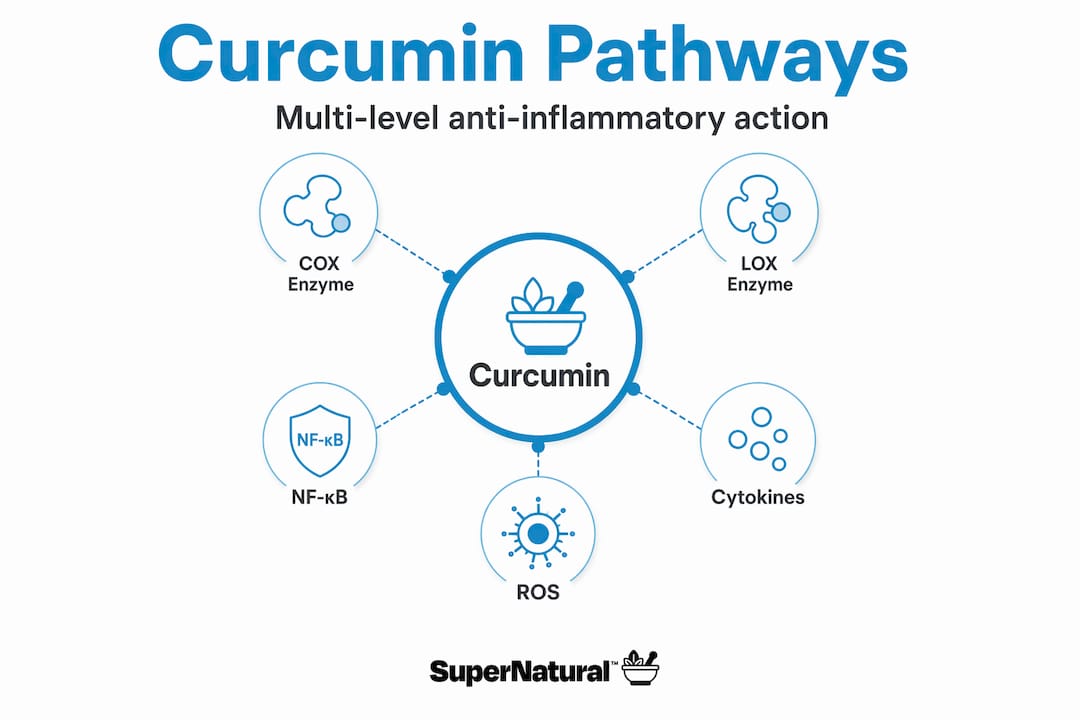
Most pharmaceutical anti-inflammatory drugs are designed around a single target. Ibuprofen, for example, primarily inhibits COX enzymes. Curcumin works differently. It modulates multiple pathways at once, including COX, LOX, NF-κB, and several cytokine cascades. Think of chronic inflammation as a fire with multiple fuel lines feeding it. Blocking one line may reduce the flame, but curcumin works toward cutting off several simultaneously.
Here is what that looks like at the cellular level:
- COX-2 inhibition: Curcumin selectively inhibits the COX-2 enzyme and reduces prostaglandin E2 synthesis in synovial fibroblasts (the cells lining your joints). This is directly relevant for joint inflammation and curcumin and arthritis symptoms.
- LOX pathway suppression: The lipoxygenase (LOX) pathway produces leukotrienes, which are inflammatory mediators involved in immune responses and tissue damage. Curcumin reduces LOX activity, adding a second layer of control.
- NF-κB modulation: NF-κB is often called the “master regulator” of inflammation because it controls the expression of dozens of pro-inflammatory genes. Curcumin suppresses NF-κB activation, which effectively turns down the volume on a broad set of inflammatory signals.
- Cytokine reduction: Curcumin lowers circulating levels of TNF-α, IL-6, and IL-1β. These are the specific proteins that signal inflammation throughout the body and are elevated in conditions like rheumatoid arthritis, metabolic syndrome, and inflammatory bowel disease.
Beyond inflammation itself, curcumin also acts as an antioxidant by scavenging reactive oxygen species (ROS). Oxidative stress and inflammation are tightly linked. When cells are under oxidative stress, they produce more inflammatory signals, and more inflammation generates more oxidative stress. Curcumin interrupts that cycle from both directions.
Pro Tip: If you are trying to evaluate whether a curcumin supplement is working, ask your doctor to check CRP (C-reactive protein) and, if relevant, IL-6 levels before and after an 8-week trial. These are the most reliable blood markers for tracking systemic inflammation changes.
Bioavailability, formulations, and dosing
Here is the frustrating reality about curcumin: it does not absorb well on its own. When you swallow standard curcumin powder, very little actually makes it into your bloodstream. The compound is poorly soluble in water, metabolizes quickly in the gut, and gets cleared rapidly by the liver. This is the core reason formulation bioavailability drives clinical outcomes more than the nominal milligram dose on a label.
Think of it this way. Wanting the benefits of curcumin from standard turmeric powder is like wanting a strong cup of coffee by sniffing the beans. The active compounds are there, but your body cannot access them efficiently without the right delivery system.
Here is a practical overview of how to navigate formulations and dosing:
- Standard curcumin extract (95% curcuminoids): Poor bioavailability. Only useful in very high doses, and even then, systemic levels stay low. Not the best starting point if you are supplementing for a specific inflammatory concern.
- Curcumin with piperine (black pepper extract): Piperine inhibits the metabolic enzymes that break down curcumin, significantly slowing clearance. A well-studied combination is 500 mg curcumin with piperine taken three times daily. This approach can increase curcumin bioavailability by up to 20 times compared to curcumin alone.
- Phospholipid complex (phytosome): Binding curcumin to phosphatidylcholine creates a fat-soluble complex that absorbs more readily through the gut wall. This form tends to produce more consistent blood levels.
- Nanoparticle and micellar formulations: Newer technologies reduce curcumin particle size to the nanoscale, dramatically increasing surface area for absorption. These are among the most bioavailable forms available and require smaller doses to achieve the same systemic effect.
- BioSoluble formulations: Patented water-solubility processes, like the one used by Ordersupernatural, dissolve curcumin at the molecular level, bypassing the usual absorption barriers entirely. This represents a meaningful step beyond older piperine-based approaches.
In terms of curcumin dosage for inflammation, clinical trials have used doses ranging from 50 mg to 4,000 mg per day, but this wide range reflects differences in formulation rather than therapeutic unpredictability. For most enhanced formulations, a practical starting range is 500 mg to 1,500 mg per day, split into two or three doses with meals.
Pro Tip: Always take curcumin supplements with a meal that contains some healthy fat. Even with enhanced formulations, fat in the digestive tract supports absorption of fat-soluble compounds.

What the research actually shows
The clinical evidence on curcumin as an anti-inflammatory is substantial, though it requires careful reading. Results vary by condition, inflammatory biomarker, dosage, and formulation. Here is a structured look at what the research shows across different contexts.
| Condition / Context | Key Findings | Typical Dose / Duration |
|---|---|---|
| Chronic inflammation (general) | Reductions in CRP, TNF-α, and IL-6 across multiple trials | 500–1,000 mg/day, 4 to 8 weeks |
| Osteoarthritis and joint pain | Reduced pain scores and inflammatory markers in synovial tissue | 500–1,500 mg/day, 6 to 12 weeks |
| Neuropathic pain (preclinical) | Dose-dependent neuroprotective effects, reduction in thermal hyperalgesia | Varies by model; condition-specific dosing critical |
| Metabolic syndrome | Lower CRP and IL-6; some improvement in endothelial function | 1,000 mg/day, 8 weeks |
| Neuroinflammation | Animal models show curcumin reduces inflammatory ncRNA expression and cavity formation in spinal cord injury | High-dose preclinical models |
A few things stand out here. Studies showing benefit for curcumin and chronic inflammation tend to cluster around 4 to 8 weeks of consistent supplementation. You are unlikely to notice a meaningful difference in two weeks. This is not a compound that provides immediate relief the way an NSAID does. It works gradually, shifting the inflammatory baseline over time.
The preclinical data on neuroinflammation is particularly interesting. In spinal cord injury models, higher doses were more effective at reducing thermal hyperalgesia, while lower doses showed better results for cold allodynia and inflammatory RNA expression. This tells us that condition-specific dosing is likely important in humans too, even though we do not yet have precise clinical guidelines for each condition.
Safety and what to watch for
Curcumin has a strong general safety profile. Most people tolerate it well, and side effects at standard doses are typically mild and gastrointestinal: nausea, loose stools, or stomach discomfort, especially on an empty stomach.
The more important consideration is a rare but real risk of idiosyncratic hepatotoxicity (liver injury). Here is what you need to know:
- The estimated incidence of liver injury from curcumin supplements is approximately 1 in 100,000 users. That is rare, but not zero.
- Cases have been linked disproportionately to enhanced bioavailability products, likely because higher systemic curcumin levels increase metabolic load on the liver.
- Piperine adds another variable. It inhibits liver enzymes (specifically CYP3A4 and P-glycoprotein), which increases curcumin exposure but also the exposure of other medications you may be taking.
- People with existing liver conditions or those on medications processed by the liver should consult a doctor before starting curcumin supplementation.
- Symptoms of liver injury to watch for include yellowing of the skin or eyes (jaundice), unusual fatigue, dark urine, or upper right abdominal pain. Stop use and seek medical attention if any of these appear.
The takeaway is not that curcumin is dangerous. It is that smart supplementation means being aware of the small risks and monitoring your response, especially with higher-bioavailability formulations.
How to choose and use curcumin supplements effectively
Selecting the right curcumin supplement involves more than picking the highest milligram count on the shelf. Here is a practical framework:
- Prioritize formulation over dose: A 250 mg dose of a well-formulated BioSoluble or phospholipid-based product will likely outperform 1,000 mg of standard curcumin powder in terms of what your body actually absorbs.
- Look for transparency: Quality brands publish bioavailability data or reference the specific patented technology in their formulation, rather than simply listing “turmeric extract” on the label.
- Set a realistic trial window: Commit to at least 6 weeks before evaluating effectiveness. If you can track an inflammatory marker like CRP through your doctor, even better.
- Take it with food: A meal with healthy fats, whether that is avocado, olive oil, or nuts, supports absorption even with enhanced formulations.
- Combine with lifestyle support: Curcumin works best as part of a broader anti-inflammatory approach that includes regular movement, reduced ultra-processed food intake, and adequate sleep. It is a meaningful addition to your wellness toolkit, not a replacement for foundational habits.
Pro Tip: If you are comparing products, search for whether the curcumin formulation used has been the subject of published human pharmacokinetic studies. That is the clearest signal of a company that has done the bioavailability work properly.
My perspective on curcumin for inflammation management
I have spent years working with people who are serious about their inflammatory health, and one pattern shows up consistently. The majority of people who say curcumin “didn’t work” for them were using standard curcumin at doses that produced negligible blood levels. The compound did not fail them. The delivery system did.
What I find most compelling about curcumin is the multi-pathway action. We have watched single-target anti-inflammatory drugs generate impressive short-term results in clinical trials, then underperform in real-world chronic inflammation because the body compensates through alternate pathways. Curcumin’s ability to address multiple inflammatory signals simultaneously is not a vague selling point. It reflects how chronic inflammation actually works, which is as a systemic, redundant process, not a single broken switch.
The safety conversation is one I take seriously too. The rare hepatotoxicity risk is real, and I think it is a disservice when supplement companies do not mention it. Being transparent about it does not undermine confidence in curcumin. It actually reinforces it, because it shows the evidence is being read honestly rather than selectively.
My recommendation for anyone exploring curcumin health benefits is to invest in a high-bioavailability formulation, start at a moderate dose, and give it two full months with consistent daily use. If you have any existing health conditions or take medications, check with your doctor first. The science is genuinely promising. Getting the delivery right is what closes the gap between promising and effective.
— SuperNatural
Experience the difference with BioSoluble® Curcumin™
If you have read this far, you understand that not all curcumin supplements deliver on their potential. Ordersupernatural was built around exactly that problem.
Our patented BioSoluble® Curcumin™ technology dissolves curcumin at the molecular level, producing absorption that standard extracts simply cannot match. BodyControl uses this technology to support detoxification and a healthy inflammatory response. If immune resilience is a priority alongside inflammation management, BodyBoost addresses those overlapping pathways with the same commitment to bioavailability. And if you are interested in the neuroinflammation angle, BrainBoost targets cognitive support through the same high-absorption curcumin platform.
Every Ordersupernatural product is formulated with the understanding that getting curcumin into your bloodstream is what separates a useful supplement from an expensive powder. As always, check with a qualified healthcare provider before beginning any new supplement regimen.
FAQ
What does curcumin do to reduce inflammation?
Curcumin reduces inflammation by simultaneously inhibiting COX and LOX enzymes, suppressing the NF-κB signaling pathway, and lowering pro-inflammatory cytokines like TNF-α, IL-6, and IL-1β. This multi-pathway action distinguishes it from single-target anti-inflammatory drugs.
Is curcumin effective for chronic inflammation?
Yes, clinical studies show curcumin can reduce chronic inflammation markers like CRP and IL-6, particularly with consistent supplementation of 500 to 1,000 mg daily over 4 to 8 weeks using a bioavailable formulation.
What is the best curcumin dosage for inflammation?
Effective doses in clinical trials range from 500 mg to 1,500 mg per day, but formulation bioavailability matters more than the milligram number. A lower dose of a well-absorbed form typically outperforms a high dose of standard curcumin extract.
Can curcumin help with arthritis symptoms?
Research shows curcumin selectively inhibits COX-2 and reduces inflammatory activity in synovial tissue, which is directly relevant to joint inflammation. Multiple clinical trials report improvements in pain and stiffness for people with osteoarthritis using curcumin over 6 to 12 weeks.
Is curcumin safe to take daily?
Curcumin is generally well-tolerated at recommended doses, with mild gastrointestinal effects being the most common concern. However, rare liver injury cases have been reported, especially with enhanced bioavailability formulations, so consulting a doctor before long-term daily use is advisable.
This article is provided for educational and informational purposes only and does not constitute providing medical advice or professional services. Always consult with a qualified and licensed physician or other medical care provider. Statements have not been evaluated by the Food & Drug Administration. This product is not intended to diagnose, treat, cure, or prevent any disease.