

Curcumin, the active compound in turmeric, has earned a reputation as one of nature’s most promising brain health allies. But not every supplement lives up to its label, and the science behind curcumin’s cognitive benefits is more layered than most headlines suggest. The real story involves mechanisms, formulation quality, and who actually benefits most. If you’re serious about protecting your cognitive health with evidence-backed tools, understanding what curcumin can and cannot do is the smartest place to start.
Table of Contents
- How curcumin affects the brain: Key mechanisms
- What the research says: Curcumin’s impact on cognition
- Bioavailability: The real-world challenge
- Who benefits most and how to use curcumin for cognition
- Our take: Why curcumin may work better for some brains than others
- Curcumin for cognitive support: Explore next steps
- Frequently asked questions
Key Takeaways
| Point | Details |
|---|---|
| Multi-pathway support | Curcumin acts via anti-inflammatory, antioxidant, and neurogenic routes, supporting brain health holistically. |
| Evidence is nuanced | Human studies show cognitive benefit mainly for memory and specific groups, not as a cure-all. |
| Bioavailability matters | Only high-absorption curcumin formulas deliver meaningful brain benefits—standard powders are often ineffective. |
| Personalization is key | Older adults with inflammation get the most from curcumin, but results require right dose, duration, and monitoring. |
How curcumin affects the brain: Key mechanisms
With curcumin’s broad popularity, let’s start by understanding how it actually works in your body and brain.
Curcumin is not a single-trick compound. It operates through several overlapping biological pathways, which is exactly why researchers keep studying it for both memory support and brain aging. Think of it less like a single key and more like a master key ring, capable of engaging multiple locks in the brain’s protective systems.
Here’s what the science has identified as curcumin’s core mechanisms:
- Anti-inflammatory action: Curcumin suppresses NF-κB, a protein complex that controls inflammation-related gene expression, and reduces pro-inflammatory cytokines that can damage neurons over time.
- Antioxidant defense: It scavenges reactive oxygen species (ROS), the unstable molecules that cause oxidative stress and accelerate brain cell aging.
- Anti-amyloid and anti-tau activity: Curcumin interferes with the buildup of amyloid plaques and tau tangles, two hallmarks of Alzheimer’s-related neurodegeneration.
- Neurogenesis support: It upregulates BDNF (brain-derived neurotrophic factor), a protein that promotes the growth and maintenance of neurons.
- Synaptic plasticity: Curcumin supports the connections between neurons that are essential for learning and memory retention.
- Epigenetic regulation: It influences DNA methylation and histone modification, affecting how genes related to brain aging are expressed.
According to recent research in Frontiers in Aging Neuroscience, curcumin’s mechanisms span anti-inflammatory, antioxidant, and epigenetic pathways, including BDNF-driven neurogenesis and synaptic plasticity. That’s a remarkably broad range of activity for a single natural compound.
Animal studies reinforce this picture. A review of 29 dementia model studies found that curcumin reduces oxidative stress and inflammation in roughly 80% of cases, with markers like TNF-α and IL-6 consistently dropping alongside improvements in cognitive performance.
“The diversity of curcumin’s mechanisms is precisely why it’s attracting serious research attention. It doesn’t just target one problem, it addresses several interconnected processes that drive cognitive decline.”
Pro Tip: The fact that curcumin works through so many pathways means it’s not just for one type of brain concern. Whether your focus is memory, mental clarity, or long-term brain resilience, the mechanisms are relevant. Pairing it with other brain-boosting foods can further support these pathways.
Understanding these mechanisms is the foundation. But mechanisms alone don’t tell you whether curcumin will work for you. That’s where the clinical evidence comes in.
What the research says: Curcumin’s impact on cognition
Now that we know the mechanisms, it’s time to examine what the scientific studies actually show, both in the lab and the real world.
The research on curcumin and cognition falls into two categories: animal studies and human clinical trials. The results are encouraging in some areas and more cautious in others.
Animal studies: Strong and consistent
In preclinical rodent models of Alzheimer’s disease, curcumin’s performance is impressive. A meta-analysis of 25 studies found that curcumin improves memory acquisition (SMD = -1.78) and retention (SMD = 2.36) in Alzheimer’s-model animals. These are large effect sizes, suggesting meaningful cognitive improvement in controlled laboratory settings.
Human trials: Promising but nuanced
Human results are more mixed. The same meta-analysis found that in randomized controlled trials (RCTs), curcumin showed no overall effect on global cognition (SMD = 0.14), but did produce meaningful improvements in working memory (SMD = 1.01) and processing speed (SMD = 0.37). That’s a significant distinction. Curcumin may not lift all cognitive measures equally, but it does appear to sharpen specific functions.

An updated meta-analysis of 9 RCTs offers more optimism. It found that curcumin improves global cognition (SMD = 0.82), with the best outcomes at 0.8g per day for at least 24 weeks, particularly in adults over 60 and in Asian populations.
Here’s a comparison of what the research shows across different study types:
| Study type | Sample | Key finding | Effect size |
|---|---|---|---|
| Preclinical (rodent AD models) | 25 studies | Memory acquisition improved | SMD = -1.78 |
| Preclinical (rodent AD models) | 25 studies | Memory retention improved | SMD = 2.36 |
| Human RCTs (broad analysis) | Multiple RCTs | Working memory improved | SMD = 1.01 |
| Human RCTs (broad analysis) | Multiple RCTs | Global cognition: no effect | SMD = 0.14 |
| Human RCTs (updated meta-analysis) | 9 RCTs | Global cognition improved | SMD = 0.82 |
The divergence between the two human meta-analyses reflects differences in study selection, populations, and curcumin formulations used. This is not a contradiction; it’s a signal that how you take curcumin matters enormously.
Four factors that shape your results:
- Formulation: Enhanced bioavailability forms consistently outperform standard curcumin powder.
- Dose: Around 800mg per day of bioavailable curcumin appears to be the sweet spot.
- Duration: Benefits accumulate over time. Trials under 12 weeks often show weaker results.
- Age and health status: Adults over 60, especially those with underlying inflammation, show the strongest response.
SuperNatural BrainBoost is formulated with exactly these research parameters in mind, targeting the dose and absorption profile that the evidence supports.
Bioavailability: The real-world challenge
This variation in results leads to a key practical issue: getting enough curcumin into your system for it to actually work.
Here’s the honest truth about standard curcumin: most of it never reaches your brain. Curcumin is poorly absorbed in the gut, rapidly metabolized, and quickly eliminated. It’s a bit like wanting a strong cup of coffee but only sniffing the beans. The potential is there, but the delivery falls short.
Poor bioavailability limits curcumin’s efficacy, and unconjugated curcumin plasma levels in humans remain low even after supplementation. This is why so many standard turmeric capsules deliver underwhelming results, and why some supplement marketing overpromises on what their product can actually do.
Common enhanced delivery technologies:
- Piperine (black pepper extract): Increases absorption by up to 20x by slowing curcumin’s breakdown in the gut.
- Liposomal curcumin: Encapsulates curcumin in fat-based vesicles that improve cellular uptake.
- Nanoparticle formulations: Reduce particle size to increase surface area and absorption rate.
- Phytosome technology: Binds curcumin to phospholipids for better integration into cell membranes.
- BioSoluble technology: A patented process that dramatically improves water solubility and systemic absorption.
Pro Tip: Always read the supplement facts panel carefully. Look for the specific form of curcumin listed, not just “turmeric extract.” If a product doesn’t specify its absorption-enhancing technology, it may not have one.
| Curcumin type | Relative bioavailability | Notes |
|---|---|---|
| Standard curcumin powder | Baseline (1x) | Poor absorption, rapid clearance |
| Curcumin + piperine | Up to 20x | Common, effective, affordable |
| Liposomal curcumin | 5-10x | Good for sensitive stomachs |
| Phytosome (Meriva) | Up to 29x | Well-studied in clinical trials |
| BioSoluble® Curcumin™ | Significantly enhanced | Patented, water-soluble process |
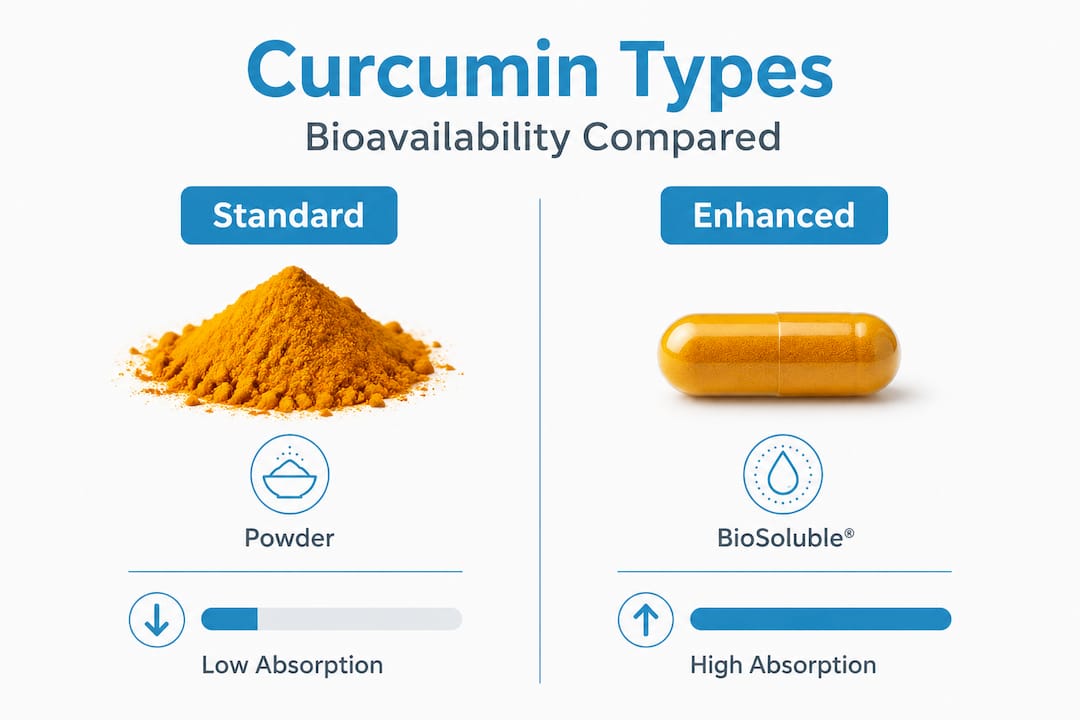
Our BioSoluble® Curcumin™ technology was developed specifically to address this absorption gap. The goal was to create a form that actually reaches the bloodstream and brain tissue at levels meaningful enough to match what the research supports. The BrainBoost cognitive support formula is built on this foundation.
Who benefits most and how to use curcumin for cognition
Knowing bioavailability is essential, so how do you choose and use curcumin in the smartest way for cognitive support?
The evidence points to a fairly clear profile of who gets the most out of curcumin supplementation. Adults over 60 with some degree of chronic low-grade inflammation, whether from lifestyle, diet, or aging itself, show the strongest and most consistent cognitive benefits. That said, younger adults focused on long-term brain health maintenance can also benefit, particularly when curcumin is part of a broader wellness strategy.
Recommended approach based on current evidence:
- Choose an enhanced bioavailability formulation. Standard turmeric or basic curcumin powder is unlikely to deliver meaningful cognitive benefits. Look for clinically validated forms.
- Target approximately 800mg per day. This dose aligns with the optimal dose of 0.8g/day identified in the most recent meta-analysis of human RCTs.
- Commit to at least 24 weeks. Cognitive benefits from curcumin are cumulative. Short-term trials consistently show weaker results. Think of it as a long-term investment, not a quick fix.
- Monitor for GI side effects. Some people experience mild digestive discomfort, especially at higher doses. Starting with a lower dose and building up gradually can help.
- Combine with lifestyle strategies for amplified results. Exercise increases BDNF independently of curcumin. Quality sleep consolidates memory. A diet rich in omega-3s and antioxidants works synergistically with curcumin’s mechanisms.
Key lifestyle pairings that amplify curcumin’s effects:
- Regular aerobic exercise (even 30 minutes, 4 days per week)
- Consistent, high-quality sleep (7 to 9 hours per night)
- A diet emphasizing colorful vegetables, fatty fish, and whole grains
- Stress management practices like meditation or breathwork
- Limiting ultra-processed foods that drive systemic inflammation
Always consult a healthcare professional before starting curcumin for cognitive health, especially if you take blood thinners, diabetes medications, or other supplements that affect inflammation. The BrainBoost supplement page includes detailed usage guidance to help you get started on the right foot.
Our take: Why curcumin may work better for some brains than others
We’ve spent years following the curcumin research, and here’s what most guides won’t tell you: the biggest predictor of whether curcumin works for your brain isn’t the compound itself. It’s the context you bring to it.
Most supplement articles either oversell curcumin as a universal brain booster or dismiss it because human trials are “mixed.” Both positions miss the point. The research is telling us something more nuanced and ultimately more useful: curcumin is highly context-dependent.
Age matters. Inflammatory status matters. Genetics matter. Even your gut microbiome influences how well you absorb and metabolize curcumin. Two people taking the same product at the same dose can have meaningfully different plasma levels and therefore different outcomes. This isn’t a flaw in the science; it’s a feature of personalized health.
What we find most compelling is the pattern that emerges when you look at the strongest responders in clinical trials. They tend to be older, they tend to have measurable inflammatory markers, and they tend to be consistent. They don’t take curcumin for two weeks and give up. They treat it as one piece of a deliberate, layered approach to brain health.
The “miracle pill” mindset is the enemy of real results. Savvy health advocates know that no single supplement rewires your brain overnight. What curcumin does, when formulated well and used consistently, is shift the biochemical environment of the brain in a direction that supports resilience, reduces the burden of inflammation, and creates conditions where cognitive function can be maintained or improved over time.
That’s not magic. That’s biology working in your favor, slowly and steadily.
We built SuperNatural BrainBoost with this philosophy in mind. Not as a shortcut, but as a precision tool for people who understand that long-term brain health is earned through consistent, intelligent choices.
Curcumin for cognitive support: Explore next steps
Ready to apply the science? Here are curated solutions matched to the latest research so you can take the next smartest step.
If the evidence in this article resonates with you, the logical next move is choosing a curcumin product that actually delivers on what the research supports. That means enhanced bioavailability, a clinically relevant dose, and a formulation designed specifically for cognitive and inflammatory health.
Our BioSoluble® Curcumin™ supplement uses a patented process to dramatically improve water solubility and systemic absorption, addressing the single biggest barrier between curcumin and real brain benefits. For advanced cognitive support, BrainBoost combines this enhanced curcumin technology with a formulation built around the dose and duration parameters the research identifies as most effective. You can also explore our full range of all supplement options to find the right fit for your complete wellness strategy, whether that’s cognitive health, immune support, or healthy inflammation management.
Frequently asked questions
What is the most effective dose and formulation of curcumin for cognition?
The strongest evidence supports around 800mg per day of an enhanced bioavailability curcumin taken consistently for at least 24 weeks, with standard powder forms showing significantly weaker results.
Is curcumin safe for long-term use in healthy adults?
Curcumin is generally well-tolerated, but human RCTs note higher adverse events including mild GI effects, so it’s wise to start at a lower dose and check with your doctor if you take any medications.
Can curcumin help with age-related memory decline?
Studies show the strongest benefits in adults over 60, particularly with long-term use of high-absorption formulations at the evidence-backed dose of 0.8g per day.
Do all turmeric supplements improve brain function?
No. Regular turmeric contains only small amounts of curcuminoids, and most basic supplements have poor bioavailability that limits efficacy unless the product uses a specifically enhanced absorption technology.
Recommended
- Curcumin absorption explained: maximize benefits for health – SuperNatural
- Natural supplements for brain health and inflammation – SuperNatural
- How to support brain health: step-by-step habits that work – SuperNatural
- BioSoluble® Curcumin™ – SuperNatural
- Brain Boosting Food for Women with ADHD
- Nutrição e saúde mental: Bem-estar na menopausa