

Curcumin, the primary bioactive compound in turmeric, has generated more scientific attention than almost any other dietary phytochemical. Search the literature and you will find thousands of studies pointing to anti-inflammatory, antioxidant, anticancer, and neuroprotective properties. Yet here is the paradox at the heart of this complex topic: curcumin research consistently produces compelling mechanistic data alongside frustratingly mixed clinical results. Understanding why that gap exists, and what the latest curcumin findings tell us about closing it, is exactly what this article unpacks.
Table of Contents
- Key takeaways
- The complex topic of curcumin research: molecular mechanisms
- Bioavailability challenges and formulation strategies
- Clinical evidence: what the latest curcumin studies show
- Interpreting clinical variability and future directions
- My take on navigating curcumin’s complexity
- Discover BioSoluble® Curcumin™ from Ordersupernatural
- FAQ
Key takeaways
| Point | Details |
|---|---|
| Curcumin acts on many pathways | Its pleiotropic pharmacology explains both its broad promise and its inconsistent clinical outcomes. |
| Bioavailability is the central obstacle | Between 40 and 85% of oral curcumin passes unabsorbed, making formulation technology critical. |
| Formulation type changes outcomes | Nanoformulations boost anticancer potency by 1.5 to 4 times compared to free curcumin in lab studies. |
| Dosing must match the target | Context-dependent dosing, not just higher amounts, determines whether curcumin produces the desired effect. |
| Clinical evidence is still maturing | Current curcumin studies favor viewing it as a dietary adjunct until large-scale standardized trials catch up. |
The complex topic of curcumin research: molecular mechanisms
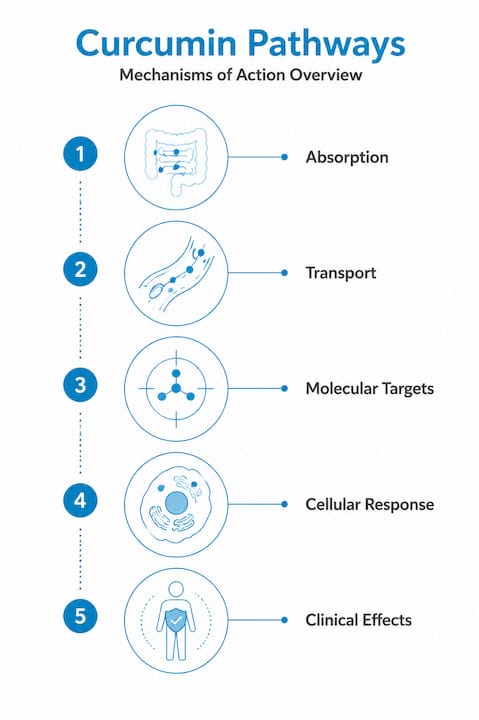
Curcumin does not work the way most pharmaceuticals do. A typical drug locks onto one receptor or blocks one enzyme. Curcumin targets dozens of molecular sites simultaneously, a property scientists call pleiotropy. Think of it less like a precision tool and more like a biological dial that adjusts multiple systems at once. That breadth is exciting, and it is also why curcumin’s pleiotropic nature complicates isolating specific clinical outcomes.
Here is a summary of the major biological pathways curcumin engages:
- NF-κB suppression: Curcumin inhibits nuclear factor kappa B, a master regulator of inflammatory gene expression, reducing the production of pro-inflammatory cytokines like TNF-α and IL-6.
- Nrf2 activation: By activating the Nrf2 pathway, curcumin upregulates endogenous antioxidant enzymes (such as heme oxygenase-1 and superoxide dismutase), bolstering the cell’s own defenses.
- Apoptosis modulation: Curcumin can promote programmed cell death in abnormal cells while protecting healthy tissue, a dual action relevant to cancer research.
- Microbiome interaction: Curcumin modulates xenobiotic metabolism, immune signaling, and gut microbiome composition, adding another layer of complexity to predicting its effects.
- Network pharmacology: Rather than acting linearly, curcumin functions as a network-level regulator, meaning its effects are shaped by the broader biological context of the organism consuming it.
This last point deserves emphasis. Curcumin’s activity in a person with active systemic inflammation looks meaningfully different from its activity in a healthy individual. The molecule responds to context, which is rare in the supplement world and almost unprecedented in the way clinical trials are traditionally designed to evaluate single-mechanism drugs.
Pro Tip: When reviewing curcumin studies, always check the inflammatory baseline of participants. A trial in healthy volunteers will consistently understate the benefits seen in people with elevated C-reactive protein or other inflammatory markers.
Bioavailability challenges and formulation strategies
If curcumin’s pharmacology is complex, its absorption story is even more humbling. Curcumin is famously poorly absorbed. Between 40 and 85% of ingested curcumin passes through the gastrointestinal tract without entering systemic circulation. What does absorb gets rapidly metabolized and glucuronidated in the liver, further limiting the amount that reaches target tissues. Standard curcumin powder, even at high doses, often delivers very little to where it matters most.

The research community has responded with a range of delivery technologies designed to solve this problem. Here is how the main approaches compare:
| Formulation Type | Mechanism | Relative Bioavailability Gain | Notes |
|---|---|---|---|
| Standard curcumin powder | None | Baseline (1x) | Poor absorption, rapid metabolism |
| Piperine co-administration | Inhibits glucuronidation | Up to 20x | Drug interaction risk; not ideal for all users |
| Phytosomes (lipid-bound) | Enhances membrane permeability | 19 to 29x | Good tolerability, well-studied |
| Nanoparticle encapsulation | Protects from GI degradation | Variable, often 10 to 50x | Strong in vitro data, growing clinical evidence |
| Micellar/solubilized forms | Increases water solubility | 40 to 185x reported | Emerging technology with promising results |
| BioSoluble® delivery systems | Patented solubilization process | Significantly enhanced | Designed specifically for systemic tissue exposure |
Dosing adds another layer of nuance. You might assume that taking more curcumin means better results, but dose-dependent effects in neuroprotection and pain models show that higher doses are needed for some outcomes (neuroprotection) while lower doses are more effective for others (pain modulation). More is not always better. The optimal dose depends on which molecular pathway you are trying to influence.
On safety, the news is largely reassuring. Human studies document that curcumin is well-tolerated at doses up to 12 g/day over three months with no significant adverse effects. That said, overuse can still cause gastrointestinal distress, including nausea and diarrhea, and there are documented drug interaction risks, particularly with blood thinners. Always check with a physician before starting high-dose protocols, especially if you take prescription medications.
Pro Tip: Fat-soluble curcumin formulations are best taken with a meal containing healthy fats. The lipid content in the meal increases mucosal absorption and reduces the amount lost to first-pass metabolism.
Clinical evidence: what the latest curcumin studies show
The volume of curcumin studies is staggering, but quality and focus vary widely. Reviewing the most recent and rigorous evidence reveals a picture that is genuinely promising in certain areas, while still incomplete in others.
Wound healing stands out as one of the stronger clinical cases. A scoping review found that curcumin improved wound healing in 89% of trials, with 84% of those studies reporting zero adverse events. That is a strong and consistent signal across diverse wound types and patient populations.
Colorectal cancer research offers some of the most mechanistically detailed data. In vitro evidence shows that nanoformulations boost cytotoxic potency by 1.5 to 4 times compared to free curcumin, with IC50 values ranging from 10 to 25 µM for standard forms. This tells us formulation quality is not just a marketing variable. It directly determines whether curcumin reaches concentrations relevant to cancer biology.
Oral health is another area gaining traction. Research documents curcumin’s antimicrobial and anti-inflammatory activity in periodontal tissues, with evidence supporting its use in adjunctive therapy for gingivitis and oral mucositis.
The curcumin health effects across these domains share a common thread: the evidence from in vitro and early-phase human studies is generally positive, but large, randomized, placebo-controlled trials remain scarce. Current clinical data position curcumin more as a dietary component than a validated therapeutic agent, at least until trials with larger sample sizes and standardized formulations are completed.
Key gaps in the current literature include:
- Lack of standardized curcumin formulations across trials, making cross-study comparisons unreliable
- Short study durations that miss cumulative effects seen over months or years
- Underrepresentation of diverse populations, which matters given the microbiome’s role in curcumin metabolism
- Minimal attention to inflammatory and redox pathways beyond the most studied mechanisms, with only 50.4% of trials engaging those pathways and even fewer addressing broader biological contexts
Understanding these limitations does not diminish the science. It clarifies where the science still needs to go, which is the more useful posture for anyone trying to apply the research intelligently.
Interpreting clinical variability and future directions
One of the most underappreciated explanations for inconsistent curcumin results is biological variability among individuals. Two people taking the same dose of the same formulation can experience dramatically different outcomes. Research points to three major sources of this variability:
-
Gut microbiome composition. Certain gut bacteria convert curcumin into active metabolites (tetrahydrocurcumin being the most studied), while other microbial profiles produce far less. People with similar diets but different microbiomes effectively receive different pharmacological inputs from the same supplement.
-
Transporter protein expression. The expression levels of efflux transporters like P-glycoprotein in intestinal cells determine how much curcumin is pumped back out of the gut lining before it can circulate. High biological variability in curcumin response is directly tied to these transporter levels, which vary substantially across individuals and ethnic groups.
-
Baseline inflammatory tone. Curcumin behaves differently in a pro-inflammatory environment. Someone with chronic low-grade inflammation may see NF-κB suppression rapidly, while someone without that baseline activation may not register a measurable change at the same dose.
Future curcumin research needs to adopt frameworks that account for this variability rather than averaging it out. The most promising direction is a high-input rational integration approach: combining metabolomic data, microbiome profiling, and computational network analysis to predict who will respond to which formulation at what dose. This kind of context calibration would let researchers design trials that actually test what curcumin can do in the populations most likely to benefit.
Combination strategies are also worth watching. Pairing curcumin with quercetin (another pleiotropic polyphenol) or with omega-3 fatty acids (which share anti-inflammatory mechanisms) may produce additive or synergistic effects. Early preclinical data are encouraging. For researchers, the next productive questions are not “does curcumin work?” but “for whom, in what formulation, at what dose, and in combination with what?”
My take on navigating curcumin’s complexity
I have spent years reviewing curcumin studies, and the honest truth is that most researchers, and certainly most supplement shoppers, are looking at this compound through the wrong lens. They want it to behave like a drug. It does not. It is a pleiotropic dietary molecule that modulates biological systems rather than switching a single pathway on or off.
What I have learned is that the researchers who get the most meaningful results from curcumin work are the ones who specify their biological context obsessively. They define inflammation status, microbiome composition, formulation type, and dose rationale before drawing any conclusions. The studies that disappoint are almost always the ones that treat curcumin as a uniform intervention in a heterogeneous population.
For health enthusiasts evaluating curcumin evidence, my advice is direct: ignore any study that does not specify the formulation used and how bioavailability was addressed. A study using standard curcumin powder tells you almost nothing about what a well-designed phytosome or BioSoluble® delivery system can do. The curcumin absorption details matter as much as the dose itself.
Curcumin’s future in clinical use is, in my view, as a targeted dietary adjunct rather than a standalone therapeutic agent. That is not a limitation. It is an honest and still remarkable role for a molecule found in a root vegetable.
— SuperNatural
Discover BioSoluble® Curcumin™ from Ordersupernatural
Ordersupernatural has built its supplement line around one core problem: standard curcumin rarely delivers on its biological promise because absorption fails before the molecule ever reaches your tissues. The patented BioSoluble® Curcumin™ process was developed specifically to overcome that barrier, providing measurably enhanced systemic exposure compared to conventional curcumin products.
Whether your focus is a healthy inflammatory response (BodyControl), immune function (BodyBoost), or cognitive support (BrainBoost), Ordersupernatural offers targeted formulations built on the same advanced delivery science. If you want curcumin that actually reaches your cells at concentrations the research supports, explore the full supplement collection and see how BioSoluble® technology translates the science into real-world results.
FAQ
What makes curcumin research so scientifically complex?
Curcumin acts on multiple molecular pathways simultaneously (a property called pleiotropy), and its effects are shaped by individual factors like gut microbiome composition and baseline inflammation. This makes results highly variable across different study designs and populations.
How much curcumin is actually absorbed from standard supplements?
Between 40 and 85% of standard oral curcumin passes through the body unabsorbed, according to published research. Advanced delivery systems like nanoformulations and phytosomes are specifically designed to address this gap.
Is high-dose curcumin safe?
Human studies confirm that curcumin is well-tolerated at doses up to 12 g per day for three months with no significant adverse effects. However, higher doses can cause gastrointestinal discomfort, and curcumin may interact with certain medications, so consulting a physician is advised.
Do nanoformulations of curcumin actually perform better in cancer research?
Yes. In vitro evidence from colorectal cancer models shows that nanoformulations increase cytotoxic potency by 1.5 to 4 times compared to free curcumin, with meaningfully lower IC50 values. This reflects the direct biological impact of delivering curcumin to target cells more effectively.
Should curcumin be viewed as a supplement or a therapeutic drug?
Based on current evidence, curcumin is best regarded as a dietary complement rather than a validated pharmaceutical therapeutic. Large-scale standardized trials are still needed before it can be recommended as a standalone treatment for specific diseases.
This article is provided for educational and informational purposes only and does not constitute providing medical advice or professional services. Always consult with a qualified and licensed physician or other medical care provider. Statements have not been evaluated by the Food & Drug Administration. This product is not intended to diagnose, treat, cure, or prevent any disease.