

A cognitive supplement is any substance taken specifically to enhance brain functions like memory, focus, attention, or mental clarity. The formal term for this category is nootropic, coined by Romanian chemist Corneliu Giurgea in 1972. Defining cognitive supplement accurately matters because the market is flooded with products making bold claims, and understanding what separates a true cognitive enhancer from a general vitamin or a simple stimulant helps you spend your money wisely and set realistic expectations. Recent 2026 meta-analyses from Frontiers in Pharmacology confirm that ingredients like Ashwagandha and polyphenols produce measurable cognitive improvements, giving this category real scientific weight.
What is a cognitive supplement, and how is it defined?
A cognitive supplement is defined as a goal-oriented cognitive enhancer within the broader dietary supplement category. The key word is goal-oriented. Unlike a general multivitamin that supports overall health, a cognitive supplement targets specific brain functions: memory encoding, sustained attention, executive function, or processing speed.

The term nootropic carries a stricter meaning. Giurgea’s original nootropic criteria require that a substance enhance memory and learning, protect the brain from chemical or physical injury, improve brain function under disruptive conditions, and produce no sedation, stimulation, or significant side effects. That is a high bar. Most products marketed as nootropics today do not fully meet all five criteria, which is why understanding the definition matters before you buy.
Common examples include Ashwagandha (Withania somnifera), Bacopa monnieri, Panax ginseng, polyphenols from berries and green tea, and phosphatidylserine. Caffeine is often grouped in this category, but it functions primarily as a stimulant rather than a true nootropic. The distinction becomes clearer in the next section.
How do cognitive supplements differ from stimulants and general supplements?
The three categories look similar on store shelves but work through different mechanisms and serve different goals. Here is a direct comparison:
| Category | Primary goal | Mechanism | Side effect profile |
|---|---|---|---|
| General dietary supplement | Overall nutritional support | Fills nutrient gaps | Minimal when dosed correctly |
| Cognitive supplement (nootropic) | Targeted brain function enhancement | Supports baseline brain capacity | Low; no tolerance or dependency |
| Stimulant (e.g., caffeine) | Temporary alertness boost | Activates central nervous system | Tolerance, withdrawal, crash possible |
True nootropics differ from stimulants in one critical way: they aim to support baseline brain capacity without producing tolerance, withdrawal, or dependency. A cup of coffee sharpens your focus for two hours, but it does not improve your brain’s underlying capacity. Bacopa monnieri, by contrast, has shown memory improvements that accumulate over weeks of consistent use.
General dietary supplements like vitamin D or magnesium support broad physiological health. They may indirectly benefit cognition by correcting deficiencies, but that is not their primary design. A cognitive supplement is formulated with a specific cognitive outcome in mind, and its ingredients are chosen to achieve that outcome.
- Stimulants produce fast, noticeable effects but carry crash and dependency risks.
- General supplements support overall health without targeting brain function directly.
- Cognitive supplements aim for measurable, sustained improvements in defined mental domains.
Pro Tip: If a product’s label lists only caffeine and B vitamins, it is closer to an energy supplement than a true cognitive enhancer. Look for standardized plant extracts with documented cognitive outcomes.
Which ingredients have the strongest scientific evidence?
The evidence base for cognitive supplements is uneven. Some ingredients have strong meta-analytic support. Others show promise in early trials but need more data. Here is where the science stands as of 2026.
| Ingredient | Cognitive benefit | Evidence strength |
|---|---|---|
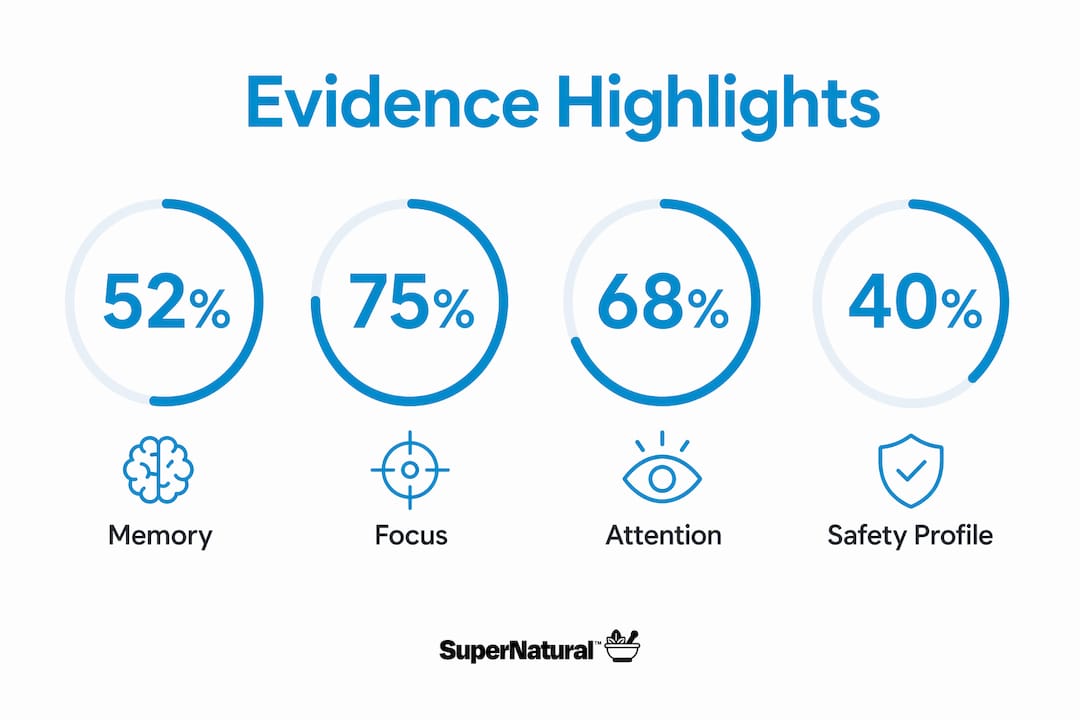
| Ashwagandha | Memory (SMD = 0.52), attention (SMD = 0.29) | Strong: 2026 meta-analysis, 1,249 participants |
| Polyphenols | MMSE score improvement of +2.06 | Strong: clinical trials, 849 participants |
| Panax ginseng | Acute alertness and working memory | Moderate: systematic review, standardized extracts |
| Black cardamom + caffeine | Alertness and executive function up to 8 hours | Emerging: randomized controlled trial, 2026 |
| Bacopa monnieri | Long-term memory consolidation | Moderate: multiple trials, effects build over weeks |
Ashwagandha stands out. A 2026 meta-analysis of 1,249 participants found it improved memory with a standardized mean difference of 0.52 and attention with an SMD of 0.29. Those are clinically meaningful numbers, not statistical noise. Polyphenols, found in blueberries, green tea, and dark chocolate, produced a pooled MMSE score improvement of +2.06 across 849 participants. The MMSE (Mini-Mental State Examination) is a validated clinical tool, so a two-point improvement represents real functional change.
Panax ginseng shows consistent cognitive facilitating effects in acute and single-dose studies in healthy adults. The catch is standardization. Ginseng products vary widely in their ginsenoside content, the active compounds responsible for cognitive effects. A product with unclear ginsenoside levels may produce no benefit at all.
One emerging combination worth watching: black cardamom extract combined with caffeine produced prolonged improvements in alertness and executive function lasting up to 8 hours without the typical crash. This points to a growing trend in next-generation cognitive supplements: using plant extracts to extend and smooth the effects of stimulants rather than relying on stimulants alone.
You can explore the research on Ashwagandha and polyphenols in more detail if you want to go deeper on the ingredient science.
Pro Tip: When evaluating a cognitive supplement, look for the specific extract ratio on the label (e.g., “KSM-66 Ashwagandha” or “Bacopa 50% bacosides”). Generic herb powder without standardization is like wanting a strong cup of coffee and getting a cup of warm water instead.
What are the real limitations and safety concerns?
The cognitive supplement market has a credibility problem. Manufacturers can market brain supplements without proving efficacy before sale. That regulatory gap means unproven claims appear on thousands of products, and consumers have no reliable way to distinguish science-backed formulas from marketing fiction.
Harvard Health, citing the COSMOS trial and broader clinical consensus, states that little high-quality evidence supports over-the-counter brain supplements reliably protecting against dementia or improving baseline cognition in healthy adults. That does not mean all supplements are useless. It means the evidence is ingredient-specific, and blanket claims about “brain health” are almost always overstated.
Key risks to know before you buy:
- Poor standardization: Products without verified active ingredient levels often fail to replicate study results.
- Contamination: Some supplements have tested positive for undisclosed stimulants or heavy metals.
- Drug interactions: Ginkgo biloba and fish oil can interact with blood thinners. Always check with your doctor.
- Misleading labels: Terms like “clinically studied” may refer to a single small study, not a body of evidence.
“Lifestyle changes remain the primary recommendation for brain health. Supplements are adjuncts, not replacements, for sleep, exercise, and a nutrient-rich diet.” — Harvard Health, 2026
Cognitive supplements are not clinical treatments. They do not treat Alzheimer’s disease, ADHD, or depression. If you are managing a clinical condition, work with a physician. If you are a healthy adult looking to support mental performance, supplements with strong evidence like Ashwagandha or polyphenols are reasonable tools when used with realistic expectations.
Pro Tip: Before adding any cognitive supplement to your routine, check the National Institutes of Health Office of Dietary Supplements database for safety summaries on specific ingredients. It is free, unbiased, and regularly updated.
How to choose and use cognitive supplements effectively
Choosing the right cognitive supplement requires more than reading a label. It requires knowing what cognitive outcome you want, selecting an ingredient with evidence for that specific outcome, and tracking whether it works for you.
-
Define your cognitive goal first. Memory consolidation, sustained attention, and verbal fluency each respond to different ingredients. Bacopa monnieri targets memory. Panax ginseng supports acute alertness. Polyphenols show broader cognitive score improvements. Match the ingredient to the goal.
-
Prioritize standardized extracts. Standardized plant extracts with known active constituent profiles are critical to replicating the benefits seen in studies. Look for ginsenosides in ginseng, bacosides in Bacopa, and withanolides in Ashwagandha. If the label does not list the active compound percentage, move on.
-
Give it enough time. Some cognitive supplements work acutely (ginseng, caffeine combinations). Others require 8–12 weeks of consistent use before effects become measurable (Bacopa, Ashwagandha). Stopping after two weeks tells you nothing.
-
Track measurable outcomes. Experts recommend treating cognitive supplements as hypotheses requiring measurable tracking. Use a simple daily log: rate your focus, memory recall, or task completion on a 1–10 scale each morning. After 30 days, you will have real data instead of guesses.
-
Avoid stacking too many compounds at once. Adding five new supplements simultaneously makes it impossible to know which one is working or causing side effects. Introduce one ingredient at a time, evaluate it for 4–6 weeks, then decide whether to continue or add another.
-
Pair supplements with lifestyle. No supplement outperforms consistent sleep, regular aerobic exercise, and a diet rich in omega-3s and polyphenols. Use supplements to support a healthy foundation, not replace one. The step-by-step habits for brain health guide from SuperNatural Supplements covers this integration in practical detail.
Key takeaways
Cognitive supplements with standardized, evidence-backed ingredients like Ashwagandha and polyphenols produce measurable improvements in memory and attention, but only when chosen carefully and used alongside healthy lifestyle habits.
| Point | Details |
|---|---|
| Definition matters | A cognitive supplement targets specific brain functions; a general supplement does not. |
| Nootropics vs. stimulants | True nootropics support baseline brain capacity without causing tolerance or withdrawal. |
| Evidence is ingredient-specific | Ashwagandha and polyphenols have strong 2026 meta-analytic support; many others do not. |
| Regulation is limited | Manufacturers can sell brain supplements without proving efficacy, so scrutiny is your responsibility. |
| Track your results | Treat each supplement as a hypothesis and log measurable cognitive outcomes over 4–12 weeks. |
Our perspective on cognitive supplements and mental performance
We have spent years researching the science behind cognitive supplementation, and the honest truth is that this category rewards patience and skepticism in equal measure. The gap between what marketing promises and what peer-reviewed research confirms is real and wide. Most products on the market are riding the wave of legitimate science done on a handful of well-studied ingredients, then applying those findings to formulas that bear little resemblance to what was actually tested.
What we have found is that the consumers who get the most out of cognitive supplements are the ones who treat them like tools, not miracles. They pick one ingredient with solid evidence, use a standardized extract at a studied dose, and track their results over weeks. They also do not skip sleep to take more supplements. That trade-off never works in your favor.
The emerging research on combinations like black cardamom and caffeine is genuinely exciting. It suggests the next generation of cognitive supplements will not just borrow from stimulant science but will actively work to extend and refine it. That is a meaningful step forward. We are watching that space closely.
The most important thing we can tell you: lifestyle is the foundation, and supplements are the finishing layer. Get the foundation right first. Then, if you want to add a well-formulated cognitive supplement on top of that, the evidence suggests it can make a real difference.
— SuperNatural
Discover BrainBoost from SuperNatural Supplements
If you are ready to put the science into practice, SuperNatural Supplements formulated BrainBoost: Advanced Cognitive Support with exactly these principles in mind. BrainBoost uses standardized, evidence-backed ingredients with full transparency on active compound levels, so you know what you are getting and why it is in the formula.
SuperNatural Supplements also uses its patented BioSoluble® Curcumin™ process, which delivers significantly enhanced bioavailability compared to standard curcumin. That means the active compounds actually reach your bloodstream at levels that matter. If you want to learn more about the science behind the formula, the BrainBoost ingredient overview breaks it down clearly. BrainBoost is designed for adults who want cognitive support grounded in real research, not marketing claims.
FAQ
What is a cognitive supplement?
A cognitive supplement is a substance taken specifically to enhance brain functions like memory, focus, or attention. The formal term is nootropic, defined by Corneliu Giurgea in 1972 with strict criteria including safety and measurable cognitive enhancement.
How do cognitive supplements work?
Cognitive supplements work by supporting specific neurological processes such as neurotransmitter production, cerebral blood flow, or neuroprotection. Effects vary by ingredient: Ashwagandha reduces cortisol to support memory, while polyphenols protect neurons from oxidative stress.
Are cognitive supplements safe?
Most well-studied cognitive supplements like Ashwagandha, Bacopa, and polyphenols have favorable safety profiles at studied doses. Risks increase with unstandardized products, high doses, or combinations with medications. Always consult a physician before starting any new supplement.
What is the difference between a nootropic and a stimulant?
A nootropic supports baseline brain capacity without causing tolerance or withdrawal. A stimulant like caffeine activates the central nervous system for a temporary boost but can cause dependency and a crash effect with regular use.
How long does it take for cognitive supplements to work?
It depends on the ingredient. Ginseng and caffeine combinations can produce acute effects within hours. Bacopa monnieri and Ashwagandha typically require 8–12 weeks of consistent use before measurable cognitive improvements appear.
This article is provided for educational and informational purposes only and does not constitute providing medical advice or professional services. Always consult with a qualified and licensed physician or other medical care provider. Statements have not been evaluated by the Food & Drug Administration. This product is not intended to diagnose, treat, cure, or prevent any disease.