

Curcumin extraction is defined as the multi-step process of isolating and purifying curcuminoids from the rhizome of Curcuma longa (turmeric) to yield a concentrated, bioactive compound suitable for health, research, and commercial use. The term “curcumin extraction” is widely used in consumer and supplement contexts, while the recognized industry and scientific terminology is curcuminoid isolation and purification. Understanding both terms matters because the extraction method directly determines the purity, potency, and bioavailability of the curcumin you ultimately consume. A 2026 review of curcumin extraction confirms that both traditional and advanced techniques are essential for obtaining high-purity curcumin. Raw turmeric contains only 2 to 5 percent curcuminoids by weight, so without a rigorous extraction and purification process, you are essentially just sniffing the coffee beans rather than brewing a strong cup.
What are the main curcumin extraction methods and how do they work?
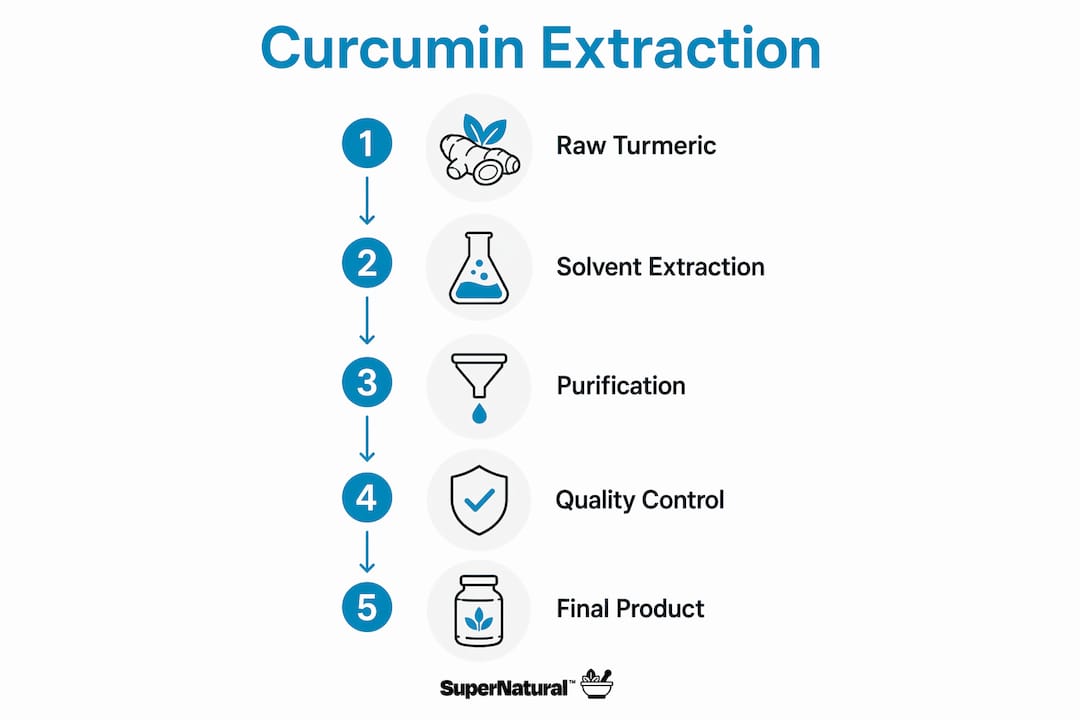
The curcumin extraction process begins with selecting a solvent capable of dissolving curcuminoids out of the turmeric matrix while leaving behind unwanted plant material. This is not a single-step operation. It is a sequence of decisions about chemistry, temperature, pressure, and time that collectively determine the quality of the final extract.
Traditional solvent-based extraction remains the most widely used approach in both laboratory and industrial settings. Common solvents include:
- Ethanol (food-grade, low toxicity, preferred for supplement-grade extracts)
- Methanol (high solubility for curcuminoids, but restricted in food applications due to toxicity)
- Acetone (effective for curcuminoid recovery, often used in research)
- Isopropanol (moderate polarity, sometimes used as an ethanol alternative)
Each solvent interacts differently with the curcuminoid molecules. Ethanol is the most practical choice for health-focused applications because it is generally recognized as safe and leaves minimal residue. Methanol and acetone produce higher raw yields in laboratory settings but require extensive downstream processing to remove solvent residues before the extract is safe for human use.
Pressurized solvent extraction (PSE) takes traditional solvent extraction a step further by applying elevated pressure and temperature to accelerate the process and improve yield. This technique reduces extraction time significantly compared to conventional Soxhlet extraction, which can take hours. PSE also allows precise control over solvent composition and temperature, which matters enormously for curcuminoid quality (more on this in the next section).
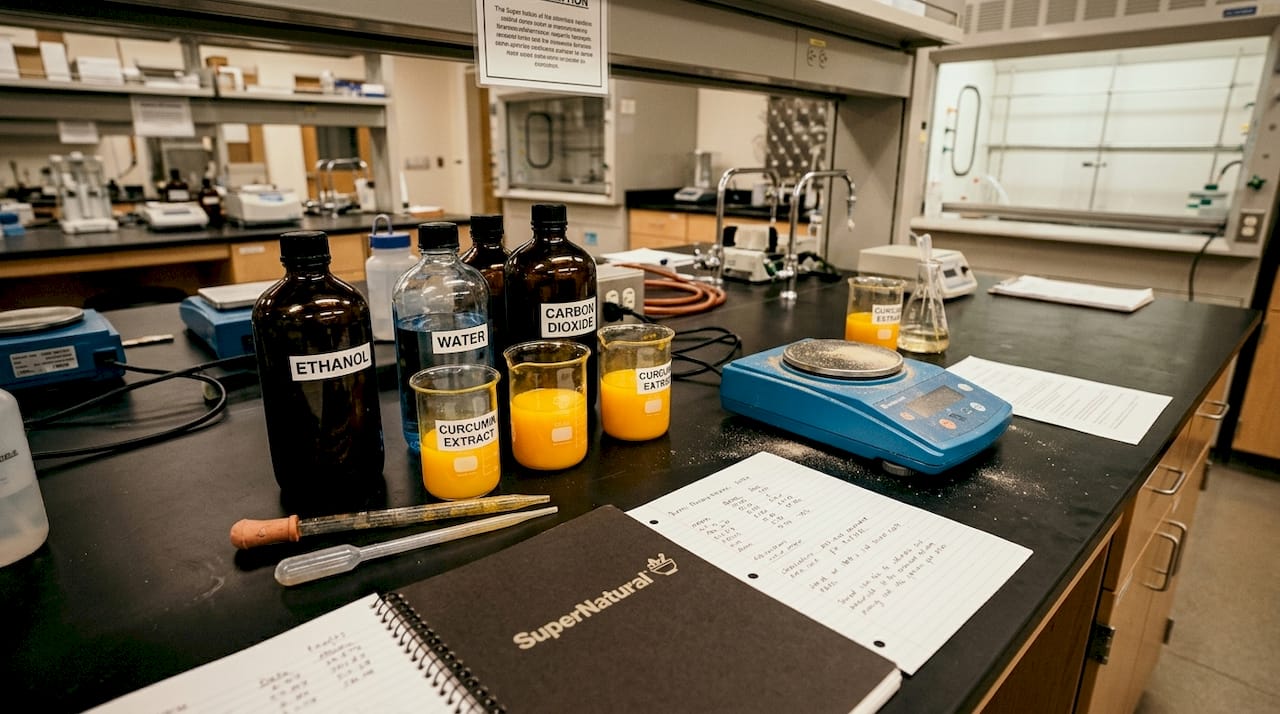
Supercritical fluid extraction (SFE) uses carbon dioxide at pressures above its critical point to act as a solvent. The advantage is that CO₂ leaves no toxic residue, making it attractive for pharmaceutical and premium supplement manufacturing. SFE is particularly effective when combined with a co-solvent like ethanol to improve curcuminoid solubility.
High-speed countercurrent chromatography (HSCCC) represents one of the more sophisticated curcumin extraction techniques. It separates compounds based on their differential partitioning between two immiscible liquid phases, producing high-purity curcuminoid fractions in a single continuous operation. A comprehensive 2026 review identifies HSCCC alongside supercritical fluid chromatography as integral to achieving research-grade curcumin purity.
Green extraction methods are gaining traction as the industry moves toward sustainability. These approaches use water, natural deep eutectic solvents, or ultrasound-assisted techniques to reduce organic solvent consumption. While green methods often yield slightly lower curcuminoid concentrations, they produce extracts with a cleaner environmental profile and are increasingly viable for commercial production.
Pro Tip: When evaluating a curcumin supplement, ask whether the manufacturer specifies the extraction solvent. Ethanol-extracted curcumin is the gold standard for consumer products. Methanol or acetone-extracted material requires rigorous purification before it is safe, and reputable brands will confirm this in their certificates of analysis.
How is curcumin purified and why is purification essential?
Extraction alone produces a crude mixture of curcuminoids, plant pigments, oils, and other compounds. Think of it as pressing grapes to get juice: you have the right liquid, but it still needs refining before it becomes wine. Purification is the step that separates curcumin (the primary curcuminoid) from its close relatives bisdemethoxycurcumin and demethoxycurcumin, as well as from impurities that reduce bioactivity or safety.
The extraction-purification relationship is inseparable: high purity is required for curcumin to perform reliably in research and commercial formulations. This means that a supplement label claiming “95% curcuminoids” is only meaningful if the purification process was rigorous enough to actually achieve that figure consistently.
| Purification method | Purity achievable | Key advantage | Limitation |
|---|---|---|---|
| Macroporous resin adsorption | 80 to 90% | Scalable, low cost | Moderate selectivity |
| Silica gel chromatography | 90 to 95% | High selectivity for curcumin isomers | Solvent-intensive |
| High-speed countercurrent chromatography | 95 to 99% | Continuous, high-purity fractions | High equipment cost |
| Supercritical fluid chromatography | 95 to 99%+ | No toxic solvent residue | Requires specialized infrastructure |
Macroporous resin adsorption is the workhorse of industrial curcumin purification. The crude extract passes through a resin bed that preferentially binds curcuminoids, allowing impurities to wash through. Silica gel chromatography then separates individual curcuminoid isomers with greater precision. For research-grade or pharmaceutical-grade material, HSCCC and supercritical fluid chromatography deliver the highest purity levels with the cleanest profiles.
Quality control at the purification stage typically involves high-performance liquid chromatography (HPLC) to verify curcuminoid content and identity, along with assays measuring antioxidant capacity such as DPPH radical scavenging. These analytical steps confirm that the purified extract meets specification before it enters a supplement or functional food product.
Which factors affect curcumin extraction quality and yield?
The outcome of any curcumin extraction process is shaped by four primary variables: solvent type, solvent-to-solid ratio, extraction temperature, and extraction time. Adjusting any one of these changes both the quantity and the quality of the curcuminoids recovered.
Solvent type and ratio have the largest combined effect on yield. Research shows that a 60:40 ethanol-water mixture at 120°C achieves up to 36.80% extraction yield, outperforming pure ethanol or pure water alone. The water component improves cell wall penetration, while ethanol dissolves the lipophilic curcuminoids. This means that using pure ethanol, while intuitive, actually leaves curcuminoids behind.
Temperature is where many extraction processes go wrong. The same research confirms that temperatures above 120°C reduce curcuminoid content and antioxidant capacity, even as crude yield continues to rise. This is a critical distinction: more mass does not mean more bioactivity. Excessive heat degrades the phenolic structure of curcumin, producing breakdown products that have no meaningful health benefit. Total curcuminoids in the range of 405.73 to 417.53 mg per gram of extract are achievable at 70 to 90°C, representing a favorable balance between recovery and bioactivity preservation.
Key factors to monitor during extraction include:
- Solid-to-liquid ratio: A higher ratio of solvent to turmeric powder generally improves yield up to a point, after which additional solvent produces diminishing returns.
- Extraction time: Longer contact time increases curcuminoid dissolution, but extended exposure to heat accelerates degradation.
- Particle size of turmeric: Finer grinding increases surface area and improves solvent penetration, directly raising yield without requiring higher temperatures.
- Light exposure: Curcumin is photosensitive. Extraction conducted under reduced light conditions preserves curcuminoid integrity throughout the process.
Pro Tip: If you are researching curcumin supplements and want to assess extraction quality, look for products that report both curcuminoid percentage and antioxidant activity (such as ORAC or DPPH values). A high curcuminoid percentage with no antioxidant data may indicate that extraction temperature was not controlled carefully.
What are practical applications of extracted curcumin beyond supplementation?
The benefits of curcumin extraction extend well beyond capsules and tablets. Once curcumin is isolated and purified, it becomes a functional ingredient that researchers and manufacturers deploy across multiple industries. Here is how extracted curcumin is used in practice:
-
Functional food formulations. Purified curcumin is incorporated into beverages, fortified foods, and nutraceutical products. Because curcumin is poorly water-soluble in its raw form, formulators use emulsification, nanoencapsulation, and polymer-based dispersion to keep it stable and bioavailable in food matrices.
-
Polymer-based dispersions for enhanced antioxidant activity. Formulating curcumin with natural polymers like Aloe vera mucilage markedly improves its functional performance. Curcumin dispersions in Aloe vera achieved a DPPH IC50 of 10.31 µg/mL compared to 16.32 µg/mL for pure curcumin alone, demonstrating a strong synergistic antioxidant effect. This means the formulated version is measurably more potent at neutralizing free radicals than the extracted compound on its own.
-
Cosmetic and topical applications. Curcumin’s antioxidant and anti-inflammatory properties make it a sought-after ingredient in skincare formulations. Extracted and purified curcumin is incorporated into creams, serums, and masks, where its stability and concentration must be tightly controlled to deliver consistent results.
-
Analytical detection in food safety. Curcumin is used as a food colorant (E100) in many countries, and regulatory compliance requires accurate measurement of curcumin levels in food products. A supramolecular solvent microextraction method paired with UV-Vis spectrophotometry achieves an enrichment factor of 131 and a detection limit of 0.23 µg/L, with recoveries of 98 to 99.7% across various food matrices. This level of precision allows food safety laboratories to detect trace curcumin contamination or verify label claims with confidence.
-
Standardization for consistent supplement quality. Standardization processes adjust curcumin content across batches to compensate for natural variability in turmeric raw material. Without standardization, two capsules from the same bottle could contain meaningfully different amounts of active curcuminoids. This is why batch-to-batch consistency is a quality marker worth asking about when choosing a curcumin supplement.
Understanding curcumin bioavailability is the natural next step after understanding extraction, because even a perfectly extracted and purified curcumin compound faces significant absorption challenges in the human body.
Key takeaways
Curcumin extraction quality is determined by the combined rigor of the isolation method, solvent selection, temperature control, and purification process, not by yield alone.
| Point | Details |
|---|---|
| Extraction method matters | Ethanol-based and supercritical CO₂ methods produce the safest, highest-quality curcuminoid extracts for health use. |
| Temperature has a ceiling | Extraction above 120°C increases crude yield but degrades curcuminoid bioactivity and antioxidant capacity. |
| Purification is non-negotiable | Crude extracts require chromatographic purification to reach the 95%+ curcuminoid purity needed for reliable health benefits. |
| Formulation amplifies results | Combining purified curcumin with natural polymers like Aloe vera mucilage significantly improves antioxidant performance beyond the raw extract. |
| Standardization protects consistency | Batch standardization compensates for natural turmeric variability and is a key quality marker in reputable supplement products. |
Our perspective on extraction quality and what it means for you
At SuperNatural Supplements, we have spent years examining what separates a genuinely effective curcumin product from one that simply looks good on a label. The single most consistent finding is this: extraction and purification cannot be treated as separate concerns. Brands that optimize only for yield, chasing the highest milligram count per batch, routinely sacrifice the bioactivity that makes curcumin worth taking in the first place.
The trend toward green extraction methods is one we follow closely, and we think it represents the right direction for the industry. Lower solvent residues and cleaner processing align with what health-conscious consumers actually want. But green methods must still meet the same purity standards as conventional approaches. A “natural” extraction process that delivers 70% curcuminoid purity is not superior to a well-controlled ethanol extraction that delivers 95%.
What we find most underappreciated is the role of post-extraction formulation. Extraction gets curcumin out of the turmeric root. Formulation determines whether your body can actually use it. The bioavailability gap between a standard curcumin extract and a well-engineered delivery system is substantial. When you are evaluating a curcumin supplement, ask two questions: What was the extraction method? And what has been done to the extract to make it absorbable? If a brand cannot answer both, that tells you something important.
— SuperNatural
Experience BioSoluble® Curcumin™ from SuperNatural Supplements
SuperNatural Supplements applies the science of extraction and formulation together, not as separate steps. Our patented BioSoluble® Curcumin™ process is designed to address the bioavailability challenge that standard curcumin extracts cannot solve on their own, delivering significantly enhanced absorption compared to conventional curcumin products.
Whether your goal is immune support with BodyBoost, cognitive performance with BrainBoost, or a healthy inflammatory response with BodyControl, each product is built on the same commitment to extraction integrity and formulation precision. We believe you deserve to know exactly what went into your supplement and why it works. Explore our full product line and see how extraction science translates into real health results.
FAQ
What is curcumin extraction in simple terms?
Curcumin extraction is the process of separating and concentrating curcuminoids from turmeric root using solvents or advanced techniques, followed by purification to remove impurities and achieve a potent, usable compound.
Which solvent is best for extracting curcumin?
Ethanol, particularly in a 60:40 ethanol-water ratio, is the preferred solvent for supplement-grade curcumin extraction because it balances high yield with safety and minimal residue.
Does extraction temperature affect curcumin quality?
Yes. Research shows that temperatures above 120°C reduce curcuminoid content and antioxidant capacity, even as crude yield increases, making temperature control a critical quality factor.
Why is purification necessary after extraction?
Crude curcumin extracts contain a mixture of curcuminoid isomers, plant pigments, and oils. Purification through methods like silica gel or high-speed countercurrent chromatography separates these components to achieve the 95%+ purity required for reliable health applications.
How does extraction method affect curcumin bioavailability?
Extraction method determines the purity and structural integrity of curcuminoids, but bioavailability also depends on post-extraction formulation. Even high-purity curcumin has poor water solubility, so delivery technologies like polymer dispersions or patented solubilization processes are needed to maximize absorption in the body.
This article is provided for educational and informational purposes only and does not constitute providing medical advice or professional services. Always consult with a qualified and licensed physician or other medical care provider. Statements have not been evaluated by the Food & Drug Administration. This product is not intended to diagnose, treat, cure, or prevent any disease.