

Patented supplements are legally protected dietary formulas or delivery technologies that grant inventors exclusive rights, typically for up to 20 years from the filing date. The term “patented supplement” is the common consumer phrase; the recognized industry category is a patented nutraceutical or patented dietary formulation. These protections are issued by bodies like the United States Patent and Trademark Office (USPTO) and, for international coverage, through the Patent Cooperation Treaty (PCT). A supplement earns patent protection by meeting three criteria: novelty, non-obviousness, and utility. That means the formulation must do something measurably better than what already exists, not just contain a natural ingredient in its original form. For health-conscious consumers, understanding patent protection supplements means knowing which products carry real scientific validation and which rely on marketing alone.
What qualifies a dietary supplement for patent protection?
Patent eligibility for dietary supplements is stricter than most people expect. Natural products that are merely isolated or purified are generally not patentable under the USPTO framework unless they demonstrate a marked difference from their natural state. That distinction matters enormously. It means you cannot patent turmeric, but you can patent a specific curcumin delivery system that makes the compound absorb at a measurably higher rate.
The marked difference standard pushes supplement developers toward genuine innovation. Three categories typically qualify:
- Proprietary ingredient ratios: A specific blend of compounds at defined concentrations that produces a synergistic effect not achievable with individual ingredients.
- Enhanced bioavailability: A formulation or delivery method (such as a phytosome, liposomal encapsulation, or BioSoluble® technology) that demonstrably improves how much of an active compound reaches the bloodstream.
- Novel manufacturing or extraction processes: A production method that yields a purer, more stable, or more effective end product than conventional techniques.
Patent applications require quantified, reproducible data showing enhanced absorption, bioavailability, or stability. That requirement forces supplement companies to run real clinical or laboratory studies before filing. The result is a higher scientific bar than most standard dietary supplements ever face.
Pro Tip: When evaluating a patented supplement, ask the company for the patent number. You can search it directly on the USPTO database to read the actual claims and supporting data.
How do patented supplements differ from conventional dietary supplements?
The gap between a patented dietary formula and a conventional supplement is wider than the label suggests. The clearest way to see it is through a direct comparison.

| Feature | Conventional Supplement | Patented Supplement |
|---|---|---|
| Ingredient protection | None; any brand can copy the formula | Legally exclusive for up to 20 years |
| Scientific validation | Often minimal or absent | Requires reproducible clinical or lab data |
| Bioavailability focus | Standard absorption, no enhancement required | Must demonstrate measurable improvement over prior art |
| Consumer transparency | Proprietary blends can hide exact amounts | Patent disclosure requires public documentation of the invention |
| Market differentiation | Commodity competition on price | Legal barrier to direct copying |
The transparency point is one most consumers overlook. Patents force a level of transparency and scientific validation that enhances consumer trust. A patent is a public document. Anyone can read the claims, the supporting data, and the rationale for why the formulation works. That is fundamentally different from a proprietary blend label that tells you nothing about actual ingredient amounts.
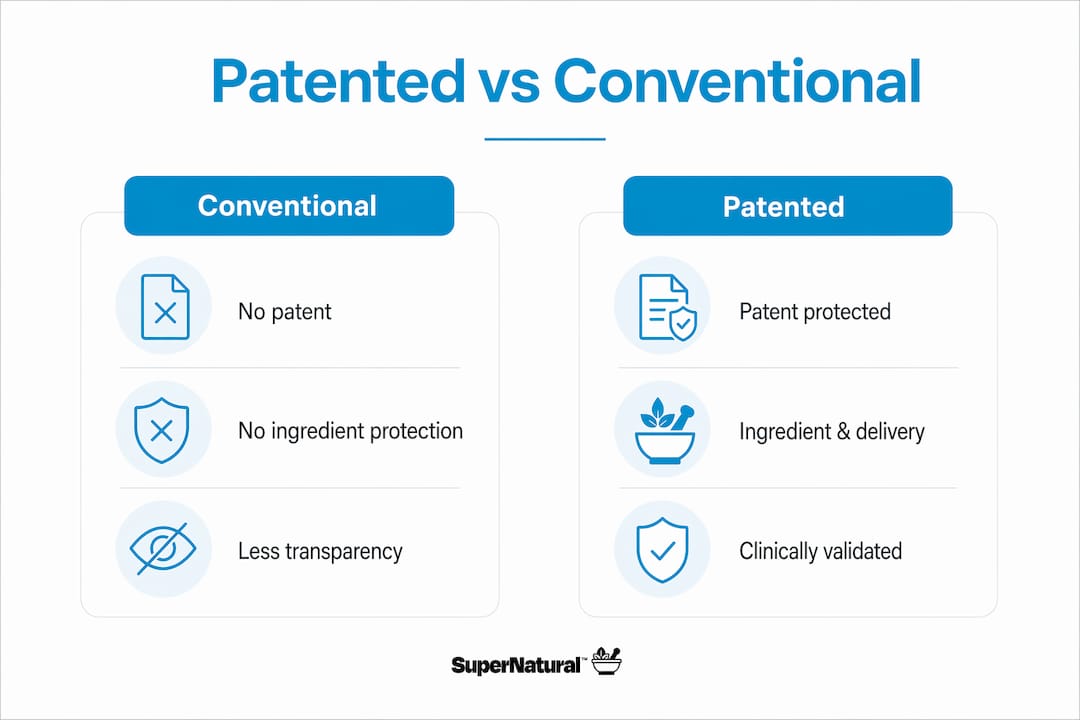
Clinical validation also separates these two categories. A patented supplement like SuperNatural Supplements’ BioSoluble® Curcumin™ must demonstrate measurable bioavailability improvements over standard curcumin to secure and defend its patent. Standard curcumin supplements face no such requirement. Think of it like wanting a strong cup of coffee instead of just sniffing the beans. The patent forces the developer to prove the cup is actually stronger.
Pro Tip: Check whether a supplement’s patent covers the ingredient itself or the delivery system. Delivery system patents are far more common and usually more meaningful for actual health outcomes. Learn more about supplement efficacy terms to read labels with confidence.
What are the common types of patents used in the dietary supplement industry?
Three patent types dominate the supplement space. Each protects a different aspect of the product, and the strongest intellectual property strategies use all three together.
-
Composition patents cover a specific combination of ingredients at defined ratios. If a company develops a blend of curcuminoids, piperine, and phospholipids at a particular concentration that produces a unique therapeutic effect, that exact composition can be patented. Competitors cannot copy that specific formula without infringing.
-
Method-of-use patents protect how a supplement is applied or administered. Method-of-use patents allow companies to secure IP even when the underlying compounds are widely available. For example, a company might patent the use of a known compound at a specific dose for a specific health application, such as supporting a healthy inflammatory response in a defined population.
-
Process patents cover the manufacturing or extraction technique. A novel fermentation process, a proprietary solubilization method, or a specific encapsulation technology can all qualify. SuperNatural Supplements’ BioSoluble Curcumin process is a clear example: the innovation is not the curcumin molecule itself but the patented method that makes it dramatically more bioavailable.
Layering composition, method-of-use, and process claims in a single patent portfolio increases protection against competitor design-arounds. A competitor who avoids the composition patent by changing a ratio might still infringe the process patent. That layered defense is what separates a well-protected supplement brand from one that can be copied within months of launch.
One critical caution applies to all three types. Patent claims that use language too close to disease treatment can trigger FDA scrutiny and risk reclassification of the product as a drug. Supplement patents favor structure-function language (“supports a healthy inflammatory response”) over disease treatment language (“treats arthritis”). The distinction is not just legal strategy. It determines whether your product stays on a supplement shelf or faces the full drug approval process.
What is the international patent process for dietary supplements?
Filing a patent in the United States protects your formulation only within U.S. borders. For supplement companies with global ambitions, the Patent Cooperation Treaty (PCT) is the standard path to international coverage.
Here is how the PCT process works in practice:
- Single application, multiple countries: One PCT application filed through the World Intellectual Property Organization (WIPO) preserves your rights in over 150 member countries simultaneously.
- 30-month delay on national filings: The PCT system delays national-level filings for up to 30 months from the original priority date. That window gives companies time to test commercial viability before committing to the high cost of individual national filings.
- International search report: The PCT process includes an international search that identifies prior art across global patent databases. This report helps applicants refine their claims before entering expensive national phases.
- Staggered investment: Instead of paying filing fees in 20 countries upfront, companies can prioritize the markets that show the strongest commercial potential after the 30-month window.
The 30-month delay is more valuable than it sounds. A supplement company can launch in its home market, gather sales data and consumer feedback, and then decide which international markets justify the cost of national patent prosecution. That approach reduces financial risk significantly for emerging brands. The challenge is that patentability criteria vary by country. What qualifies as a marked difference in the United States may face a different standard in the European Patent Office or in Asian markets. Companies pursuing international protection for patented dietary formulas need legal counsel familiar with each target jurisdiction. Understanding supplement innovation strategy is the first step toward making those decisions well.
Key takeaways
Patented supplements are legally protected formulations that require demonstrated novelty, measurable bioavailability improvements, and public scientific disclosure to qualify for up to 20 years of exclusive rights.
| Point | Details |
|---|---|
| Patent eligibility requires proof | Natural ingredients alone do not qualify; formulas must show a marked, measurable difference. |
| Three patent types matter | Composition, method-of-use, and process patents each protect a different layer of the product. |
| Transparency is built in | Patent law requires public disclosure, giving consumers access to the supporting science. |
| International protection takes strategy | The PCT system delays national filings by up to 30 months, allowing market testing before full commitment. |
| Delivery systems drive value | Most supplement patents cover the delivery method or manufacturing process, not the raw ingredient. |
Why patents in supplements are more nuanced than most people realize
We have spent years working at the intersection of supplement formulation and patent strategy, and the most common misconception we encounter is this: people assume the patent covers the ingredient. It almost never does. Protection focuses on delivery systems, specific ratios, or manufacturing methods, not the raw botanical or nutrient itself.
That distinction changes how you should evaluate any patented supplement. The question is not “is curcumin patented?” The question is “what specific process makes this curcumin absorb better, and is that process protected?” When we developed BioSoluble® Curcumin™, the entire value proposition rested on the solubilization method, not the curcumin molecule. That is where the science lives, and that is what the patent protects.
We also see founders make a costly mistake by ignoring method-of-use patents. Failing to secure method-of-use patents is one of the most common errors in supplement IP strategy. A competitor can reformulate around a composition patent. They cannot easily reformulate around a well-drafted method-of-use claim that ties the product to a specific health application.
One more thing worth saying plainly: a patent is not a health claim. It is a legal document. Always read the actual patent claims, not just the marketing copy. And always check with a doctor before adding any supplement to your health routine, patented or otherwise.
SuperNatural Supplements and the science behind patented formulas
SuperNatural Supplements built its product line around one core principle: a supplement that does not absorb is a supplement that does not work.
That principle is why every SuperNatural formula centers on patented delivery technology. BioSoluble® Curcumin™ uses a proprietary solubilization process that delivers significantly enhanced bioavailability compared to standard curcumin. BodyControl supports detoxification and a healthy inflammatory response. BodyBoost is formulated for superior immune support, and BrainBoost targets advanced cognitive health. Each product reflects the same commitment: patented processes, validated science, and full transparency about what you are putting in your body. For anyone serious about patented curcumin benefits, SuperNatural is the place to start.
FAQ
What are patented supplements, exactly?
Patented supplements are dietary formulas or delivery technologies that hold legal protection from the USPTO or equivalent international bodies. Protection covers the specific formulation, process, or application, not the raw ingredient alone.
How long does patent protection last for a supplement?
A utility patent grants exclusive rights for up to 20 years from the filing date. After that period, the formulation enters the public domain and competitors may legally replicate it.
Can a natural ingredient be patented?
Natural ingredients in their original form cannot be patented. A formulation qualifies only when it demonstrates a marked difference from the natural state, such as significantly improved bioavailability or a novel synergistic effect.
What is the difference between a composition patent and a process patent?
A composition patent protects a specific ingredient blend at defined ratios. A process patent protects the manufacturing or extraction method used to create the supplement, regardless of the final ingredient list.
Why does the PCT matter for supplement companies?
The PCT allows a single international application to preserve patent rights in over 150 countries while delaying national filings for up to 30 months. That delay gives companies time to validate commercial demand before committing to expensive country-by-country prosecution.
This article is provided for educational and informational purposes only and does not constitute providing medical advice or professional services. Always consult with a qualified and licensed physician or other medical care provider. Statements have not been evaluated by the Food & Drug Administration. This product is not intended to diagnose, treat, cure, or prevent any disease.