

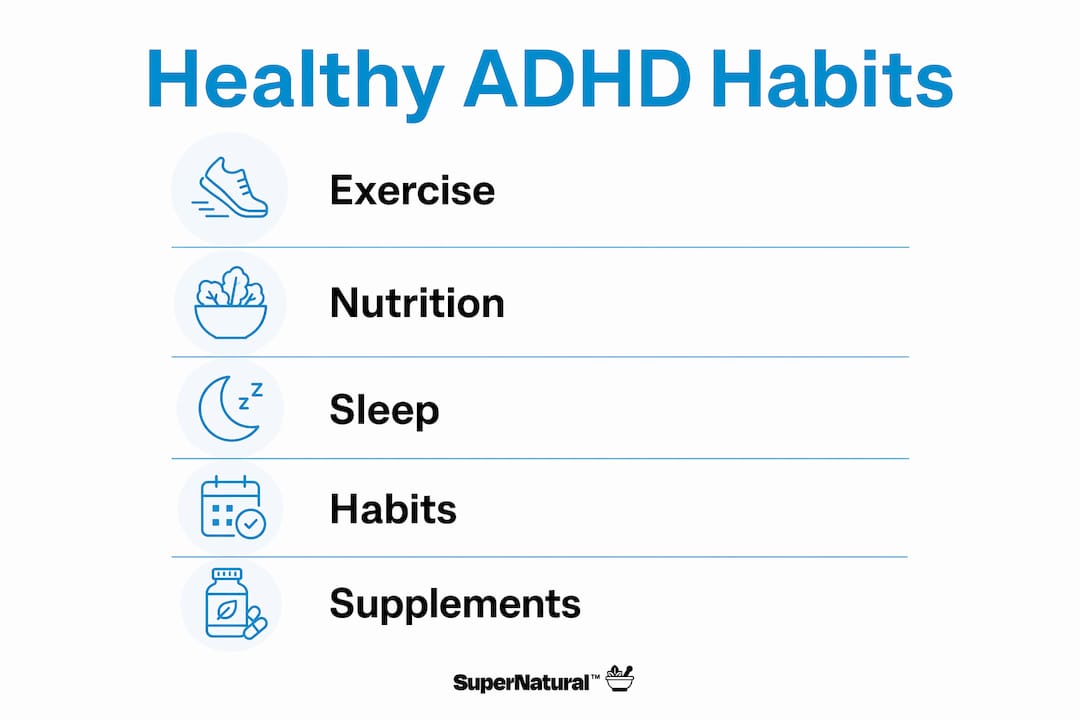
A balanced lifestyle built around exercise, nutrition, sleep, and targeted natural supplements is one of the most effective non-pharmacological approaches to managing ADHD symptoms. Research consistently shows that lifestyle changes improve ADHD functioning across all age groups, a position supported by clinical practice guidelines and researchers like Dr. Joel Nigg, whose work on epigenetics confirms that daily habits can influence how strongly ADHD genes express themselves. The goal is not a dramatic overhaul. Small, sustainable changes, stacked deliberately, produce real results.
Here is what a practical ADHD lifestyle plan covers:
- Exercise: Short, varied bursts of physical activity that sharpen focus and mood
- Nutrition: Brain-supportive foods rich in omega-3s, lean protein, and micronutrients
- Habit building: ADHD-specific motivation strategies that work with your brain, not against it
- Natural supplements: Targeted formulations to support cognition and a healthy inflammatory response
- Sleep and routine: Consistent schedules that regulate attention and emotional control
- Stress management, time skills, and environment: The structural supports that hold everything together
Table of Contents
- 1. Exercise strategies that actually work for ADHD brains
- 2. Nutrition tips that support focus and mood in ADHD
- 3. How to build habits when your brain resists routine
- 4. Natural supplements that support ADHD cognition and inflammation
- 5. Why sleep and routine are non-negotiable for ADHD
- 6. A note on using this guide responsibly
- 7. Stress management techniques tailored for ADHD
- 8. Time management and organizational skills as part of your lifestyle
- 9. Environmental modifications that improve focus and reduce distractions
- 10. Social support and community engagement for ADHD management
- Key Takeaways
1. Exercise strategies that actually work for ADHD brains
Physical activity is one of the most direct tools available for ADHD symptom support. Exercise improves executive functioning, attention, and working memory by promoting neuroplasticity and brain efficiency, with the most dramatic changes occurring in exactly the regions ADHD affects most.
You do not need a full hour at the gym. Multiple short bursts (e.g., several 15-minute sessions) of moderate to vigorous activity produce the same cognitive benefits as one uninterrupted hour, which makes it far easier to fit into an ADHD schedule. The key is that activity should be moderate to vigorous, meaning you are breathing hard but not exhausted.
- Prioritize activities that combine coordination and muscle learning: martial arts, basketball, and dance show particular benefits for ADHD brains
- Work out with a friend or family member to increase consistency
- Aerobic exercise helps regulate dopamine by raising heart rate and releasing key brain chemicals
- Exercising before taking ADHD medication can enhance the medication’s effect
Pro Tip: Pick an activity you genuinely enjoy. ADHD motivation is driven by interest, not obligation. If you love the activity, you will keep showing up.
2. Nutrition tips that support focus and mood in ADHD
Diet shapes brain chemistry in ways that directly affect attention and impulse control. The brain is largely composed of fat, and the fatty cells surrounding neurons depend on omega-3 fatty acids for strong signal transmission. Beyond omega-3s, micronutrients like zinc, iron, and vitamin D play a critical role in brain signaling, and deficiencies in these nutrients are linked to poorer focus and impulse control in people with ADHD.
Micronutrient note: Zinc, iron, and vitamin D deficiencies are common in people with ADHD and are directly linked to reduced attention and impulse control. Ask your doctor about a simple blood test before starting any supplementation.
Practical nutrition for ADHD management starts with variety and consistency:
- Aim to include at least five portions of fruits and vegetables daily, choosing a range of colors
- Include lean proteins at every meal (chicken, eggs, fish, lentils) for sustained energy and satiety
- Limit sugar, salt, and saturated fats, which can destabilize mood and focus
- Add cold-water fish or a fish oil supplement regularly to support omega-3 intake
- Shop the outer edges of the grocery store to naturally reduce processed food intake
Nutrition, exercise, and sleep reinforce each other. Nutritious food fuels more intense workouts; intense workouts prepare the body for deeper, more restorative sleep.
3. How to build habits when your brain resists routine
Executive dysfunction is the core obstacle to habit formation in ADHD. It disrupts the brain’s ability to manage thoughts, emotions, and actions, making it easy to set a goal and nearly impossible to follow through consistently. The good news is that specific strategies work reliably with how the ADHD brain is wired.
Habit stacking attaches a new behavior to an existing routine, using the established habit as an anchor. Want to take a supplement every morning? Stack it onto making coffee. The new behavior borrows the momentum of the old one. Pair this with the 1% rule: instead of overhauling your diet overnight, prep one healthy dinner per week, then two, then three.
- Use visual cues: sticky notes on mirrors, whiteboard goals, app reminders on your home screen
- Try the Five-Minute Rule when facing task paralysis: commit to just five minutes, then reassess
- Body doubling (working alongside another person, even virtually) improves accountability and follow-through
- Reward consistency, not perfection; showing up imperfectly still counts
Perfectionism is a common trap. Giving yourself permission to do a “good enough” job prevents the task paralysis that kills momentum. Habit formation for ADHD typically takes months, not weeks, so self-compassion is not optional.
Pro Tip: ADHD motivation responds to fun. If a habit feels like a chore, redesign it until it feels like something you actually want to do.
4. Natural supplements that support ADHD cognition and inflammation
Natural supplements work best as complements to lifestyle changes and professional care, not as replacements for medication or therapy. That said, the right formulation can meaningfully support cognitive function and a healthy inflammatory response, two areas where ADHD creates ongoing challenges.
SuperNatural Supplements developed a patented process called BioSoluble Curcumin, which delivers significantly enhanced bioavailability compared to standard curcumin. Standard curcumin is poorly absorbed by the body, like wanting a strong cup of coffee but only getting to sniff the beans. BioSoluble Curcumin solves that absorption problem at the molecular level.
- BrainBoost is formulated for advanced cognitive support, targeting focus, mental clarity, and the brain health demands associated with ADHD
- BodyControl promotes detoxification and a healthy inflammatory response, addressing the neuroinflammatory component that can worsen ADHD symptoms
- BodyBoost supports immune function, keeping the body resilient so that illness does not derail hard-won routines
Pro Tip: Always consult your doctor before adding any supplement to an existing ADHD treatment plan. Supplements work best when they complement, not compete with, your prescribed care.
5. Why sleep and routine are non-negotiable for ADHD
Poor sleep and ADHD create a feedback loop that is hard to break. Sleep quality directly affects mood regulation, daytime attention, and executive function. Adults with ADHD frequently experience delayed sleep timing, difficulty falling asleep, and daytime sleepiness regardless of how many hours they log.
Building a consistent sleep routine is the most reliable fix. The power lies in repetition: when you do the same things every night before bed, your body begins to associate those activities with calm, restorative sleep.
- Avoid screens for at least 60 minutes before bed; blue light suppresses melatonin production
- Set a fixed wake time and stick to it, even on weekends
- Keep your bedroom cool, dark, and quiet; blackout curtains and white noise machines help
- Avoid caffeine after noon and skip daytime naps
- Melatonin supplements can help older teens and adults reset their circadian rhythm, but take it a few hours before sleep, not right before lying down, and always check with your doctor first
6. A note on using this guide responsibly
Natural supplements complement but do not replace medication or therapy in an ADHD treatment plan. When used thoughtfully alongside professional care, lifestyle changes may reduce symptom burden and support a better quality of life.
7. Stress management techniques tailored for ADHD
ADHD amplifies stress because the same executive dysfunction that makes tasks hard also makes it hard to regulate the emotional response to those tasks. Stress management for ADHD works best when it is built into the daily structure rather than treated as a separate practice.

Mindfulness techniques adapted for ADHD favor short, frequent check-ins over long meditation sessions. A two-minute breathing exercise before a difficult task, progressive muscle relaxation at bedtime, or a brief body scan during a work break all lower cortisol without requiring extended focus. Physical activity, as covered earlier, also functions as a direct stress regulator by raising dopamine and norepinephrine levels.
Journaling is underused as a stress tool for ADHD. Writing a brief to-do list earlier in the day reduces nighttime rumination, a common ADHD sleep disruptor. Externalizing worries onto paper frees working memory for the task at hand.
8. Time management and organizational skills as part of your lifestyle
Time blindness, the difficulty in sensing how much time has passed, is one of the most disruptive ADHD traits in daily life. You may know what needs doing but consistently misjudge how long it will take or how to sequence tasks across a day.
Analog tools often outperform digital ones for ADHD time awareness. An hourglass or a visible analog clock makes the passage of time tangible in a way that a phone timer does not. Time-blocking planners that divide the day into labeled segments give the ADHD brain a concrete map rather than an abstract schedule.
- Use digital calendars with layered reminders for appointments and deadlines
- Break large projects into micro-steps and assign each step its own time block
- Set a brief planning session at the start of each day to prioritize three “must-do” items
- Learn to say no: the more you take on, the harder it becomes to do any of it well
Staying organized with ADHD is less about willpower and more about designing systems that reduce the number of decisions your brain has to make.
9. Environmental modifications that improve focus and reduce distractions
Your physical environment either supports or undermines your attention, and for ADHD brains, the effect is magnified. A low-distraction workspace reduces the cognitive load required to stay on task, freeing mental resources for the work itself.
Clear your desk of everything unrelated to the current task. Avoid facing a window or a busy hallway. Noise-canceling headphones are one of the most practical investments for ADHD focus, blocking auditory distractions without requiring willpower. If you work from home, designate a specific area for focused work and keep it consistent so your brain learns to associate that space with concentration.
Visual organization matters too. Files, labeled bins, and planners keep important items visible and accessible, countering the ADHD tendency toward “out of sight, out of mind.”
10. Social support and community engagement for ADHD management
Strong social support is one of the most underutilized tools in ADHD management. Peer accountability, shared strategies, and the simple experience of being understood by others who face the same challenges all contribute to healthier habit adoption and better long-term outcomes.
ADDA (Attention Deficit Disorder Association) runs peer support groups specifically for adults with ADHD, including a Healthy Habits group focused on building exercise, nutrition, and sleep routines together. Body doubling, working alongside another person, is a formalized version of this principle and is consistently effective for ADHD task completion.
Community engagement also reduces the shame and isolation that often accompany ADHD. When you share the journey with people who get it, setbacks feel less catastrophic and progress feels more worth celebrating.
Key Takeaways
A balanced lifestyle combining exercise, nutrition, sleep, and targeted natural supplements is the most evidence-backed non-pharmacological approach to ADHD symptom management.
| Point | Details |
|---|---|
| Exercise in short bursts | Four 15-minute bursts of exercise equal the benefits of one hour for ADHD focus and mood. |
| Prioritize micronutrients | Zinc, iron, and vitamin D deficiencies worsen ADHD focus and impulse control; get levels tested. |
| Stack habits, not overhauls | Attach new behaviors to existing routines using habit stacking and the 1% incremental improvement rule. |
| Sleep routine over sleep duration | A consistent pre-bed routine and fixed wake time regulate ADHD mood and attention more reliably than hours alone. |
| Supplements complement care | Natural supplements like BrainBoost support cognition alongside, not instead of, professional ADHD treatment. |
This article is provided for educational and informational purposes only and does not constitute providing medical advice or professional services. Always consult with a qualified and licensed physician or other medical care provider. Statements have not been evaluated by the Food & Drug Administration. This product is not intended to diagnose, treat, cure, or prevent any disease.