

Cognitive fatigue is not a character flaw. It is a physiological reality that millions of professionals and students face every single day. If you have ever stared at a half-finished report, re-read the same paragraph three times, or hit a wall at 2 PM despite sleeping seven hours, you already know the problem. Understanding how to increase productivity with supplements means knowing which compounds are backed by real science, how to test them honestly, and how to set realistic expectations. This guide covers all of that, without the marketing hype.
Table of Contents
- Key takeaways
- Science-backed supplements for boosting productivity
- Establishing your baseline before starting supplements
- A step-by-step protocol for using supplements safely
- Troubleshooting why your supplements are not working
- Long-term strategies for sustaining your productivity gains
- My honest take on supplements and productivity
- Support your focus with Ordersupernatural’s formulas
- FAQ
Key takeaways
| Point | Details |
|---|---|
| Supplements support, not replace | Sleep, diet, and exercise are primary productivity drivers; supplements offer marginal but real gains on top. |
| Start with the basics | Vitamin B12, Vitamin D, and magnesium are worth testing first if you suspect a deficiency is draining your energy. |
| Track before you take | Establish a two-week baseline of your focus and output before introducing any supplement. |
| Test one at a time | Adding multiple supplements simultaneously makes it impossible to know what is actually working. |
| Bioavailability matters | The form and quality of a supplement determines how much your body actually absorbs and uses. |
Science-backed supplements for boosting productivity
Not every supplement on the shelf deserves a spot in your routine. The best supplements for productivity share one thing: evidence from human trials, not just cell cultures or rodent studies. Here is what the research actually supports.
Vitamin B12 and B-complex vitamins are foundational. They support the energy metabolism that keeps your neurons firing efficiently. That said, B12 supplementation primarily benefits those who are actually deficient. If your levels are normal, extra B12 will not turbocharge your focus. It is worth getting tested before spending money on high-dose formulas.
Vitamin D is different. Low vitamin D measurably depresses mood and reduces muscle strength, both of which drag productivity down. Given how many people work indoors under artificial light, deficiency is far more common than most assume.
Omega-3 fatty acids, particularly DHA (docosahexaenoic acid), are structural components of brain cell membranes. Consistent intake supports cognitive longevity, meaning the gains are slow but lasting. Think of DHA less like a pre-workout and more like long-term brain maintenance.
When it comes to natural productivity enhancers with strong cognitive evidence, these stand out:
- Creatine: Most people associate it with lifting weights, but creatine’s cognitive benefits are now confirmed in large-scale studies, including research from over 72,000 adults in the UK Biobank. It is particularly effective for people with low baseline creatine levels, such as vegetarians and vegans.
- Caffeine + L-theanine: This combination is arguably the most reliable cognitive tool available without a prescription. Caffeine and L-theanine together improve sustained attention while the L-theanine smooths out the anxious edge caffeine alone can create.
- Bacopa monnieri: A traditional Ayurvedic herb with solid clinical backing for memory and information processing. The important caveat: Bacopa takes 8 to 12 weeks of consistent use to show meaningful effects. It is not a same-day solution.
- Rhodiola rosea: An adaptogen that helps the body regulate the stress response. Useful if your productivity problems trace back to chronic stress and mental fatigue rather than simple lack of alertness.
- Lion’s mane mushroom: Promising for nerve growth factor support, though human evidence remains early-stage. Worth watching, but do not make it the centerpiece of your strategy yet.
Iron and magnesium round out the picture. Iron deficiency is one of the most common causes of fatigue, but supplementing without a confirmed deficiency can cause real harm, including organ damage from iron overload. Get tested first.
Pro Tip: If you are choosing between supplements for energy and focus, start with the caffeine plus L-theanine combination. It delivers measurable effects within the same session, which makes it easier to evaluate whether it is actually working for you.

Establishing your baseline before starting supplements
The biggest mistake people make when trying to improve work efficiency with supplements is skipping this step entirely. Without a baseline, you have no way to know whether that new nootropic is working, whether the placebo effect is doing the heavy lifting, or whether your focus improved simply because you started going to bed 30 minutes earlier.
Objective tracking before introducing nootropics is the difference between a controlled experiment and wishful thinking. Here is a straightforward protocol to get you started:
- Track focus session length for two weeks. Use a simple timer or an app like Toggl. Log how long you can sustain deep work before your attention breaks.
- Record output quality, not just quantity. Note how many tasks you completed to your own standard, not just how many you touched.
- Log interruptions and mental fatigue checkpoints. Note the time of day when your focus tends to drop. Patterns matter.
- Rate your energy on a 1-to-10 scale each afternoon. This gives you a consistent marker to compare against once you introduce a supplement.
- Audit your lifestyle foundations. Before adding anything to your regimen, honestly assess your sleep consistency, diet quality, and whether you are exercising at least three times a week. Supplements are marginal optimizations built on top of these pillars, not replacements for them.
After two weeks, you will have a real data set. Some people discover their productivity problems were rooted in poor sleep or skipped meals all along. That is valuable information. Others confirm that their foundations are solid and there is room for targeted supplementation to push performance further.
Pro Tip: Behavioral tracking alone often improves productivity, independent of any supplement. The act of measuring focus creates awareness that naturally reduces distraction. Treat the tracking phase as an intervention in itself.
A step-by-step protocol for using supplements safely
Once you have your baseline data, you are ready to introduce supplements systematically. The keyword is systematically. Stacking five new compounds at once tells you nothing useful. Here is a structured protocol.
-
Week 1 to 2: Start with caffeine plus L-theanine. A common starting ratio is 100mg caffeine to 200mg L-theanine, taken in the morning. Compare your tracked focus scores against your baseline. If you notice genuine improvement without side effects, you have your first confirmed tool.
-
Week 3 to 6: Add Bacopa monnieri. Standard doses range from 300 to 450mg daily of a standardized extract. Set your expectations correctly here. Bacopa is not an acute booster. You will not feel it on day one. Commit to consistent daily use and re-evaluate at the eight-week mark.
-
Week 7 onward: Consider an adaptogen if stress is a factor. If your tracking reveals that your focus collapses during high-pressure periods specifically, an adaptogen like Rhodiola rosea or Ashwagandha may address the root cause. B-complex vitamins and adaptogens are particularly relevant for burnout-driven fatigue, according to integrative medicine recommendations.
-
Allow a minimum 2 to 4 weeks per supplement. Changing variables before you have collected sufficient data defeats the purpose. Patience is not optional here. It is methodology.
-
Consult a healthcare provider before starting anything new. This matters most if you are on medications, managing a chronic condition, or considering high-dose protocols. Supplements can interact with prescription drugs in ways that are easy to underestimate.
“The goal of supplementation is not to feel different on day one. It is to measure whether you are performing measurably better over four to eight weeks of consistent, tracked use.”
For deeper guidance on choosing supplements for cognition, the science behind what makes certain compounds effective is worth understanding before you spend money.
Troubleshooting why your supplements are not working
You followed the protocol. You tracked your data. And yet nothing seems to have changed. Before assuming the supplement is useless, run through these common pitfalls.
- Placebo and nocebo effects are real. Studies consistently show that people who expect a supplement to work report improvements, and people who are skeptical report nothing, even when taking the same compound. Objective data from your tracking phase is the only reliable filter.
- Lifestyle foundations were not in place. If you are averaging five hours of sleep and surviving on processed food, no supplement will compensate for that deficit. Trying to boost productivity with vitamins while ignoring sleep is like adding premium fuel to a car with a cracked engine block.
- You tested too many things at once. If you added three new supplements in week one, you cannot attribute any change, positive or negative, to a specific compound.
- The dosage or form was wrong. Supplement quality and bioavailability vary dramatically between products. A poorly absorbed form of magnesium, for instance, will do very little compared to a highly bioavailable chelated form. This is not a minor detail. It is often the entire explanation for why a supplement appears to fail.
- Adverse effects can be subtle. Watch for signs like persistent headaches, digestive disruption, increased anxiety, or changes in sleep quality. Any of these warrant stopping the supplement and reassessing.
Signs you need to consult a professional: If you experience significant mood changes, cardiovascular symptoms, or have been supplementing with iron without a confirmed deficiency, see a doctor. High-dose iron without deficiency risks organ damage and can paradoxically worsen fatigue. Accurate testing before supplementation is not optional with iron. It is mandatory.
Long-term strategies for sustaining your productivity gains
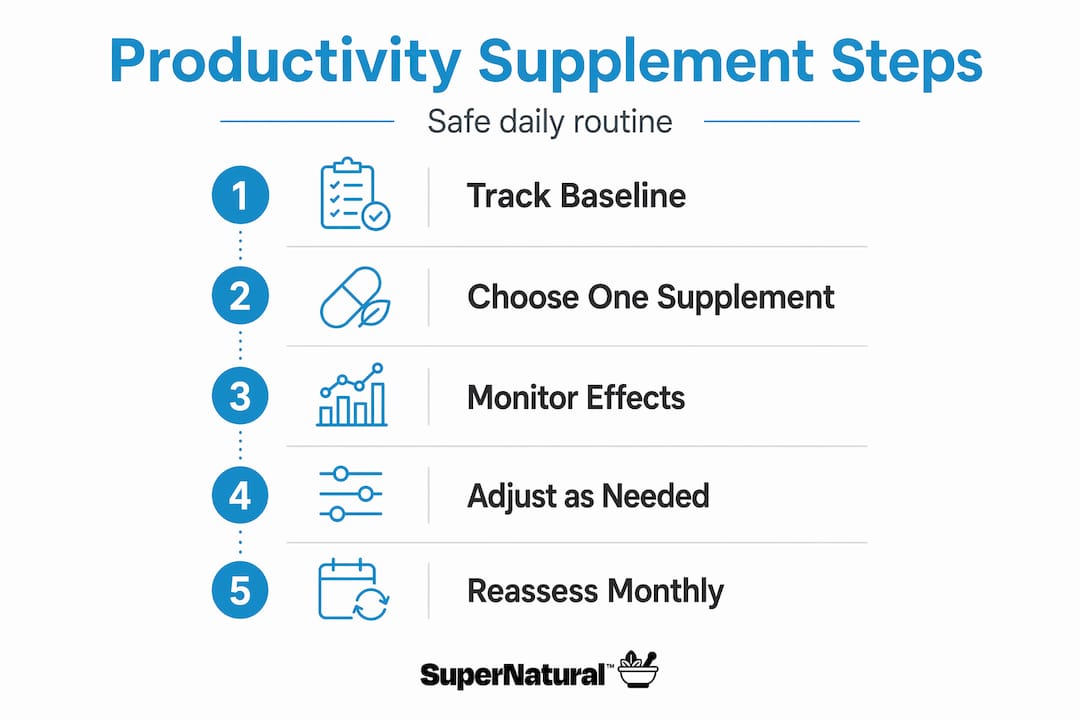
Sustaining the gains you build through supplementation requires treating your protocol as a living system, not a one-time setup. Here is how short-term and long-term approaches compare:
| Strategy | Short-term focus | Long-term focus |
|---|---|---|
| Supplementation | Test and confirm one compound at a time | Cycle or adjust based on changing demands and data |
| Diet | Eliminate obvious nutrient gaps | Shift toward a Mediterranean-style diet for brain health |
| Exercise | Establish a consistent baseline routine | Progress intensity to sustain neurochemical benefits |
| Sleep | Prioritize consistent sleep timing | Optimize sleep quality with environment and habits |
| Stress management | Use adaptogens for acute high-pressure periods | Develop sustainable mindfulness or recovery practices |
| Supplement quality | Choose reputable brands with third-party testing | Prioritize bioavailable supplement forms for lasting efficacy |
Re-assess your tracked metrics every four to six weeks. If a supplement that worked well for three months no longer moves the needle, that is meaningful data. Needs change with seasons, workloads, stress levels, and age.
Mental health deserves a direct mention here. Chronic anxiety and unmanaged stress blunt cognitive function more reliably than any nutrient deficiency. Supplements can support the stress response, but they cannot replace therapy, boundaries, or genuine recovery time. Build those into your system with the same seriousness you bring to your supplement protocol.
My honest take on supplements and productivity
I have spent years observing how professionals and students respond to supplement protocols, and I will tell you plainly: the biggest transformations almost never come from a new pill. They come from the tracking itself.
When someone starts measuring their focus sessions honestly, they suddenly see that their worst productivity days follow nights under six hours of sleep, not nutrient gaps. That awareness alone tends to create change. The supplement then works on top of an improved baseline, and the gains feel significant because they are layered, not because a single compound did all the work.
What I have learned is that the people who get the most out of top nootropics for productivity are the ones who treat them like tools in a toolbox, not magic. They use creatine or Bacopa because the data supports it and because their lifestyle earns it. They do not use supplements to compensate for skipped meals or chronic sleep debt.
My honest recommendation: get your foundations locked in first. Then add one evidence-backed supplement at a time, track your results, and let the data guide you. Modest, measurable improvements compound over months into something genuinely meaningful.
— SuperNatural
Support your focus with Ordersupernatural’s formulas
If your foundations are solid and you are ready to add targeted supplementation, Ordersupernatural has built formulas specifically for this stage.
BrainBoost is Ordersupernatural’s advanced cognitive support formula, designed for professionals and students who need sustained mental energy and focus under pressure. For those dealing with inflammation-related fatigue that dulls cognitive performance, Ordersupernatural’s patented BioSoluble® Curcumin™ delivers significantly better absorption than standard curcumin. And BodyBoost supports immune function and energy, helping you stay consistent during high-stress periods when your productivity protocol is most at risk of breaking down. These are not shortcuts. They are precision tools for people who have already done the foundational work.
FAQ
What are the most effective supplements for productivity?
Caffeine plus L-theanine, creatine, and Bacopa monnieri have the strongest evidence for cognitive performance and focus. Vitamin D and B12 are effective only if you are deficient in those nutrients.
How long do supplements take to improve focus?
It depends on the compound. Caffeine plus L-theanine works within the same session, while Bacopa monnieri requires 8 to 12 weeks of consistent use to show measurable memory improvements.
Can you increase productivity with vitamins alone?
Vitamins like B12 and D can restore energy and focus if a deficiency is the underlying cause, but they are unlikely to enhance performance beyond your normal baseline in someone who is already nutritionally replete.
How do I know if a supplement is actually working?
Track your focus sessions and energy levels for two weeks before starting any supplement, then compare your data objectively after four to six weeks of consistent use. Subjective impressions alone are unreliable.
Is it safe to take multiple productivity supplements at once?
Starting multiple supplements simultaneously makes it impossible to identify what is working or causing side effects. Introduce one supplement at a time, allow two to four weeks of data collection, and consult a healthcare provider before combining compounds.
This article is provided for educational and informational purposes only and does not constitute providing medical advice or professional services. Always consult with a qualified and licensed physician or other medical care provider. Statements have not been evaluated by the Food & Drug Administration. This product is not intended to diagnose, treat, cure, or prevent any disease.