

Brain health is the state of functioning across cognitive, sensory, social-emotional, behavioral, and motor domains that allows you to realize your full potential throughout life. Two things follow from that definition: first, no single supplement addresses all of it; second, the words on a product label matter enormously. SuperNatural Supplements builds its formulas around that reality, which is why understanding the terminology is the right starting point before you buy anything.
- Evidence first: Look for ingredients with published clinical trials, not just wellness language like “supports clarity.”
- Lifestyle is the foundation: Sleep, exercise, and diet have stronger evidence than any supplement category.
Table of Contents
- What do brain health terms actually mean?
- Why precise terminology matters when you shop
- What does the evidence actually say about common ingredients?
- How to evaluate any brain-health supplement
- Supplements are supportive, not the whole strategy
- How SuperNatural Supplements approaches brain health
- Ready to try a supplement? Here is a practical trial plan
- Key Takeaways
- The case for evidence-forward supplement choices
- BrainBoost: a tested starting point for cognitive support
- Useful sources and further reading
What do brain health terms actually mean?
The industry uses a cluster of overlapping terms that sound interchangeable but carry distinct meanings. Researchers have flagged this fragmentation as a barrier to clear consumer communication, and a CDC-commissioned scoping review found that even clinical researchers rarely define their terms consistently.
- Brain health (umbrella): per the WHO definition, covers all brain-driven functions across the lifespan — thinking, emotion, movement, sensation, and social behavior.
- Cognitive health (subset): the National Institute on Aging defines it specifically as the ability to think, learn, and remember clearly. It is one component of the broader brain health umbrella.
- Nootropic: a marketing and research term for any substance claimed to support cognitive performance in healthy people. No FDA-regulated definition exists; the word appears on labels without a required evidence threshold.
- Neuroprotective: describes a substance or intervention that may reduce neuronal damage or slow decline. Clinical use is specific (e.g., certain stroke medications); supplement marketing applies it loosely.
- Neuroresilience: wellness language for the brain’s capacity to adapt and recover. You will not find a clinical endpoint called “neuroresilience” in most trial registries.
- Memory vs. focus vs. mental clarity: three distinct cognitive domains. Memory involves encoding and retrieval; focus (attention) involves sustained concentration; clarity is a subjective, consumer-facing term with no standard clinical measure.
Marketing translation example: A label reading “supports focus” is a structure/function claim under U.S. law. It does not mean a randomized controlled trial measured attention scores. “Clinically shown to improve working memory in adults” should cite a specific published trial — if no citation appears, treat the claim as unverified.
Why precise terminology matters when you shop
Vague language costs you money and, potentially, your health. The American Academy of Neurology’s Brain Health Initiative frames neurologists as preventive specialists — meaning even clinicians are now focused on upstream language precision, not just reactive diagnosis.
Red flags on a supplement label:
- “Proprietary blend” with no individual ingredient doses listed
- “Clinically proven” with no trial citation or link
- Claims that a product “prevents,” “treats,” or “cures” any condition (illegal for dietary supplements under FDA rules)
- No third-party testing seal (USP, NSF International, or ConsumerLab)
Trust signals to look for:
- Published trial citations with a DOI or PubMed link
- Certificate of Analysis (CoA) from an independent lab
- Transparent serving size and per-ingredient dosing
- Realistic, scoped claims (“may support attention in healthy adults”)
Pro Tip: When a label says “clinically shown,” paste the cited study title into PubMed (pubmed.ncbi.nlm.nih.gov). Check whether the study used the same ingredient form, dose, and population as the product you are considering. A trial on elderly patients with deficiency does not validate a claim for healthy adults.
What does the evidence actually say about common ingredients?

Systematic reviews consistently find that no single supplement prevents Alzheimer’s disease or cognitive decline universally. Evidence is ingredient-specific, dose-specific, and population-specific.
| Ingredient | Evidence Level | Typical Dose Range | Key Context |
|---|---|---|---|
| Omega-3 (DHA/EPA) | Moderate | typical doses studied vary | Strongest benefits seen in populations with low baseline intake or deficiency |
| B vitamins | Moderate | doses vary by form | Benefit seen in people with elevated homocysteine or deficiency |
| Citicoline | Moderate | doses in trials vary | Some trials show improved attention in certain contexts |
| Bacopa monnieri | Limited | doses studied vary | Some memory benefits shown after consistent use over weeks |
| Ginkgo biloba | Limited/Insufficient | doses studied vary | Large trials do not show significant prevention of dementia |
| Curcumin | Limited–Moderate | doses vary by formulation | Bioavailability is the central challenge; standard curcumin absorbs poorly |
| Lion’s mane (Hericium erinaceus) | Limited | doses studied vary | Early human trials show promise; larger randomized controlled trials are needed |
| Caffeine + L-theanine | Moderate | doses vary | Consistent short-term attention and reaction-time effects |
| Multivitamin combinations | Limited | doses per product label | Some trials suggest modest benefit in older adults over several years |
The U.S. regulatory context shapes all of this. The FDA does not pre-approve dietary supplements for efficacy before they reach store shelves. Manufacturers are responsible for label accuracy and must include a disclaimer that their structure/function claims have not been evaluated by the FDA. That means the burden of verification falls on you as the consumer. For a deeper look at curcumin’s evidence base, SuperNatural Supplements has published a detailed breakdown.
How to evaluate any brain-health supplement
Use this checklist at the product page before you add anything to your cart.
- Verify the ingredient and its form. “Curcumin” and “curcumin phytosome” are not the same thing. The form determines absorption.
- Check the dose against published trials. A dose far below what trials used is unlikely to replicate trial outcomes.
- Assess bioavailability. Standard curcumin, for example, absorbs poorly without a delivery technology. Look for patented forms or bioavailability data.
- Look for third-party testing. USP, NSF International, and ConsumerLab verify label accuracy and screen for contaminants.
- Confirm transparent sourcing and manufacturing. GMP-certified facilities and disclosed ingredient origins are baseline quality signals.
- Screen for interactions. Ginkgo and omega-3 can potentiate anticoagulants. Citicoline may interact with cholinesterase inhibitors. Always discuss new supplements with your physician if you take prescription medications.
- Check for realistic claims. Any product promising to “reverse” cognitive decline or “cure” brain fog is making an illegal claim under FDA rules.
Pro Tip: On a Supplement Facts panel, check whether the dose shown is per capsule or per serving (which may be two or three capsules). “Proprietary blend 500 mg” tells you nothing about how much of any single ingredient you are actually getting.
For a broader look at where supplements fit in a wellness plan, the SuperNatural Supplements blog walks through the decision framework in plain language.
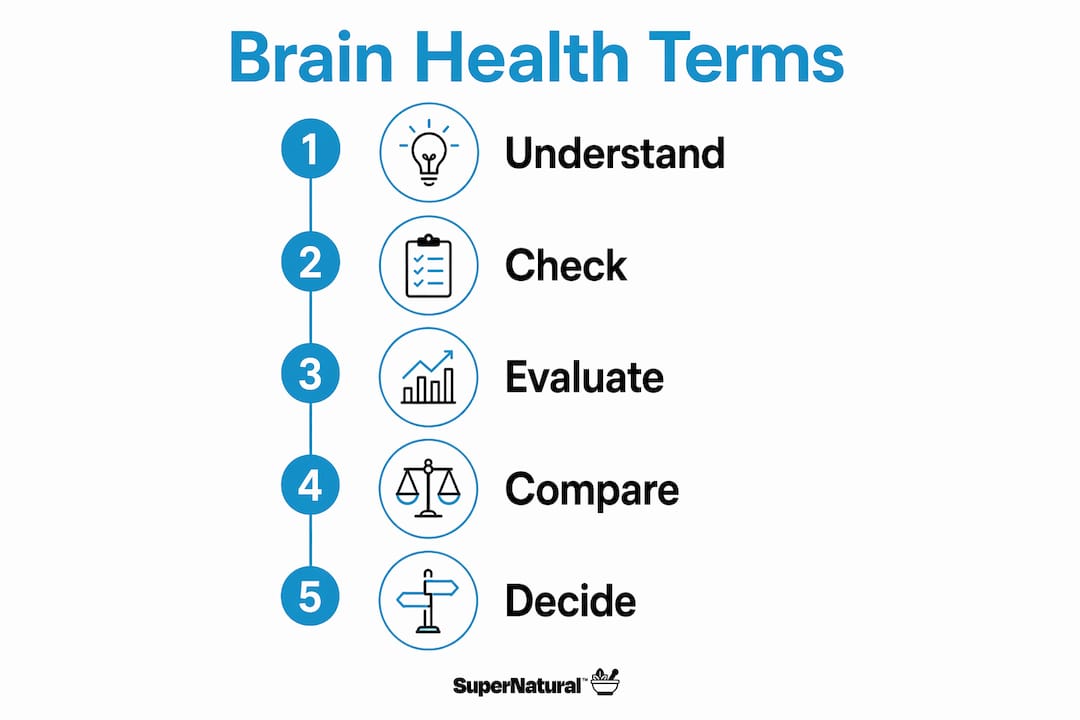
Supplements are supportive, not the whole strategy
The NIA’s SPRINT MIND trial linked midlife blood-pressure control to lower risk of later cognitive impairment. The ACTIVE trial showed cognitive training produced durable benefits in reasoning and processing speed over a decade. McKinsey’s analysis of brain health interventions concludes that preventive, upstream approaches deliver the best long-term outcomes when implemented early.
Lifestyle priorities with the strongest evidence:
- Sleep: a consistent healthy duration; sleep is when the brain clears metabolic waste via the glymphatic system
- Blood pressure control: controlling midlife hypertension is important to reduce dementia risk
- Aerobic exercise: increases BDNF (brain-derived neurotrophic factor) and supports hippocampal volume
- Mediterranean or MIND dietary patterns: observational evidence is strong; trial evidence is mixed but directionally positive
- Cognitive training: clinical trials demonstrate preservation of reasoning and processing speed over years in older adults
- Social engagement: linked with lower dementia risk in observational studies
Supplements become most useful when they fill a documented nutritional gap (B12 deficiency, low omega-3 intake) or deliver a bioactive compound at a dose diet alone cannot provide. They are not a substitute for the lifestyle pillars above. For step-by-step brain-supporting habits, SuperNatural Supplements has a practical guide grounded in the same evidence base.
How SuperNatural Supplements approaches brain health
SuperNatural Supplements built its BrainBoost formula around a core problem the evidence table above makes clear: bioavailability. Standard curcumin passes through the digestive system largely unabsorbed, like wanting a strong cup of coffee and only getting to sniff the beans. The patented BioSoluble® Curcumin™ process addresses that directly, delivering curcuminoids in a form the body can actually use.
- BrainBoost is formulated for advanced cognitive support, with ingredient selection guided by the same evidence-level framework outlined in this article.
- BioSoluble® Curcumin™ uses a patented delivery process to significantly enhance absorption compared to standard curcumin, addressing the bioavailability gap that limits most curcumin products.
- Transparency: SuperNatural Supplements publishes educational content and supports access to product documentation so you can verify what you are taking.
Pro Tip: When comparing curcumin products, ask whether the brand uses a patented absorption technology and whether bioavailability data exists. A higher milligram count on a standard curcumin label often delivers less active compound than a lower-dose bioavailable form.
Ready to try a supplement? Here is a practical trial plan
Before you start, define your goal and screen for contraindications.
- Define your goal: focus and attention, memory support, or general neuroprotection? Your goal determines which ingredients are relevant.
- Screen for contraindications: review your current medications with a pharmacist or physician before adding any new supplement.
- Apply the evaluation checklist from Section 5 to any product you are considering.
- Start a monitored trial: commit to 8–12 weeks, the minimum window for most cognitive ingredients (especially bacopa) to show measurable effects.
What to track during your trial:
- Sleep quality and duration (a sleep log or wearable)
- Subjective mood and energy (a simple 1–10 daily rating)
- Objective task performance (timed reading, a free cognitive app like Cambridge Brain Sciences)
- Any side effects, even mild ones
Stop and consult a clinician if you experience: unusual headaches, GI distress that persists beyond two weeks, mood changes, or any symptom that feels out of the ordinary. For a structured step-by-step process for integrating supplements with lifestyle habits, SuperNatural Supplements offers a detailed guide.
Key Takeaways
Precise brain health terminology is the foundation of smart supplement shopping: know the definitions, check the evidence level, and treat lifestyle as the non-negotiable baseline.
| Point | Details |
|---|---|
| Brain health vs. cognitive health | Brain health is the broad umbrella; cognitive health covers thinking, learning, and memory specifically. |
| Evidence is ingredient-specific | No supplement prevents Alzheimer’s universally; benefits depend on ingredient form, dose, and your health status. |
| Bioavailability determines effectiveness | Standard curcumin absorbs poorly; patented delivery technologies like BioSoluble® Curcumin™ address this gap directly. |
| Trial window matters | Most cognitive ingredients require 8–12 weeks of consistent use before effects are measurable. |
| SuperNatural Supplements | BrainBoost uses patented BioSoluble® Curcumin™ for enhanced absorption, with transparent ingredient sourcing and educational resources. |
The case for evidence-forward supplement choices
We believe the supplement industry does consumers a disservice when it leans on wellness language to sidestep the harder question: what does the clinical evidence actually show, and for whom? At SuperNatural Supplements, we built our formulas around that question rather than around marketing convenience. Curcumin is a compelling bioactive compound, but only when your body can absorb it. That is why the patented BioSoluble® Curcumin™ process is central to everything we make.
Lifestyle comes first. Supplements are targeted support for gaps that diet and habits alone cannot close. That framing is not a disclaimer — it is the honest, evidence-grounded position the AAN’s preventive neurology initiative and the NIA both support.
BrainBoost: a tested starting point for cognitive support
If you have worked through the evaluation checklist and want a product that addresses bioavailability head-on, BrainBoost by SuperNatural Supplements is formulated for exactly that purpose. The patented BioSoluble® Curcumin™ process delivers curcuminoids at absorption levels standard curcumin cannot match, and the formula is built around the same evidence-level framework this article outlines. Check with your physician before starting, particularly if you take blood thinners or other prescription medications. Visit the BrainBoost product page to review the full ingredient panel and get started.
Useful sources and further reading
- Brain health | World Health Organization — authoritative definition used in Sections 1 and 2
- Cognitive health and older adults | National Institute on Aging — cognitive health definition, ACTIVE trial, SPRINT MIND; Sections 2, 4, and 6
- AAN Brain Health Initiative | American Academy of Neurology — preventive neurology framing; Sections 2, 6, and 10
- What is brain health? | McKinsey — prevention and early intervention evidence; Sections 6 and 10
- What is brain health? | PMC — evidence gaps and supplement framing; Sections 1, 4, and 10
- Terms and Measures of Cognitive Health | CDC/Healthy Brain Initiative — terminology variability and measurement; Sections 2 and 3
- Terminology and consumer clarity | SAGE Journals — fragmentation of brain health terms; Sections 2 and 3
- Glossary of Neurological Terms | NINDS — plain-language clinical definitions; background reference
This article is provided for educational and informational purposes only and does not constitute providing medical advice or professional services. Always consult with a qualified and licensed physician or other medical care provider. Statements have not been evaluated by the Food & Drug Administration. This product is not intended to diagnose, treat, cure, or prevent any disease.