

Supplements are everywhere, and so is the confusion around them. The role of supplements in wellness is real, but it is far more specific than most marketing suggests. Many people assume that taking a daily stack of vitamins and botanicals translates automatically into better brain function, reduced inflammation, and improved energy. The science tells a more nuanced story. Whether you are managing ADHD symptoms, working to reduce chronic inflammation, or looking to sharpen your cognitive edge, what actually moves the needle is targeted, evidence-informed supplementation rather than a broad, hopeful approach.
Table of Contents
- Understanding dietary supplements and their role in wellness
- Cognitive benefits of supplements: Evidence and limitations
- Supplements and inflammation: Omega-3s and biomarker insights
- Navigating risks, myths, and practical guidance for supplement use
- Why targeted supplementation, not shortcuts, shapes real wellness
- Explore SuperNatural’s proven supplements for cognitive and inflammation support
- Frequently asked questions
Key Takeaways
| Point | Details |
|---|---|
| Targeted supplementation | Supplements work best when addressing confirmed nutrient deficiencies, not as broad wellness shortcuts. |
| Limited cognitive evidence | Probiotic and vitamin D supplements show modest cognitive or ADHD symptom benefits with low certainty. |
| Omega-3 inflammation role | Omega-3s can reduce inflammatory biomarkers, but symptom improvements need more research. |
| Risks of high doses | Excessive supplement intake can cause toxicity, interactions, and no added benefits. |
| Prioritize lifestyle | Balanced diet, exercise, sleep, and medical care remain the foundation of wellness beyond supplements. |
Understanding dietary supplements and their role in wellness
Dietary supplements include vitamins, minerals, herbs, amino acids, and enzymes sold in pill, powder, or liquid form. Legally, they are classified as food, not drugs. That distinction matters enormously. It means supplements are not required to prove they treat or prevent any condition before hitting store shelves.
Dietary supplements supply concentrated nutrients but carry no pharmacological guarantee of benefit, and in some cases they cause harm when taken without a documented need. Think of it this way: swallowing extra iron when your iron levels are already normal is not like adding more fuel to a full tank. It is more like flooding the engine.
The importance of dietary supplements shows up most clearly when real deficiencies exist. When they do not, the evidence for broad benefit is thin. Key facts worth knowing:
- Supplements cannot legally claim to diagnose, treat, cure, or prevent diseases.
- Nutrient toxicity is real. Fat-soluble vitamins like A, D, E, and K accumulate in body tissue and can reach harmful levels.
- Interactions matter. St. John’s Wort, for example, can reduce the effectiveness of certain medications, including antidepressants and blood thinners.
- More is rarely better. Higher doses do not proportionally improve outcomes and often increase risk.
- Targeted use wins. Supplementing based on a confirmed gap, such as low vitamin D or a documented omega-3 shortfall, produces measurably better results than blanket supplementation.
Understanding natural supplements at a foundational level helps you cut through the noise and spend your health dollars on what actually works for your biology.
Having clarified what supplements are fundamentally, it is essential to explore the evidence behind their specific cognitive and inflammation benefits.
Cognitive benefits of supplements: Evidence and limitations
This is where the conversation gets both exciting and sobering. If you are dealing with brain fog, attention difficulties, or ADHD, you have probably wondered whether a supplement could help. The honest answer is: sometimes, under the right conditions.
Probiotic supplementation shows modest improvements in cognitive function after approximately 12 weeks, but the certainty of this evidence is rated as low. Gut-brain axis research is genuinely promising, but we are not yet at the point where a probiotic prescription replaces structured ADHD treatment or proven cognitive therapies.
Vitamin D is one of the more compelling areas for ADHD specifically. Vitamin D deficiency is linked to significantly higher odds of ADHD, and supplementation has been shown to improve some inattention and hyperactivity scores in children and adolescents. The causal link is not yet fully established, meaning researchers cannot definitively say the deficiency causes ADHD, but the association is strong enough to warrant testing.
What does the evidence actually support? Here is a realistic breakdown:
- Probiotics: Mild cognitive improvements in some trials, particularly in memory and processing speed; effect sizes are small and evidence quality is low.
- Vitamin D: Supplementation improves specific ADHD symptom scores when deficiency is present; unlikely to help if levels are already adequate.
- B vitamins (B6, B12, folate): Associated with neurotransmitter production; deficiency in B12 can cause cognitive decline that is fully reversible with supplementation.
- Omega-3 fatty acids (EPA/DHA): Some evidence for attention improvement in ADHD, particularly when EPA is the dominant fatty acid.
The benefits of wellness supplements for cognition are real but conditional. They depend on your baseline nutrient status, the specific compound, the dose, and the duration of use. Large, rigorous randomized controlled trials are still needed across all of these areas before anyone can make sweeping recommendations.
Understanding natural ingredients that boost cognition can help you identify which options are worth discussing with your doctor and which are premature to act on.
Pro Tip: Before supplementing for cognition or ADHD, ask your doctor for a blood panel that includes vitamin D (25-OH), B12, iron, and ferritin. Supplementing what you actually lack is exponentially more effective than guessing.
Understanding the cognitive effects sets the stage to evaluate supplements targeting inflammation, a closely related wellness concern.
Supplements and inflammation: Omega-3s and biomarker insights
Inflammation is the body’s repair system. Short-term, it is essential. Chronic low-grade inflammation, the kind that quietly raises disease risk over years, is a different story. This is where omega-3 fatty acids (specifically EPA and DHA, the forms found in marine sources) have accumulated some of the strongest supplement evidence available.

Omega-3 EPA/DHA supplementation reduced key inflammatory markers, including C-reactive protein (CRP) and erythrocyte sedimentation rate (ESR), in controlled trials. These same trials also showed improvements in glucose metabolism indicators like insulin sensitivity, suggesting omega-3s influence multiple biological pathways simultaneously.
Marine omega-3s interact with receptors in immune cells to modulate inflammatory signaling, which is a plausible biological mechanism that supports these findings. The science here is more mechanistically grounded than in many other supplement categories.
Here is how the data maps out practically:
| Biomarker | Effect of omega-3 supplementation | Clinical significance |
|---|---|---|
| CRP (C-reactive protein) | Significantly reduced in trials | Marker of systemic inflammation |
| ESR (erythrocyte sedimentation rate) | Reduced in burn injury and obesity studies | Indicates general inflammatory load |
| Insulin sensitivity | Improved in metabolic studies | Relevant for metabolic syndrome risk |
| TNF-alpha (tumor necrosis factor) | Variable reductions reported | Key pro-inflammatory cytokine |
The important caveat: biomarker improvements do not automatically equal symptom relief. Bringing down your CRP level on a lab report is a positive biological signal, but it does not guarantee that joint pain, fatigue, or brain fog will improve proportionally. The connection between biomarkers and lived experience is real but not always direct.
Explore natural supplements for inflammation and brain health to understand how specific compounds, including curcumin, work alongside omega-3s.
Pro Tip: Use biomarker changes as signals, not endpoints. If your CRP drops after 8 weeks of omega-3 supplementation, that is encouraging. But track how you actually feel and report both the numbers and your subjective experience to your healthcare provider.
After examining inflammation, let us review practical approaches to choosing and using supplements safely and effectively in your wellness routine.
Navigating risks, myths, and practical guidance for supplement use
The supplement industry is full of loud promises. Some of the most persistent myths actively undermine your health decisions rather than support them.
“The best supplement is the one that answers a real need, not the one with the loudest promise on the label.”
Higher supplement doses do not produce proportionally better outcomes and frequently cause harm. This is one of five supplement myths Stanford researchers have specifically called out for public education. And yet, megadosing remains common, especially with vitamin C, vitamin D, and zinc.
Unnecessary supplementation often produces what researchers bluntly call “expensive urine”: your kidneys simply excrete what your body cannot use, and you absorb the cost without any benefit. Worse, some excess is not excreted and accumulates to toxic levels.
Common risks of unsupervised supplement use:
- Nutrient imbalances (excess zinc depletes copper; high calcium can impair magnesium absorption)
- Drug interactions (omega-3s at high doses may thin blood; vitamin K interferes with warfarin)
- Masking underlying conditions (fatigue from anemia needs diagnosis, not a B12 guess)
- Financial cost without measurable benefit
Best practices for safe, effective supplementation:
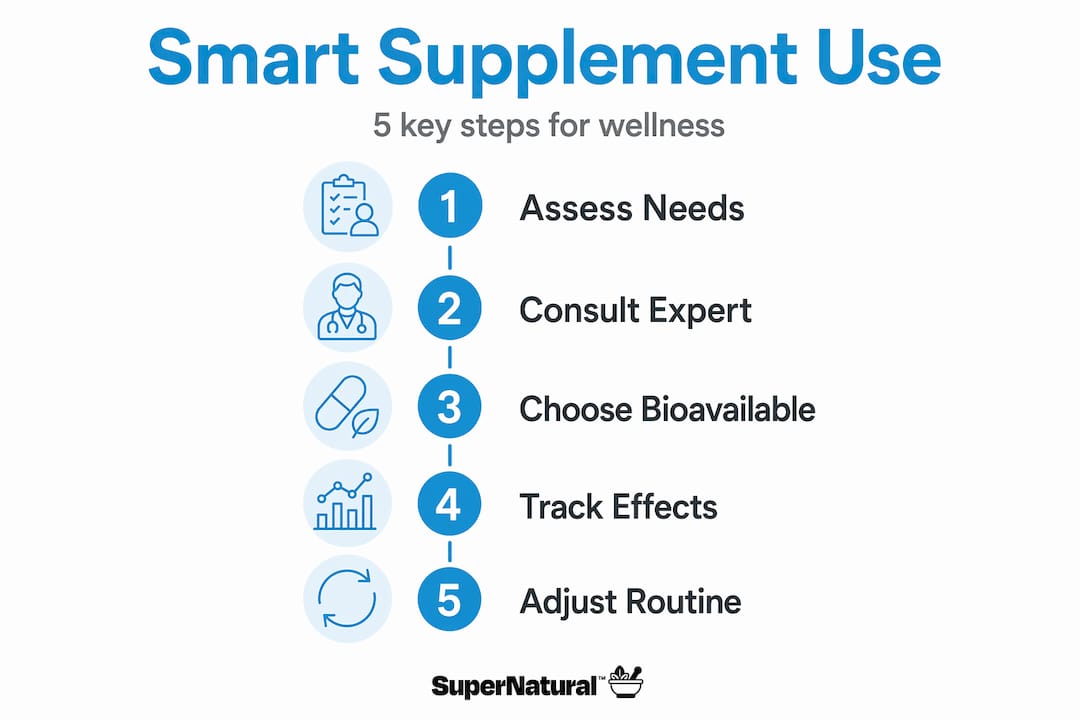
- Test first. Get blood work to confirm actual deficiencies before purchasing anything.
- Consult a healthcare provider. Especially important if you are managing a condition like ADHD or chronic inflammation.
- Use validated doses. Follow amounts supported by clinical research, not label marketing.
- Monitor and reassess. Re-test biomarkers after 8 to 12 weeks to evaluate whether the supplement is doing anything measurable.
- Build your foundation first. Supplements complement a diet rich in whole foods, consistent exercise, quality sleep, and stress management. They do not replace any of these.
A practical guide to bioavailable supplements can help you evaluate which forms of nutrients your body actually absorbs versus which pass through with little effect.
With these cautions clearly in mind, let us consider our perspective on what truly drives supplement success.
Why targeted supplementation, not shortcuts, shapes real wellness
We have seen what happens when people chase wellness through volume, adding supplement after supplement to a morning routine without testing, without monitoring, and without addressing the lifestyle factors that drive most health outcomes. The result is usually a cluttered cabinet, a drained wallet, and no real change.
The core problem is a framing issue. Supplements are positioned by some brands as the foundation of wellness when they are actually a targeted layer on top of a much stronger foundation. Diet, sleep, exercise, and social connection are not nice-to-haves sitting below your supplement stack. They are the primary drivers of your brain function and inflammatory status.
That said, we do not take the opposite extreme position either. Testing your nutrient status for markers like vitamin D, B12, and iron is genuinely valuable. When a real deficiency surfaces, correcting it with a well-formulated supplement can produce changes that feel almost immediate. A person with a vitamin D level of 18 ng/mL who corrects to 50 ng/mL often reports noticeably better mood, sharper focus, and more consistent energy within weeks. That is targeted supplementation working as designed.
The failure mode we see most often is people taking six to ten supplements simultaneously without a clear reason for any individual one. If something improves, they have no idea which compound helped. If nothing improves, they have no data to act on. Worse, interactions between compounds may blunt or amplify effects in ways that are impossible to track without methodical use.
Our position: supplements are precision tools, and precision tools require you to know what you are actually trying to fix. Test. Identify. Supplement specifically. Monitor results. Adjust. This cycle of informed decision-making is how supplementation for a healthy lifestyle actually works.
Explore SuperNatural’s proven supplements for cognitive and inflammation support
Turning evidence into action starts with choosing supplements that are formulated with both quality and bioavailability in mind. Many supplements fail not because the active ingredient is wrong but because your body cannot absorb enough of it to matter (like wanting the benefits of curcumin from standard powder when your body absorbs only a fraction of it).
That is exactly why we developed our patented BioSoluble® Curcumin™ process, which significantly improves curcumin absorption compared to standard forms, giving your body more of what it actually needs to support healthy inflammatory responses. For cognitive support specifically, BrainBoost is formulated with targeted nutrients designed for focus and advanced cognitive function. And for immune and overall wellness support that complements inflammation management, BodyBoost rounds out a well-designed supplement approach. Each product is built around the same principle that guides this guide: answer a real need with a well-absorbed, evidence-aligned formula.
Frequently asked questions
Do supplements improve cognitive function for everyone?
Supplements may benefit cognitive function mainly when correcting specific deficiencies, but the evidence for broad, universal use is still uncertain. Probiotic supplementation can improve cognitive function after 12 weeks, but the certainty of this evidence is rated as low.
Can omega-3 supplements reduce inflammation effectively?
Omega-3s can meaningfully reduce inflammatory biomarkers like CRP and ESR in controlled trials, but larger studies are still needed to confirm that these biological changes translate into measurable symptom relief. Omega-3 supplementation reduced both inflammation markers and improved metabolic measures in a 2025 trial.
Is taking high doses of vitamins safer or more effective?
No. High doses do not guarantee better outcomes and frequently cause toxicity or other adverse effects. High doses of certain vitamins can backfire rather than amplify benefits, so validated, research-supported doses are always the safer choice.
Should people with ADHD take vitamin D supplements?
Only after testing. Vitamin D deficiency is associated with higher ADHD odds, and supplementation has improved some symptom scores, but there is no confirmed causal proof and professional guidance is essential before starting.
Are probiotics safe for cognitive health?
Probiotics appear generally safe in trials, with no significant increase in adverse events reported. However, their cognitive benefits remain uncertain and the evidence is classified as very low certainty, meaning more rigorous research is still needed before firm recommendations can be made.
Recommended
- Bioavailable supplements guide: boost focus and wellness – SuperNatural
- Why Choose Bioavailable Supplements for Better Health – SuperNatural
- Natural supplements explained: Benefits, uses, and safety – SuperNatural
- Natural supplements for brain health and inflammation – SuperNatural
This article is provided for educational and informational purposes only and does not constitute providing medical advice or professional services. Always consult with a qualified and licensed physician or other medical care provider. Statements have not been evaluated by the Food & Drug Administration. This product is not intended to diagnose, treat, cure, or prevent any disease.