

Supplement absorption is defined as the biological process by which ingested nutrients move from the digestive tract into the bloodstream, where the body can actually put them to work. Taking a supplement and absorbing it are two entirely different events. Dr. Sharad Malhotra identifies gut integrity and enzyme activity as the primary gatekeepers of nutrient effectiveness, meaning a high-quality supplement can still fail you if your digestive system is not ready to receive it. For anyone focused on cognitive function or managing inflammation, understanding supplement absorption is not optional. It is the foundation of every result you are trying to achieve.
What is supplement absorption and why does it matter?
Bioavailability is the industry term for what most people mean when they talk about supplement absorption. It describes the fraction of an ingested nutrient that actually reaches systemic circulation in an active form. Think of it like wanting a strong cup of coffee instead of just sniffing the beans. You can buy the finest roast available, but if the brewing process is broken, you get nothing useful.
Oral supplements face a significant obstacle called first-pass metabolism, where the liver intercepts and converts nutrients before they reach the rest of the body. Some nutrients are activated during this process, while others are partially deactivated. This is why the same dose of two different supplement forms can produce dramatically different results in your bloodstream.

The factors that shape bioavailability include supplement form (capsule, liquid, liposomal), the chemical structure of the nutrient itself, your digestive health, what you ate before taking the supplement, and your individual physiology. For supplements targeting brain health or inflammation, such as curcumin, omega-3s, or B vitamins, each of these variables can mean the difference between measurable benefit and zero effect. Knowing how these factors interact gives you real leverage over your results.
How supplement form and nutrient type affect absorption
Not all delivery formats perform equally. The format your supplement comes in determines how much of the active ingredient survives the journey from your mouth to your cells.
| Format | Absorption advantage | Best suited for |
|---|---|---|
| Liposomal | Phospholipid vesicles bypass digestive degradation | Fat-soluble nutrients, curcumin, vitamin C |
| Enteric-coated capsule | Survives stomach acid, releases in small intestine | Probiotics, omega-3s, sensitive enzymes |
| Softgel | Dissolves faster than hard tablets, good for oils | Fat-soluble vitamins A, D, E, K |
| Standard tablet | Slowest dissolution, most affected by low stomach acid | Minerals with enteric protection |
| Liquid or powder | Fastest absorption, no dissolution step needed | Water-soluble vitamins, electrolytes |
Liposomal supplements use phospholipid vesicles sized under 200nm to bypass digestive degradation entirely, delivering encapsulated nutrients directly into cells. This is the same structural principle behind how cell membranes work, which is why the body accepts liposomal delivery so efficiently. For curcumin specifically, this technology addresses one of the most stubborn absorption problems in the supplement world.
The chemical form of a nutrient matters just as much as the delivery format. Vitamin B12 as methylcobalamin is already in the active form your body uses, while cyanocobalamin requires conversion steps that reduce net uptake. Similarly, magnesium glycinate absorbs more readily than magnesium oxide because the glycinate form is gentler on the gut and more soluble. For anyone taking supplements to support focus, memory, or reduce neuroinflammation, choosing the right chemical form is a non-negotiable starting point.
Pro Tip: When selecting a B-complex for cognitive support, look specifically for methylcobalamin (B12) and methylfolate (B9) on the label. These are the pre-converted, active forms your neurons can use immediately.
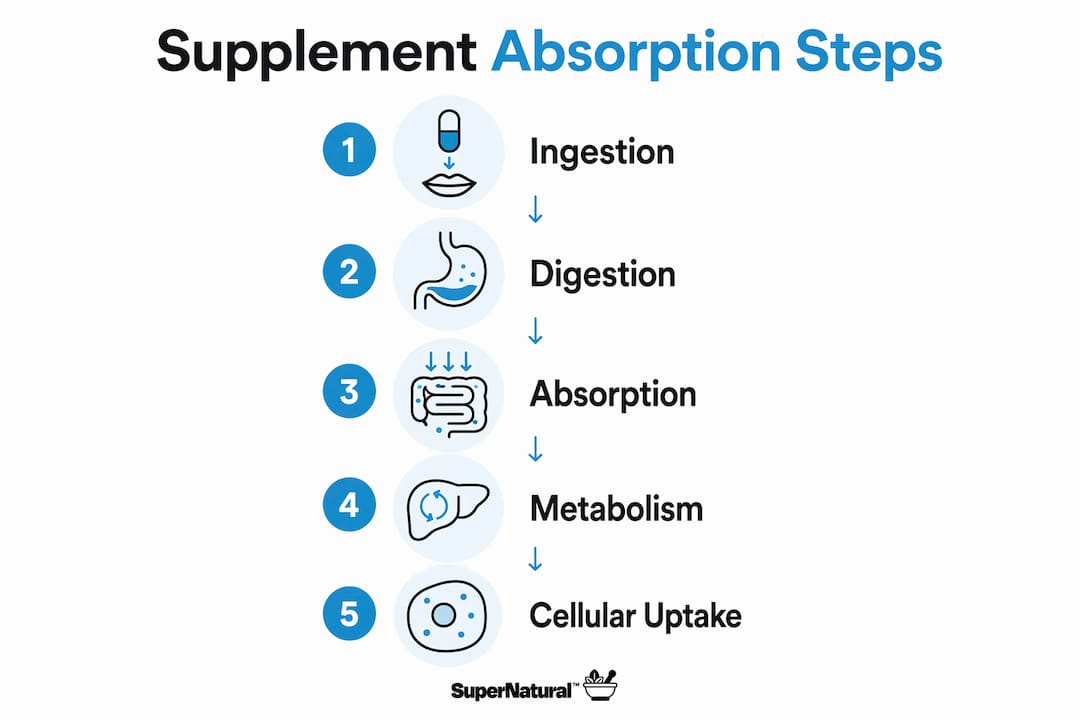
How does your gut environment shape nutrient uptake?
Your gut is not a passive tube. It is an active, selective barrier, and its condition directly determines how much of any supplement you actually absorb.
The integrity of the gut lining controls which molecules pass into the bloodstream and which do not. When that lining is compromised by inflammation or poor enzyme activity, even a well-formulated supplement cannot compensate. Chronic stress compounds this problem by reducing digestive enzyme output and slowing gut motility, which shortens the window during which nutrients can be absorbed in the small intestine.
Several specific physiological factors reduce absorption efficiency:
- Low stomach acid: Acid-suppressing medications and the natural decline in stomach acid with age impair the dissolution of standard tablets and the release of minerals and vitamin B12 from food and supplements.
- Reduced enzyme output: Pancreatic enzymes break down fats, proteins, and carbohydrates into absorbable units. Aging and chronic inflammation both reduce enzyme production.
- Gut inflammation: An inflamed gut lining has fewer functional transport proteins, which are the actual channels nutrients use to cross into the bloodstream.
- Microbiome imbalance: Certain B vitamins and vitamin K2 are partially synthesized by gut bacteria. A disrupted microbiome reduces this internal production.
- Stress response: Cortisol redirects blood flow away from the digestive tract, reducing the absorptive surface area available during digestion.
“The gut is the gatekeeper. You can take the most expensive supplement on the market, but if your digestive system is compromised, you are largely wasting your money.” — Dr. Sharad Malhotra
For people focused on cognitive and inflammation supplements, this is especially relevant. Nutrients like omega-3 DHA, curcumin, and magnesium L-threonate all depend on a healthy gut environment to reach the brain in meaningful concentrations. Addressing gut health is not a separate project from optimizing your supplement stack. It is the same project.
What is the impact of food and timing on supplement effectiveness?
When you take a supplement matters almost as much as what you take. Food changes the gut environment in ways that can either accelerate or block nutrient absorption.
-
Pair fat-soluble vitamins with dietary fat. Vitamins A, D, E, and K require fat to stimulate bile secretion, which forms the micelles that carry these nutrients across the gut wall. Taking fat-soluble vitamins with a handful of nuts, avocado, or a meal containing olive oil meaningfully increases their uptake.
-
Take iron on an empty stomach, away from calcium. Iron absorbs best without competition. Calcium, tea, and coffee all reduce iron uptake when consumed at the same time. Vitamin C, on the other hand, enhances non-heme iron absorption by converting it to a more soluble form.
-
Separate calcium and iron by at least two hours. These two minerals compete for the same intestinal transporters. Taking them together reduces the absorption of both.
-
Take magnesium and zinc in the evening. Both are better tolerated and absorbed when the digestive system is not competing with a large meal. Magnesium also supports sleep quality, making evening timing doubly beneficial.
-
Take curcumin with a fat-containing meal. Curcumin is fat-soluble and notoriously difficult to absorb in standard form. Pairing it with dietary fat, or choosing a bioavailable curcumin formulation, dramatically increases the amount that reaches circulation.
-
Avoid taking B vitamins late in the day. B vitamins, particularly B6 and B12, support energy metabolism and can interfere with sleep if taken in the evening.
Pro Tip: Build your supplement schedule around your meals, not your convenience. A supplement taken at the wrong time relative to food can lose 30 to 50 percent of its potential effectiveness before it even reaches your small intestine.
Nutrient synergies are equally worth planning for. Vitamin D works significantly better when paired with K2 and magnesium, because all three are required for proper calcium metabolism and immune regulation. For anyone using a daily supplement plan to support brain health or reduce systemic inflammation, mapping these pairings in advance removes a lot of guesswork.
Why more is not always better with supplement dosing
Doubling your supplement dose does not double your results. This is one of the most misunderstood principles in supplementation, and it has real consequences for both your wallet and your health.
Nutrients are absorbed through saturable transport proteins in the gut lining. Once those transporters are occupied, additional nutrient molecules simply pass through unabsorbed. The result is that megadosing primarily increases the amount of unabsorbed material in your gut, not the amount reaching your cells.
The specific risks of excess dosing include:
- Fat-soluble vitamin toxicity. Unlike water-soluble vitamins, vitamins A, D, E, and K accumulate in body fat and the liver. Excess vitamin A causes liver damage and bone loss. Excess vitamin D raises blood calcium to dangerous levels.
- Mineral imbalances. High-dose zinc supplementation depletes copper over time. Excess calcium without adequate magnesium and K2 can contribute to arterial calcification.
- Wasted B12. Oral B12 absorption is often below 5% without adequate intrinsic factor, a protein produced in the stomach. Taking a 5,000mcg tablet does not override this limitation. It simply increases the unabsorbed fraction.
- Gut irritation. High doses of certain minerals, particularly iron and magnesium oxide, cause gastrointestinal distress precisely because they overwhelm absorptive capacity and remain in the gut longer.
The practical takeaway is to match your dose to your actual need, confirmed through blood testing where possible. A targeted dose of a highly bioavailable form consistently outperforms a megadose of a poorly absorbed form. This principle is central to how we approach formulation at SuperNatural Supplements.
Key takeaways
Supplement absorption determines whether the nutrients you take actually reach your cells in a usable form, and optimizing it requires attention to supplement form, gut health, food timing, and dose strategy.
| Point | Details |
|---|---|
| Bioavailability is the real metric | The fraction of a nutrient reaching circulation, not the dose on the label, determines effectiveness. |
| Gut health governs absorption | Inflammation, low stomach acid, and poor enzyme activity reduce uptake even from high-quality supplements. |
| Form and chemistry matter | Liposomal and enteric-coated formats, plus active nutrient forms like methylcobalamin, outperform standard tablets. |
| Food timing changes outcomes | Fat-soluble vitamins need dietary fat; iron needs separation from calcium and coffee to absorb properly. |
| Megadosing has limits | Saturable gut transporters mean excess doses increase waste, not absorption, and can cause toxicity with fat-soluble vitamins. |
Our perspective on absorption-first supplementation
We have spent years studying why people take high-quality supplements and still do not feel a difference. The answer is almost always absorption, not ingredient quality. The supplement industry has historically focused on what goes into a capsule. We believe the more important question is what actually gets out of it and into your cells.
Gut health is the foundation. Before adding more supplements to your routine, it is worth asking whether your digestive system is actually prepared to absorb them. Chronic stress, processed food diets, and overuse of acid-suppressing medications quietly erode the absorptive capacity most people take for granted. Addressing these factors first multiplies the return on every supplement you take.
We are also skeptical of megadosing as a strategy. More is not more when transport proteins are the bottleneck. A smaller dose of a well-formulated, bioavailable supplement will outperform a large dose of a poorly absorbed one every time. That is not a marketing claim. It is basic pharmacokinetics.
For cognitive and anti-inflammatory goals specifically, we recommend choosing supplements with clinically validated delivery technologies, pairing them strategically with meals, and testing your baseline nutrient levels before stacking multiple products. Professional guidance from a physician or registered dietitian makes this process faster and safer. The goal is precision, not volume.
— SuperNatural
How SuperNatural Supplements addresses the absorption problem
At SuperNatural Supplements, we built our entire formulation philosophy around the absorption science covered in this article. Our patented BioSoluble® Curcumin™ process delivers significantly enhanced bioavailability compared to standard curcumin, directly addressing the fat-solubility and poor gut uptake that makes conventional curcumin supplements so ineffective. For cognitive support, BrainBoost is formulated for advanced bioavailability, targeting the nutrient delivery challenges that matter most for brain function. If you want supplements that are actually designed to be absorbed, not just ingested, explore our full product line at SuperNatural Supplements.
FAQ
What is supplement absorption?
Supplement absorption, formally called bioavailability, is the process by which ingested nutrients move from the digestive tract into the bloodstream in an active, usable form. Only the fraction that reaches systemic circulation produces any physiological effect.
How long does supplement absorption take?
The supplement absorption timeline varies by form and nutrient type. Liquids and powders begin absorbing within 15 to 30 minutes, while standard tablets can take one to two hours to dissolve and release nutrients, depending on stomach acid levels.
What factors affect nutrient absorption the most?
The primary factors affecting nutrient absorption are supplement delivery format, the chemical form of the nutrient, gut lining integrity, stomach acid levels, enzyme activity, and whether the supplement is taken with or without food. Age and chronic inflammation both reduce absorptive capacity over time.
Does taking more of a supplement improve absorption?
No. Absorption is saturable, meaning gut transport proteins have a fixed capacity. Exceeding that capacity through megadosing increases unabsorbed waste rather than effective uptake, and creates toxicity risk with fat-soluble vitamins like A and D.
What are the best practices for supplement intake?
Take fat-soluble vitamins with a fat-containing meal, separate iron from calcium and coffee by at least two hours, choose active nutrient forms like methylcobalamin over cyanocobalamin for B12, and prioritize bioavailable supplement forms such as liposomal or enteric-coated products for nutrients with known absorption challenges.
This article is provided for educational and informational purposes only and does not constitute providing medical advice or professional services. Always consult with a qualified and licensed physician or other medical care provider. Statements have not been evaluated by the Food & Drug Administration. This product is not intended to diagnose, treat, cure, or prevent any disease.