

Supplement bioavailability is defined as the fraction of an ingested nutrient that reaches your bloodstream in active form and is available for your body to use. This single concept explains why two people can take the same 500 mg capsule and experience completely different results. If you are managing brain health concerns like ADHD or dealing with chronic inflammation, understanding bioavailability is not optional. It is the difference between a supplement that works and one that is expensive waste. Bioavailability can range from 10% to 60% depending on formulation alone, meaning identical label doses can produce a six-fold difference in physiological impact.
What is supplement bioavailability and why does it matter?
Bioavailability is the industry’s standard pharmacokinetic term for measuring how much of a substance actually enters circulation after you consume it. Think of it like wanting a strong cup of coffee instead of just sniffing the beans. The label tells you what is in the capsule. Bioavailability tells you how much of that actually reaches your brain, your joints, or your immune cells.
The distinction matters most when you are targeting specific health outcomes. Curcumin, omega-3 fatty acids, magnesium, and fat-soluble vitamins like D and K all have notoriously variable absorption rates. A supplement with poor bioavailability forces your body to work harder for less return, and no amount of dose escalation fully compensates for that gap.
Bioavailability also separates absorption from utilization. Absorption means a compound crosses the gut wall. Bioavailability means it survives the entire journey, including liver metabolism, and arrives at target tissue in a form your cells can actually use. These are not the same thing, and confusing them leads to poor supplement decisions.
How bioavailability differs from absorption and what affects it
Absorption is one step in a longer process. Bioavailability is the outcome of every step working together. Here is what happens between swallowing a capsule and a nutrient reaching your bloodstream:
- Dissolution: The capsule or tablet must break down in your stomach. Poorly manufactured supplements may pass through partially intact.
- Enzymatic digestion: Digestive enzymes in the stomach and small intestine break compounds into absorbable units. Supplement form affects how efficiently this happens.
- Intestinal transport: Nutrients cross the gut lining through specific transport proteins. Many of these transporters are selective and can become saturated.
- First-pass metabolism: After crossing the gut wall, compounds travel to the liver before entering general circulation. The liver can degrade a large portion of absorbed compounds before they ever reach your bloodstream. This is why delivery technologies like liposomal encapsulation exist.
- Delivery system: The physical form of a supplement, whether it is a standard tablet, softgel, liposomal liquid, or phytosome complex, directly determines how much survives each stage.
Supplement form and co-ingredients are more important than label dose for determining how much nutrient reaches target tissue. A 1,000 mg dose of a low-bioavailability form can deliver less active nutrient than a 200 mg dose of a high-bioavailability form.
Which supplement forms have the best bioavailability?
Not all supplement forms are created equal. The table below compares common nutrients and their bioavailability across different forms, which is one of the most practical tools for making smarter purchasing decisions.
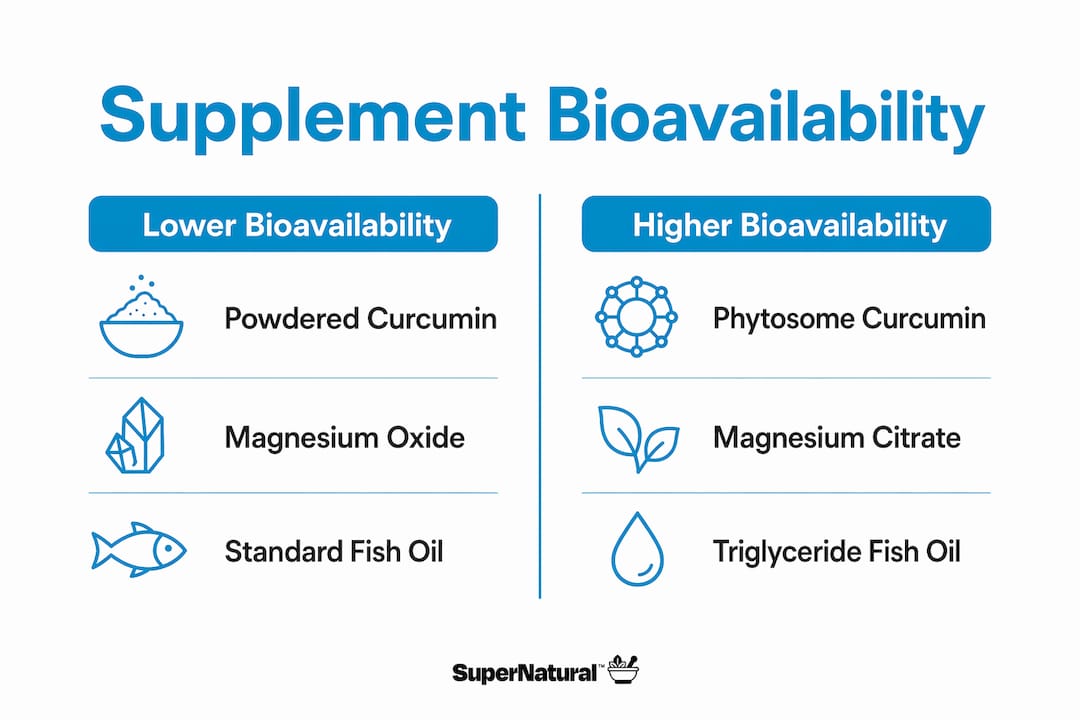
| Nutrient | Lower Bioavailability Form | Higher Bioavailability Form | Key Factor |
|---|---|---|---|
| Magnesium | Magnesium oxide | Magnesium citrate or glycinate | Solubility and chelation |
| CoQ10 | Crystalline CoQ10 | Liposomal or ubiquinol CoQ10 | Fat solubility and particle size |
| Curcumin | Standard curcumin powder | BioSoluble® Curcumin™, phytosome | Lipid matrix and solubility technology |
| Iron | Ferric iron (non-heme) | Ferrous bisglycinate | Oxidation state and chelation |
| Vitamin D | D2 (ergocalciferol) | D3 (cholecalciferol) with fat | Fat co-ingestion and form |
| Vitamin C | High-dose ascorbic acid | Liposomal vitamin C | Transporter saturation avoidance |
Fat-soluble vitamins like D, E, A, and K require dietary fat to stimulate bile secretion for proper absorption. Taking vitamin D on an empty stomach with no fat present can cut absorption significantly. Iron, by contrast, is often better absorbed away from food, since certain compounds in meals can bind to it and block uptake.
Water-soluble vitamins like vitamin C and B12 compete for shared intestinal transporters. Taking very high doses of vitamin C does not proportionally increase absorption because those transporters become saturated. Spreading doses throughout the day is more effective than one large dose.
The bioavailability of vitamins is not fixed. It shifts based on the form you choose, what you eat alongside the supplement, and the health of your digestive system.
How your physiology shapes supplement absorption
Bioavailability is a personal metric, shaped by your individual gut health, metabolic rate, and current nutrient status. Two people taking the same supplement can experience meaningfully different outcomes. Here is why:
- Gut health: Chronic gut inflammation, leaky gut, or conditions like Crohn’s disease reduce the absorptive surface area of the intestinal lining. Less surface area means less absorption, regardless of supplement quality.
- Stomach acid levels: Declining stomach acid, which becomes more common with age and chronic stress, reduces the breakdown of nutrients like B12, calcium, and iron before they reach the small intestine.
- Age: Older adults produce less intrinsic factor (needed for B12 absorption) and less stomach acid, making them structurally more vulnerable to poor bioavailability.
- Nutrient status: If you are already deficient in a nutrient, your body often upregulates absorption. If you are replete, absorption efficiency drops. This is why iron-deficient individuals absorb dietary iron at higher rates than those with normal stores.
- Genetics: Variants in genes like MTHFR affect how efficiently your body converts folic acid into its active form, methylfolate. For people with this variant, standard folic acid supplements have significantly lower effective bioavailability.
The presence or absence of food when you take a supplement can drastically change absorption outcomes. Fat-soluble nutrients need fat. Some minerals compete with each other when taken together. Calcium and magnesium share transporters, so taking them simultaneously at high doses reduces absorption of both.
Pro Tip: Take fat-soluble supplements like vitamins D, K, and E with your largest meal of the day, which typically contains the most dietary fat. For minerals like magnesium, splitting your dose morning and evening improves absorption compared to one large nighttime dose.
What strategies and technologies actually improve bioavailability?
Supplement science has developed several proven methods to increase how much of a compound survives digestion and reaches circulation. These are not marketing claims. They are measurable delivery improvements.
| Strategy | How it works | Example application |
|---|---|---|
| BioPerine (piperine) | Inhibits liver enzymes that break down compounds during first-pass metabolism | Adding 5 mg of BioPerine improves CoQ10 bioavailability by approximately 30% |
| Liposomal encapsulation | Wraps nutrients in lipid spheres that bypass gut degradation | Liposomal vitamin C, liposomal glutathione |
| Phytosome technology | Binds plant compounds to phospholipids for better membrane crossing | Curcumin phytosome, silymarin phytosome |
| Enteric coatings | Protects compounds from stomach acid, releasing them in the small intestine | Probiotic capsules, omega-3 softgels |
| Co-formulation with fat | Stimulates bile production to aid fat-soluble nutrient absorption | Vitamin D3 in olive oil softgels |
| BioSoluble® technology | Patented process that makes water-insoluble compounds soluble for absorption | SuperNatural Supplements BioSoluble® Curcumin™ |
Standard curcumin is a useful example of the problem. Curcumin is fat-soluble and poorly absorbed in its raw powder form. Studies consistently show that standard curcumin has very low bioavailability, which is why so many people take it and feel little effect. Phytosome technology and patented solubility processes like BioSoluble® Curcumin™ address this directly by making the compound structurally accessible to gut transporters.
Pro Tip: When comparing curcumin supplements, look for products that specify a delivery technology by name, such as phytosome, liposomal, or BioSoluble®. A product that lists only “curcumin extract” with no delivery system is likely delivering a fraction of its labeled dose.
For enhancing supplement absorption, the most reliable approach combines a high-bioavailability form with appropriate co-ingestion strategy. Neither alone is as effective as both together.
How to apply bioavailability knowledge to your supplement routine
Knowing the science is only useful if it changes what you do. Here is how to translate bioavailability concepts into a smarter daily supplement routine, especially if your goals include cognitive support or reducing inflammation.
- Match form to function. If you are taking curcumin for inflammation, choose a product with a named delivery technology. If you are taking magnesium for sleep or cognitive support, choose glycinate or citrate over oxide.
- Time supplements around meals strategically. Fat-soluble vitamins go with food containing fat. Minerals like iron and zinc are often better absorbed away from high-calcium meals.
- Do not overdose to compensate for poor absorption. Increasing supplement dose to overcome poor bioavailability may not raise blood nutrient levels due to saturable gut transporters, and it may cause digestive distress. A better-formulated product at a lower dose outperforms a high-dose, low-bioavailability product.
- Support your gut first. If your gut lining is inflamed or your stomach acid is low, even the best-formulated supplement will underperform. Prioritizing gut health through diet, stress management, and probiotics creates the foundation for better absorption.
- Track your response. Bioavailability is personal. Monitor how you feel over 4–8 weeks with a consistent protocol before switching products. Subjective improvements in focus, energy, or inflammation markers are meaningful signals.
For a deeper look at how physiology and metabolism interact with supplement effectiveness, the guide on supplement absorption for brain health covers the mechanisms in detail.
Key takeaways
Supplement bioavailability determines how much of a labeled dose actually reaches your cells, and formulation quality matters far more than dose size alone.
| Point | Details |
|---|---|
| Bioavailability vs. absorption | Absorption is crossing the gut wall; bioavailability includes surviving liver metabolism and reaching target tissue. |
| Form determines outcome | Magnesium glycinate, liposomal CoQ10, and BioSoluble® Curcumin™ outperform standard forms at equivalent doses. |
| Physiology is personal | Gut health, stomach acid, age, and genetics all shift how much of a supplement you actually absorb. |
| Overdosing does not fix poor formulation | Saturable transporters mean higher doses stop increasing absorption and may cause side effects. |
| Timing and food matter | Fat-soluble vitamins need dietary fat; some minerals compete for transporters and should be spaced apart. |
Why bioavailability is the metric we focus on first
At SuperNatural Supplements, we have spent years watching people take high-dose supplements and feel nothing. The most common reason is not that the supplement is ineffective. It is that the form they chose never had a realistic chance of reaching their cells in meaningful amounts.
The uncomfortable truth is that the supplement industry still sells a lot of products based on label dose rather than delivered dose. A 1,000 mg curcumin capsule sounds impressive. But if it uses raw curcumin powder with no delivery technology, the amount reaching your bloodstream is negligible. We have seen this pattern repeatedly, and it is why we built our formulations around bioavailability from the start, not as a feature, but as the baseline requirement.
We also want to be honest about something most brands skip: gut health is upstream of everything. You can take the most bioavailable supplement on the market and still absorb it poorly if your gut lining is compromised or your stomach acid is low. Fixing the foundation matters as much as choosing the right product. That means managing stress, eating a diet that supports gut integrity, and not relying on supplements alone to do all the work.
The readers who get the best results are the ones who treat bioavailability as a system, not a single product decision. They choose high-quality forms, time them correctly, support their digestion, and give the protocol enough time to show results. That approach consistently outperforms chasing higher doses of poorly formulated products.
— SuperNatural
How SuperNatural Supplements addresses the bioavailability gap
SuperNatural Supplements was built around one core problem: most supplements do not deliver what their labels promise. Our patented BioSoluble® Curcumin™ process transforms curcumin, one of the most poorly absorbed compounds in standard supplement form, into a water-soluble, highly bioavailable form that your body can actually use. BodyControl uses this technology to support a healthy inflammatory response and detoxification. For cognitive support, BrainBoost delivers bioavailable ingredients specifically chosen for brain health, including focus and mental clarity. BodyBoost targets immune function with the same formulation-first philosophy. Every product we make starts with the question of how much actually reaches your cells, not how much fits on a label.
FAQ
What is supplement bioavailability in simple terms?
Supplement bioavailability is the percentage of a nutrient from a supplement that your body absorbs and uses. A supplement with 10% bioavailability delivers only 10% of its labeled dose to your bloodstream.
Why does supplement form affect bioavailability so much?
Different forms of the same nutrient dissolve, survive digestion, and cross the gut wall at very different rates. Magnesium glycinate, for example, is absorbed significantly more efficiently than magnesium oxide because of its solubility and chelation structure.
Can taking more of a supplement compensate for low bioavailability?
No. Gut transporters become saturated at certain intake levels, meaning higher doses stop increasing absorption and may cause digestive distress. A better-formulated supplement at a lower dose is more effective than a high dose of a poorly absorbed form.
How does gut health affect supplement absorption?
Chronic gut inflammation, low stomach acid, and reduced intestinal surface area all limit how much of a supplement crosses into your bloodstream. Supporting gut health through diet and stress management directly improves supplement effectiveness.
What delivery technologies improve curcumin bioavailability?
Phytosome complexes, liposomal encapsulation, and patented processes like BioSoluble® Curcumin™ all significantly increase curcumin absorption compared to standard curcumin powder. These technologies address curcumin’s natural fat solubility and poor water solubility.
This article is provided for educational and informational purposes only and does not constitute providing medical advice or professional services. Always consult with a qualified and licensed physician or other medical care provider. Statements have not been evaluated by the Food & Drug Administration. This product is not intended to diagnose, treat, cure, or prevent any disease.
Recommended
- How to Enhance Bioavailability for Better Supplement Results – SuperNatural
- Understanding Supplement Absorption for Brain and Inflammation Health – SuperNatural
- Bioavailable supplements guide: boost focus and wellness – SuperNatural
- Supplement science: Your guide to focus and inflammation – SuperNatural