

What actually works to increase mental energy quickly and sustainably
The most effective approach to mental energy combines fast-acting resets with habits that build lasting cognitive stamina. You do not have to choose between feeling sharp right now and staying sharp for months. Both are achievable, and the strategies reinforce each other.
Quick-acting strategies (results within minutes):
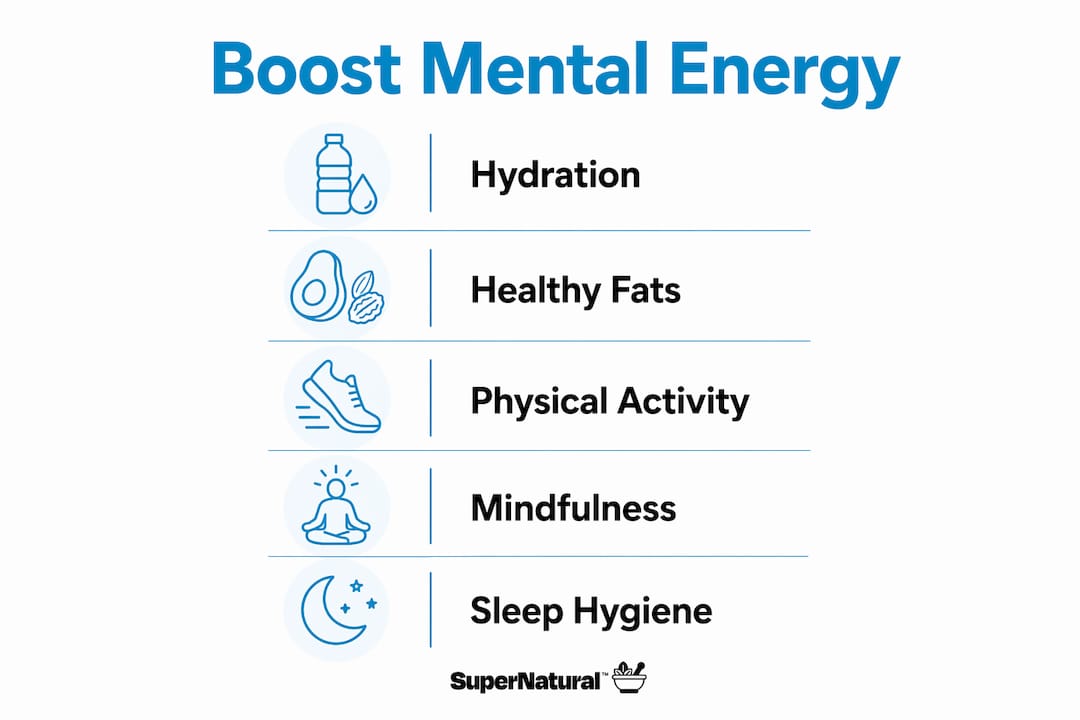
- Drink water immediately upon waking to restore overnight hydration and sharpen cognition
- Practice box breathing: inhale for 4 counts, hold for 4, exhale for 4, hold for 4, repeat 4 times
- Take a 5–10 minute walk to trigger a BDNF and blood flow surge that clears mental fog
- Step outside or change rooms to give your brain a fresh sensory input and reset attention
- Do a “brain dump” on paper to offload mental clutter before a demanding task
Sustainable habits (results over weeks and months):
- Eat complex carbohydrates, healthy fats, and antioxidant-rich foods to maintain steady glucose levels
- Exercise at moderate intensity for 150 minutes weekly to protect and grow brain volume
- Practice 10 minutes of daily mindfulness to strengthen prefrontal cortex function
- Sleep 7–9 hours per night to allow full cognitive restoration
- Use Thorne Vitamin B12 or other evidence-backed supplements to fill nutritional gaps
How nutrition and hydration fuel your brain’s performance
Food is your brain’s most direct source of fuel, and the quality of that fuel determines how long you can concentrate before hitting a wall. The brain runs on glucose, but the source matters. Complex carbohydrates from oats, legumes, and whole grains release glucose steadily, while refined sugars cause sharp spikes followed by crashes that leave you foggy and irritable.
Healthy fats, particularly omega-3 fatty acids from fatty fish, walnuts, and flaxseed, support the structural integrity of brain cell membranes and reduce neuroinflammation. Antioxidants from berries, leafy greens, and dark chocolate protect neurons from oxidative stress. A Mediterranean-style diet has direct research support for sustaining brain health and concentration over time.
Hydration is just as foundational. Even mild dehydration impairs working memory and slows reaction time. Drinking 400–500ml of water first thing in the morning is one of the simplest and fastest ways to restore cognitive performance after sleep.
Practical nutrition and hydration tips:
- Eat breakfast with protein and complex carbs to stabilize morning glucose
- Add electrolytes (sodium, potassium, magnesium) to water during long work sessions
- Snack on walnuts, blueberries, or dark chocolate rather than processed foods
- Avoid skipping meals, which causes glucose dips that impair focus
- Limit alcohol, which disrupts sleep architecture and reduces next-day cognitive output
For deeper guidance on brain-supporting nutrition, the connection between specific nutrients and sustained mental energy is well documented.
| Nutrient | Brain benefit | Best food sources |
|---|---|---|
| Omega-3 fatty acids | Supports cell membrane function and reduces inflammation | Salmon, walnuts, flaxseed |
| Complex carbohydrates | Provides steady glucose for sustained focus | Oats, legumes, whole grains |
| Antioxidants | Protects neurons from oxidative damage | Blueberries, spinach, dark chocolate |
| B vitamins | Supports neurotransmitter production and energy metabolism | Eggs, leafy greens, fortified foods |
| Electrolytes | Maintains optimal brain hydration and nerve signaling | Bananas, avocado, coconut water |
How movement and your environment sharpen mental focus
Physical activity is one of the most reliable tools for boosting cognitive energy, and the benefits start faster than most people expect. Short bouts of movement as brief as 5–10 minutes increase brain-derived neurotrophic factor (BDNF) and blood flow, producing immediate improvements in alertness and mental clarity. BDNF acts like a growth hormone for neurons, strengthening the connections your brain uses to think, learn, and recall information.

For long-term gains, the CDC recommends 150 minutes of moderate-intensity aerobic activity per week. That can be broken into 22-minute daily sessions or 30 minutes on five days. Research from Harvard Medical School shows that six months of consistent moderate exercise is associated with measurable increases in brain volume in regions tied to memory and executive function.
Your environment also shapes how well your brain performs. Cluttered, noisy, or unchanging spaces drain attention faster than varied, calm ones. Stepping outside, even briefly, restores the directed attention your brain depletes during focused work.
Pro Tip: Treat exercise like a daily prescription, not a bonus activity. Dr. Scott McGinnis of Harvard Medical School recommends starting with just a few minutes a day and adding 5–10 minutes each week until you reach the 150-minute weekly target. Cognitive benefits accumulate over months, so consistency matters more than intensity.
Simple movement and environment strategies:
- Walk for 10 minutes before a demanding task or meeting
- Use stairs instead of elevators to add movement without scheduling it
- Work near a window with natural light to reduce eye strain and support alertness
- Rotate your workspace occasionally, even moving from desk to a different room
- Take a 2-minute stretch break every 45–60 minutes to reset posture and circulation
Why mindfulness and breathing are tools for cognitive energy, not just calm
Mindfulness does more than reduce stress. It physically restructures the brain circuits that govern attention, making it easier to stay focused and filter out distractions. Ten minutes of daily mindfulness practice strengthens prefrontal cortex function, the region most responsible for sustained attention and decision-making.
“Mindfulness is about focusing attention on the present moment, and practicing mindfulness has been shown to rewire the brain so that attention is stronger in everyday life.” — Kim Willment, neuropsychologist, Brigham and Women’s Hospital (Harvard Health)
Breathing exercises offer an even faster on-ramp. Box breathing, in particular, activates the parasympathetic nervous system within seconds, reducing cortisol and clearing the mental static that comes with stress or overwhelm.
Box breathing: step-by-step
- Sit upright and close your eyes.
- Inhale slowly through your nose for 4 counts.
- Hold your breath for 4 counts.
- Exhale fully through your mouth for 4 counts.
- Hold again for 4 counts.
- Repeat the cycle 4 times.
This takes under two minutes and can be done before any high-stakes task. Pair it with a brief body scan, noticing tension in your shoulders, jaw, or hands, to deepen the reset. For those new to formal meditation, a single-task reading exercise works equally well: read for 30 minutes, set a timer every 5 minutes, and simply notice whether your mind has wandered. That act of noticing and refocusing is the core training mechanism.
Managing mental workload and sleep to sustain focus all day
Decision fatigue drains cognitive energy faster than most people realize. Every choice you make, from what to eat to which email to answer first, draws from the same finite pool of executive function. Automating low-stakes decisions and batching similar tasks into focused blocks preserves that resource for the work that actually requires deep thinking.
Sleep is where the brain replenishes what the day depletes. Adults who sleep fewer than 7 hours nightly show measurable cognitive impairment over time. The recommended range for adults is 7–9 hours, and quality matters as much as quantity. Deep slow-wave sleep clears metabolic waste from the brain, while REM sleep consolidates memory and restores emotional regulation.
Sleep deprivation stat: Consistently sleeping fewer than 7 hours per night leads to measurable cognitive impairment, including reduced attention, slower processing speed, and impaired working memory.
Healthy sleep and workload habits:
- Set a consistent sleep and wake time, even on weekends
- Avoid screens for 30–60 minutes before bed to protect melatonin production
- Keep your bedroom cool and dark to support deep sleep stages
- Batch decisions: plan tomorrow’s schedule the night before to reduce morning cognitive load
- Use time-blocking to group similar tasks and minimize context-switching
- Identify your two or three most important tasks each morning and protect time for them first
What the research says about nootropic supplements and mental energy
Caffeine is the world’s most widely used cognitive stimulant, but it works by blocking adenosine receptors rather than generating real energy. Think of it like wanting a strong cup of coffee instead of actually resting. The alertness is real, but it is borrowed. Sustainable cognitive energy depends on stable blood glucose and stress-modulating adaptogens, not caffeine alone.
Research published in the European Journal of Nutrition shows that multi-ingredient nootropic blends can improve selective attention and executive function comparably to caffeine, but without raising blood pressure or causing negative mood effects. Adaptogens like Rhodiola and Ashwagandha help the body regulate cortisol, reducing the mental fatigue that stress accumulates over the day.
Thorne Vitamin B12 is a well-regarded option for supporting cognitive function, particularly for people whose diets may be low in B12 from animal sources. B12 deficiency is directly linked to brain fog, fatigue, and impaired nerve signaling. For cognitive enhancement supplements, quality and bioavailability determine whether a product actually delivers its intended benefit.
SuperNatural Supplements formulated BrainBoost specifically for advanced cognitive support, combining evidence-backed ingredients designed to support mental energy, focus, and clarity. Always consult a qualified physician before adding any supplement to your routine.
| Supplement type | Cognitive benefit | Notes |
|---|---|---|
| B12 (e.g., Thorne Vitamin B12) | Supports nerve signaling and reduces brain fog | Especially useful for those with dietary gaps |
| Adaptogens (Rhodiola, Ashwagandha) | Modulates cortisol and reduces stress-related fatigue | Works best alongside lifestyle changes |
| Multi-ingredient nootropics | Improves attention and executive function | Research shows comparable benefits to caffeine with fewer side effects |
| BioSoluble® Curcumin™ | Supports healthy inflammatory response and brain health | SuperNatural’s patented process enhances absorption significantly |
What to look for in a cognitive supplement:
- Clinically studied ingredients at effective doses
- High bioavailability (how well the body absorbs the active compounds)
- Transparent labeling with no proprietary blends that hide ingredient amounts
- Third-party testing for purity and potency
How to use technology wisely and reduce digital cognitive fatigue
Every notification, tab switch, and unread badge pulls a small amount of attention away from whatever you are doing. Over a full workday, those micro-interruptions add up to a serious drain on cognitive energy. Research on attention consistently shows that recovering full focus after an interruption takes longer than the interruption itself.
A practical digital detox does not require abandoning your phone. It means creating structured boundaries. Turn off non-essential notifications during focused work blocks. Use app timers to cap social media use. Schedule specific times to check email rather than responding reactively throughout the day. These small changes reduce the number of attention switches your brain has to manage, which directly preserves mental energy for higher-value thinking.
Grayscale mode on your phone screen reduces its visual pull without requiring willpower. Website blockers like Freedom or Cold Turkey let you remove distracting sites during work sessions without relying on self-discipline alone. The goal is to design your digital environment so that staying focused is the path of least resistance, not a constant act of restraint.
Key Takeaways
Combining immediate energy-boosting techniques with sustainable lifestyle habits is the most effective way to increase mental energy and maintain sharp focus over time.
| Point | Details |
|---|---|
| Hydrate first thing | Drinking 400–500ml of water upon waking quickly restores cognitive performance after overnight dehydration. |
| Move daily for brain health | The CDC recommends 150 minutes of moderate aerobic activity weekly; even 5–10 minute walks produce immediate alertness gains. |
| Sleep 7–9 hours consistently | Aim for 7–9 hours of sleep per night, as consistently sleeping fewer than 7 hours nightly causes measurable cognitive impairment; quality sleep restores executive function. |
| Manage decisions, not just energy | Automating low-stakes choices and batching tasks preserves executive function for deep, demanding work. |
| Use supplements as adjuncts | Nootropics like Thorne Vitamin B12 and adaptogens support mental energy but work best alongside solid nutrition and sleep. |
SuperNatural Supplements developed BrainBoost to support the cognitive demands that daily life places on your brain, combining advanced bioavailability technology with evidence-backed ingredients. If you are building a mental energy plan that goes beyond lifestyle basics, BrainBoost is worth exploring as part of that foundation.
This article is provided for educational and informational purposes only and does not constitute providing medical advice or professional services. Always consult with a qualified and licensed physician or other medical care provider. Statements have not been evaluated by the Food & Drug Administration. This product is not intended to diagnose, treat, cure, or prevent any disease.