

Chronic inflammation sits at the root of some of the most common health challenges people face today, from joint pain to cardiovascular issues. Choosing among the many types of anti-inflammatory supplements on the market is not as simple as picking the one with the boldest label. The science matters, the formulation matters, and so does how your body actually absorbs what you swallow. This article breaks down the top options, what the research says about each, and how to think through which supplement fits your specific health goals.
Table of Contents
- Key takeaways
- 1. What to look for in types of anti-inflammatory supplements
- 2. Omega-3 fatty acids: the foundational anti-inflammatory supplement
- 3. Curcumin: the most popular natural anti-inflammatory option
- 4. Ginger extract: fast-acting support for acute inflammation
- 5. Boswellia serrata: joint-focused anti-inflammatory support
- 6. Vitamin D: the overlooked inflammation regulator
- 7. Resveratrol and quercetin: polyphenol support for inflammation
- 8. Probiotics: supporting inflammation from the gut
- 9. Anti-inflammatory supplements comparison at a glance
- My honest take on choosing the right anti-inflammatory supplements
- Why Ordersupernatural’s curcumin formulation stands apart
- FAQ
Key takeaways
| Point | Details |
|---|---|
| Bioavailability changes everything | A supplement that your body cannot absorb is money wasted, so always check the formulation before buying. |
| Omega-3s are the foundation | EPA and DHA reduce multiple inflammatory markers and carry the broadest evidence base of any supplement in this category. |
| Curcumin needs a delivery system | Standard curcumin from turmeric is poorly absorbed; piperine or phytosomal forms are required for clinical effectiveness. |
| Safety and drug interactions matter | Several anti-inflammatory supplements, including fish oil and garlic, can increase bleeding risk when combined with common medications. |
| Consistency produces results | Most supplements require weeks to months of regular use before measurable changes in inflammation markers become apparent. |
1. What to look for in types of anti-inflammatory supplements
Before picking a specific supplement, you need a framework for evaluating them. Not every product backed by a celebrity endorsement or a clean label has the evidence to support the claims printed on the bottle.
Here is what to assess before you commit:
- Clinical evidence: Look for supplements studied in randomized controlled trials, not just lab or animal studies. Human data tells a very different story.
- Dosage standardization: The amount of active compound matters enormously. A turmeric capsule with 500 mg of turmeric powder is not the same as one containing 500 mg of curcuminoids (the actual active fraction).
- Bioavailability: This describes how much of a compound your body can actually use. Poor bioavailability means most of the supplement passes through you without doing anything useful, like wanting a strong cup of coffee and only getting the smell.
- Safety profile: Some supplements are safe at low doses but carry real risks at higher doses or when combined with medications.
- Time to effect: Some supplements show results in 24 to 48 hours; others require 4 to 12 weeks of consistent use.
Pro Tip: When comparing supplements for reducing inflammation, check whether the clinical studies used the same form and dose as the product you are considering. Many studies use specialized extracts that standard store-bought products do not replicate.
Budget matters too, but prioritize quality over price. A cheaper product with poor bioavailability costs more per effective dose than a well-formulated supplement at a higher price point. Learning about natural supplements and safety can help you develop a sharper eye for quality.
2. Omega-3 fatty acids: the foundational anti-inflammatory supplement
Omega-3 fatty acids, specifically EPA (eicosapentaenoic acid) and DHA (docosahexaenoic acid), represent the most evidence-supported supplements for reducing inflammation available today. Omega-3 fatty acids are considered foundational for systemic anti-inflammatory support due to their broad reach across multiple body systems.
The clinical data is specific and impressive. Studies show omega-3s reduce CRP by effect sizes of 0.40 for C-reactive protein (CRP), 0.23 for TNF-alpha, and 0.22 for interleukin-6 (IL-6). These three markers are among the most widely tracked indicators of systemic inflammation, which makes omega-3s an excellent baseline for almost any anti-inflammatory supplement regimen.
What the research supports:
- Cardiovascular health, including reduced triglyceride levels
- Joint inflammation, particularly in rheumatoid arthritis
- Post-exercise muscle soreness and recovery
- General systemic inflammatory marker reduction
Dosage: Most clinical trials use 1 to 3 grams of combined EPA and DHA per day. Note that this refers to the EPA+DHA content, not the total fish oil weight printed on the label.
Safety note: High-dose fish oil above 3 grams per day can produce clinically meaningful antiplatelet effects, increasing bleeding risk. Anyone taking anticoagulants like warfarin should consult a physician before supplementing.
Pro Tip: Choose fish oil in the “reformed triglyceride” form (rTG) rather than the ethyl ester (EE) form. Triglyceride-form omega-3s absorb roughly 70% better, meaning you get more EPA and DHA from each capsule.
3. Curcumin: the most popular natural anti-inflammatory option
Curcumin is the active compound in turmeric and one of the most researched natural supplements for inflammation reduction. The problem is that the spice itself is mostly curcumin by weight only at about 2 to 5%, and even pure curcumin has notoriously poor bioavailability in standard form.
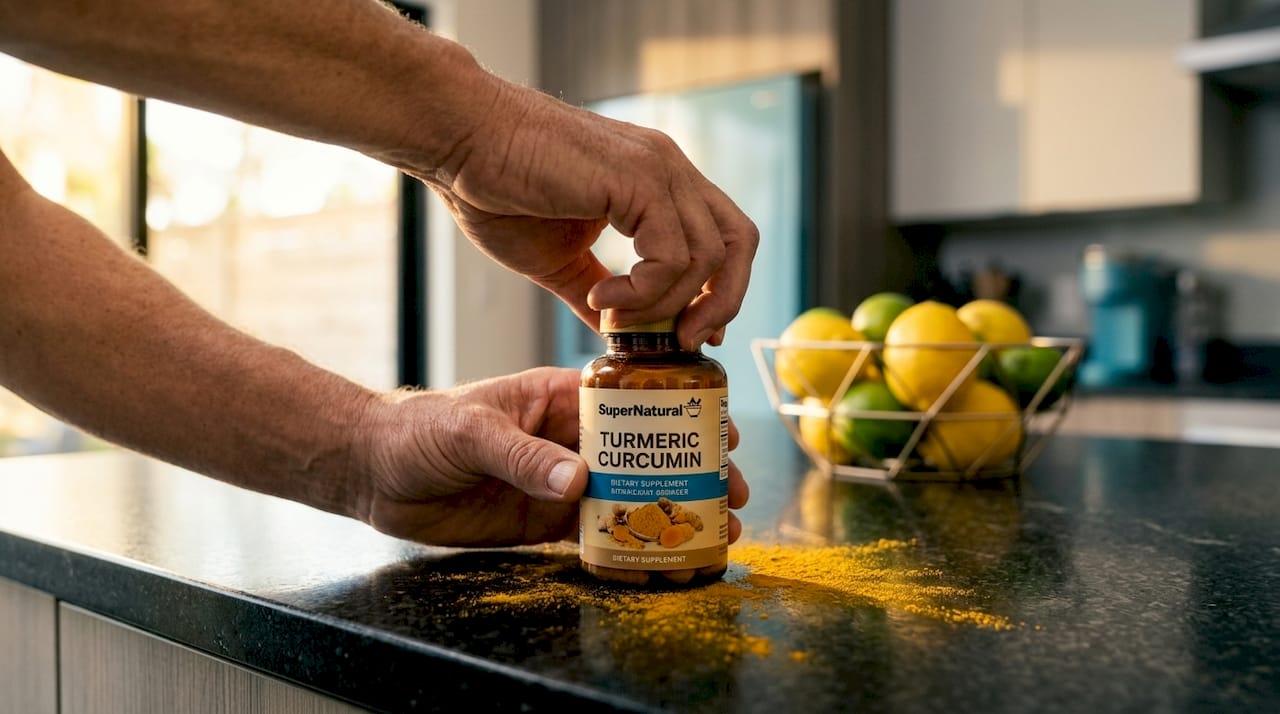
Clinical trials confirm real benefits when the right dose reaches the bloodstream. Curcumin at 500 to 1500 mg per day reduces serum hs-CRP and TNF-alpha across studies involving 114 to 1,705 participants with chronic inflammatory conditions.
The bioavailability issue is the central challenge with curcumin. Standard curcumin is metabolized and excreted so quickly that blood levels barely rise. BioSoluble® Curcumin™ is 98.994% water soluble. Phytosomal formulations (curcumin bound to phospholipids) produce similarly dramatic improvements.
What to look for on the label:
- “Curcumin phytosome” (brand names like Meriva or equivalent)
- Patented enhanced-bioavailability formulations with documented absorption data that include BioSoluble® Curcumin™
Some comparisons to NSAIDs have appeared in joint pain literature, though curcumin is generally considered complementary rather than a direct replacement. Curcumin can interact with blood thinners and diabetes medications, so check with your doctor if you take either. Exploring the full picture of curcumin health benefits and bioavailability is worth your time before choosing a product.
Pro Tip: Always take curcumin with a meal that contains healthy fat. Curcumin is fat-soluble, so dietary fat significantly improves its absorption even beyond what piperine or phytosomes provide.
4. Ginger extract: fast-acting support for acute inflammation
Ginger (Zingiber officinale) works through a different mechanism than curcumin or omega-3s. Its active compounds (gingerols and shogaols) inhibit COX enzymes, the same target as many NSAIDs, but with a gentler side effect profile and no prescription required.
Ginger extract at 1 to 2 grams per day is well-supported for acute inflammation and exercise recovery, with benefit onset appearing as quickly as 24 hours in some studies. This makes ginger particularly useful for people dealing with post-workout soreness or short-term inflammatory flares rather than chronic conditions requiring months of supplementation.
Ginger is also one of the safest options in this category. It has a long history of culinary use, tolerates well at recommended doses, and has minimal drug interaction concerns compared to fish oil or curcumin. At very high doses it may thin the blood slightly, so moderation remains wise.
5. Boswellia serrata: joint-focused anti-inflammatory support
Boswellia serrata, derived from the frankincense tree, works by inhibiting 5-LOX (5-lipoxygenase), an enzyme involved in producing leukotrienes that drive joint inflammation. This mechanism differs from both omega-3s and curcumin, which is why Boswellia is often used in combination protocols.
Boswellia at 300 to 400 mg daily has shown efficacy comparable to NSAIDs for joint pain in clinical trials, with one significant advantage: it produces fewer gastrointestinal side effects than traditional anti-inflammatory drugs. For anyone who has experienced stomach upset from ibuprofen or naproxen, this makes Boswellia a compelling alternative worth exploring.
Results typically appear within 4 to 8 weeks of consistent use. Look for products standardized to at least 65% boswellic acids, and specifically for the presence of AKBA (acetyl-11-keto-beta-boswellic acid), which is considered the most active component.
6. Vitamin D: the overlooked inflammation regulator
Most people think of vitamin D purely as a bone health nutrient. The reality is more interesting. Vitamin D influences multiple inflammation pathways and immune function through what researchers call “pleiotropic effects,” meaning it acts on several different biological systems simultaneously.
A significant percentage of adults are deficient in vitamin D, and deficiency correlates with elevated inflammatory markers. Correcting that deficiency with supplementation (typically 1,000 to 4,000 IU daily, depending on baseline blood levels) can meaningfully support a healthy inflammation response. This is not a direct anti-inflammatory like omega-3s, but it removes a deficiency-driven obstacle to normal immune regulation.
Getting your 25-hydroxyvitamin D level tested before supplementing is genuinely useful here. The goal is sufficiency, not excess, since very high doses can cause toxicity over time.
7. Resveratrol and quercetin: polyphenol support for inflammation
Resveratrol (found in red grapes and berries) and quercetin (found in apples, onions, and capers) are plant polyphenols with demonstrated anti-inflammatory activity in human studies, though the evidence base is thinner than for omega-3s or curcumin.
Resveratrol at 150 to 500 mg per day has shown reductions in CRP and TNF-alpha in populations with metabolic conditions. Quercetin at 500 to 1,000 mg per day appears useful for mast cell stabilization and reducing histamine-driven inflammation, which makes it particularly relevant for people dealing with allergy-driven inflammatory responses.
Both compounds share the same bioavailability challenge as curcumin. They are rapidly metabolized, so formulations with enhanced delivery systems (liposomal, phytosomal, or nanoparticle forms) produce meaningfully better results than standard powders. These are good supporting supplements rather than first-line choices for most people.
8. Probiotics: supporting inflammation from the gut
The gut and inflammation are deeply connected. An imbalanced gut microbiome (dysbiosis) actively promotes systemic inflammatory signaling, which means restoring microbial balance can reduce whole-body inflammation. Probiotics do not fight inflammation directly the way omega-3s do. They work by improving the gut environment that regulates immune responses.
Multi-strain probiotic formulas containing Lactobacillus and Bifidobacterium species at 10 to 50 billion CFU per day have shown modest but consistent reductions in CRP in people with metabolic conditions. The timeline is longer here, typically 8 to 12 weeks before measurable changes appear. Probiotics pair well with other supplements on this list. Think of them as improving the foundation so the other supplements can do their jobs more effectively.
9. Anti-inflammatory supplements comparison at a glance
| Supplement | Typical Daily Dose | Main Benefit | Time to Effect | Safety Notes |
|---|---|---|---|---|
| Omega-3 (EPA+DHA) | 1 to 3 g | CRP, TNF-alpha, IL-6 reduction | 4 to 8 weeks | Bleeding risk at high doses; caution with anticoagulants |
| Curcumin | 500 to 1,500 mg | CRP, TNF-alpha; joint and systemic | 4 to 8 weeks | Use enhanced forms; may interact with blood thinners |
| Ginger extract | 1 to 2 g | Acute inflammation, exercise recovery | 24 hrs to 4 weeks | Very safe; slight blood-thinning at high doses |
| Boswellia serrata | 300 to 400 mg | Joint pain comparable to NSAIDs | 4 to 8 weeks | Fewer GI side effects than NSAIDs; well-tolerated |
| Vitamin D | 1,000 to 4,000 IU | Immune regulation, inflammation pathways | 8 to 12 weeks | Test blood levels first; toxicity risk at very high doses |
| Resveratrol | 150 to 500 mg | Metabolic inflammation, CRP | 8 to 12 weeks | Use enhanced-absorption forms |
| Quercetin | 500 to 1,000 mg | Histamine-driven inflammation | 4 to 8 weeks | Use liposomal form for best results |
| Probiotics | 10 to 50 billion CFU | Gut-driven systemic inflammation | 8 to 12 weeks | Strain selection matters; refrigerated forms preferred |
Natural supplements for inflammation span a wide range of mechanisms, and this table makes the distinctions clearer when you are deciding where to start.
My honest take on choosing the right anti-inflammatory supplements
I’ve spent years working with curcumin formulations and researching what separates supplements that genuinely move the needle from those that look good in a catalog. Here is what I’ve learned that most articles skip over.
The single biggest mistake I see is treating all products in the same category as equal. Two curcumin supplements at the same milligram dose can have wildly different clinical effects depending on the delivery system. Curcumin and fish oil are not cures and should be treated as adjuncts, but an adjunct that your body cannot absorb is no adjunct at all.
I’ve also found that people underestimate the importance of consistency. Most of the clinical benefits in the research show up at the 8-week mark or later. Quitting after three weeks because you do not feel different yet is the most common reason supplements fail.
My honest recommendation: start with omega-3s as your baseline, add a bioavailability-enhanced curcumin if joint or systemic inflammation is your concern, and build from there based on your specific symptoms. And please, always tell your doctor what you are taking. High-dose omega-3s and garlic alongside ibuprofen can increase bleeding risk due to additive antiplatelet effects. These are real interactions, not theoretical footnotes.
Why SuperNatural’s BioSoluble® Curcumin™ formulation stands apart
If bioavailability-enhanced curcumin belongs in your supplement routine (and the evidence suggests it does for most people dealing with chronic inflammation), the formulation is everything.
SuperNatural developed BioSoluble® Curcumin™ using a patented process that significantly improves absorption over standard curcumin products. The result is curcumin that reaches your bloodstream at levels where the clinical benefits documented in research actually apply. For those looking to pair inflammation support with immune resilience, BodyBoost complements a curcumin-based regimen with targeted immune support. Both products reflect the same commitment to evidence-backed formulation that defines everything SuperNatural does.
FAQ
What are the most effective types of anti-inflammatory supplements?
Omega-3 fatty acids (EPA+DHA), bioavailability-enhanced curcumin, Boswellia serrata, and ginger extract have the strongest clinical evidence for reducing inflammation markers. The best choice depends on your specific condition and health goals.
How long do anti-inflammatory supplements take to work?
Most supplements require 4 to 12 weeks of consistent daily use before inflammatory markers measurably improve. Ginger extract can produce acute benefits in as little as 24 hours, while probiotics and vitamin D typically need 8 to 12 weeks.
Is standard curcumin powder effective for inflammation?
Standard curcumin has very poor bioavailability, meaning most of it passes through without entering the bloodstream. Formulations with piperine or phytosomal delivery systems improve absorption by up to 2,000%, making them far more effective at clinically meaningful doses.
Can anti-inflammatory supplements interact with medications?
Yes. High-dose fish oil above 3 grams per day can increase bleeding risk when combined with anticoagulants. Garlic supplements combined with NSAIDs like ibuprofen carry additive antiplatelet effects. Always disclose all supplements to your physician before starting a new regimen.
Should I take multiple anti-inflammatory supplements together?
Combining supplements that work through different mechanisms (such as omega-3s and Boswellia) can offer complementary benefits. However, start with one or two at established doses, assess your response, and consult a healthcare provider before building a multi-supplement protocol.
This article is provided for educational and informational purposes only and does not constitute providing medical advice or professional services. Always consult with a qualified and licensed physician or other medical care provider. Statements have not been evaluated by the Food & Drug Administration. This product is not intended to diagnose, treat, cure, or prevent any disease.