

Bioavailability is the measure of how much of an administered drug or substance actually reaches its intended site of action, and how quickly it gets there. Think of it like wanting a strong cup of coffee instead of just sniffing the beans: the active compound has to be absorbed and delivered to where it does its work, or the dose is largely wasted. According to StatPearls on NCBI, intravenous (IV) administration sets the 100% bioavailability benchmark, because the drug enters systemic circulation directly. Every other route, whether oral, transdermal, or inhaled, delivers some fraction of that benchmark.
This concept sits at the core of pharmacokinetics, the branch of pharmacology that studies how the body absorbs, distributes, metabolizes, and eliminates drugs. Bioavailability directly determines whether a drug reaches a therapeutic plasma concentration, which is why clinicians, formulators, and regulators all treat it as a foundational parameter. Not every drug needs systemic absorption, though. Some act locally at the site of application, and for those, bioavailability is defined by availability at the site of action rather than in the bloodstream.
A few core concepts to keep in mind as you read:
- Bioavailability is expressed as a fraction (F) or percentage of the administered dose that reaches systemic circulation or the site of action.
- Intravenous administration is the reference standard, defined as 100% bioavailability.
- Absolute bioavailability compares a non-IV route to IV administration.
- Relative bioavailability compares two non-IV formulations or routes against each other.
- Bioequivalence means two pharmaceutical products deliver the drug at the same rate and extent under equivalent conditions.
- Therapeutic equivalence means two products produce the same clinical outcomes and adverse effect profiles.
- The FDA sets the regulatory definitions and standards for all three concepts in the United States.
Table of Contents
- How absolute and relative bioavailability differ
- What actually affects how much drug your body absorbs
- Why bioavailability matters for clinical decisions and dosing
- How scientists measure bioavailability in practice
- U.S. regulatory standards and the science pushing bioavailability forward
- What you should take away about bioavailability
- Key Takeaways
- SuperNatural Supplements puts bioavailability science to work
How absolute and relative bioavailability differ
Understanding the two types of bioavailability is not just academic. The distinction shapes how drugs are developed, tested, and approved.
Absolute bioavailability is the ratio of drug exposure from a non-IV route compared to IV administration, adjusted for dose. It is calculated using the area under the plasma concentration-time curve (AUC), which represents total drug exposure in systemic circulation over time. The formula is straightforward: divide the AUC of the non-IV route by the AUC of the IV route, then multiply by the dose ratio if the doses differ. A drug with low oral absolute bioavailability means that only a fraction of the swallowed dose reaches systemic circulation intact.
Relative bioavailability compares two non-IV formulations or routes, neither of which is IV. This is the more common measurement in generic drug development, where a new formulation is compared to an established reference product. Both AUC values are measured under the same conditions, and the ratio tells you whether the new formulation delivers drug exposure equivalent to the reference. Dose normalization is critical in both calculations: if the two doses are not identical, the AUC values must be adjusted before the ratio is meaningful.
Key distinctions at a glance:
- Absolute bioavailability requires an IV comparator; relative does not.
- AUC is the preferred metric because peak plasma concentration (Cmax) alone can be misleading, as StatPearls notes that elimination begins immediately upon absorption.
- Dose normalization corrects for unequal doses between study arms.
- Oral drugs frequently show absolute bioavailability well below 100% due to first-pass metabolism and incomplete absorption.
Pro Tip: When reading a drug’s prescribing information, look for the “Pharmacokinetics” section. The absolute bioavailability figure listed there tells you exactly how much of an oral dose survives first-pass metabolism and reaches circulation, which directly explains why oral and IV doses of the same drug are often very different.
What actually affects how much drug your body absorbs
Bioavailability is not a fixed property of an active ingredient. It shifts based on physiology, formulation, and context, sometimes dramatically. Research on carrier systems confirms that small changes in formulation can cause therapeutic nonequivalence even when the active ingredient is chemically identical.
Here are the major factors:
- First-pass metabolism: Orally administered drugs are absorbed through the gut wall and pass through the liver before reaching systemic circulation. The liver can metabolize a substantial portion of the drug before it ever reaches its target. Drugs with high first-pass effects, like certain beta-blockers, have much lower oral bioavailability than their IV equivalents.
- Intestinal absorption barriers: The intestinal epithelium is selectively permeable. Drug solubility, molecular size, lipophilicity, and the presence of efflux transporters (like P-glycoprotein) all determine how readily a compound crosses into the bloodstream.
- Formulation and manufacturing: Tablet compression, particle size, excipients, and coating all affect how quickly and completely a drug dissolves and is absorbed. Carriers like cyclodextrins improve solubility and protect drugs from premature degradation, directly enhancing absorption.
- Food effects: Food can increase, decrease, or delay absorption depending on the drug. High-fat meals slow gastric emptying, which extends the absorption window for some drugs and reduces it for others.
- Concurrent medications: Drug-drug interactions can inhibit or induce metabolic enzymes (particularly CYP450 isoforms), altering how much of a co-administered drug survives to reach circulation.
- Individual physiology: Intestinal motility, disease state, and liver function all modulate absorption. Patients with Crohn’s disease, liver cirrhosis, or altered gastric pH absorb many drugs differently than healthy individuals.
- Route of administration: Sublingual, transdermal, inhaled, and intramuscular routes each bypass different barriers and produce distinct bioavailability profiles for the same compound.
- Local versus systemic action: Some drugs, like inhaled corticosteroids or topical antifungals, are designed to act at the site of application. For these, systemic bioavailability is intentionally low, and efficacy is measured at the local site rather than in plasma.
The rate of absorption matters separately from the extent. Two formulations can deliver the same total drug exposure (equal AUC) but at different speeds, producing different peak concentrations and onset times. For drugs where rapid onset is clinically critical, like analgesics or antiepileptics, rate differences can have real therapeutic consequences.

Why bioavailability matters for clinical decisions and dosing
Bioavailability is not just a pharmacokinetic curiosity. It directly governs how clinicians design dosing regimens and how regulators ensure that generic drugs are safe substitutes for brand-name products.

Dosing strategy. Loading and maintenance doses are calculated with bioavailability as a core variable. A loading dose is set higher than the maintenance dose to rapidly achieve therapeutic plasma concentrations; the maintenance dose then offsets ongoing elimination. If bioavailability is low or variable, the dose must be adjusted upward to compensate, or the route of administration changed entirely.
Bioequivalence and generic drug approval. The FDA requires that generic drugs demonstrate bioequivalence to their brand-name reference before approval. Bioequivalence studies confirm that the generic delivers the same rate and extent of drug absorption, producing plasma concentration profiles within an acceptable range of the reference product. This is the scientific basis for the FDA’s confidence that a generic can substitute for a brand-name drug without loss of efficacy or safety.
Therapeutic equivalence. Bioequivalence is a necessary but not always sufficient condition for therapeutic equivalence. The FDA defines therapeutically equivalent products as those that produce the same clinical and adverse effects. When a patient switches from one formulation to another, a clinician needs to know whether the switch is therapeutically equivalent, not just chemically similar. For narrow therapeutic index drugs like warfarin or levothyroxine, even small bioavailability differences can shift a patient out of their therapeutic window.
Key clinical implications:
- Bioavailability data informs the oral-to-IV dose conversion when switching routes during hospitalization.
- Variable bioavailability in a patient population requires therapeutic drug monitoring to confirm adequate plasma levels.
- Formulation switches for chronic medications should be evaluated carefully, particularly for drugs with narrow therapeutic windows.
- Understanding bioavailability helps explain why the same active ingredient in different products can produce different clinical outcomes.
Pro Tip: If you or a patient is switched from a brand-name drug to a generic, and symptoms change or side effects appear, bioavailability differences between formulations are one of the first things worth investigating with a prescribing physician. The FDA’s Orange Book lists therapeutic equivalence ratings for approved generics.
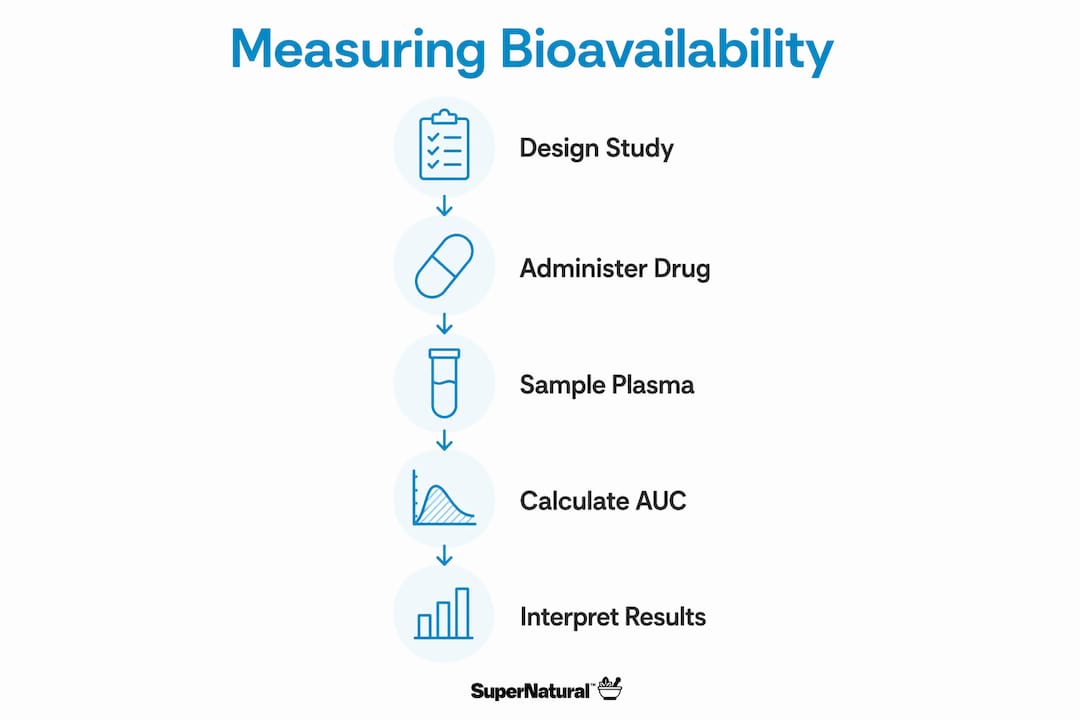
How scientists measure bioavailability in practice
Quantifying bioavailability requires careful pharmacokinetic study design. The gold standard is the plasma concentration-time curve, but several complementary methods exist depending on the drug’s properties.
| Method | How it works | Best used when | Key limitation |
|---|---|---|---|
| AUC comparison (plasma) | Measures total drug exposure in plasma after IV and non-IV dosing; calculates ratio | Most drugs with measurable plasma concentrations | Requires IV reference arm; invasive sampling |
| Urine excretion study | Measures unchanged drug excreted in urine after a single dose | Drugs primarily excreted unchanged in urine | Collection must span 7–10 elimination half-lives for accuracy |
| Steady-state assessment | Estimates bioavailability from urine collection during multiple dosing | Chronic dosing regimens | Assumes constant absorption; complex kinetics |
| Single-dose plasma study | Tracks plasma concentration at multiple time points after one dose | Early drug development, bioequivalence studies | Variability between subjects can be high |
The AUC is the most reliable metric because it captures total drug exposure rather than just the peak concentration. Peak plasma concentration (Cmax) can be misleading: two formulations can share the same Cmax but differ substantially in total exposure, or vice versa. Dose normalization, dividing AUC by the administered dose, is required whenever the test and reference doses are not identical, and it is a non-negotiable step for valid comparison.
Variability is the central challenge in bioavailability measurement. Intrasubject and intersubject variability in absorption, metabolism, and elimination means that a single measurement rarely tells the whole story. Crossover study designs, where the same subjects receive both test and reference formulations in separate periods, are the standard approach for minimizing this variability in bioequivalence trials.
U.S. regulatory standards and the science pushing bioavailability forward
The FDA’s regulatory framework for bioavailability and bioequivalence is among the most detailed in the world, and it directly shapes how drugs reach American patients.
The FDA defines bioavailability as the rate and extent to which an active ingredient is absorbed and becomes available at the site of action. Bioequivalence, under the same framework, means there is no significant difference in the rate and extent of absorption between pharmaceutical equivalents under the same conditions. Critically, chemical equivalence does not automatically mean bioequivalence: two products with identical active ingredients can differ in bioavailability because of differences in inactive ingredients, manufacturing processes, or formulation design.
The FDA permits both in vivo and in vitro study designs for bioequivalence determinations, depending on the drug class and the strength of the correlation between in vitro dissolution and in vivo absorption. For most oral solid dosage forms, in vivo pharmacokinetic studies in human subjects remain the standard.
“Bioavailability is not a fixed property of the active compound alone but depends on delivery method and physiological context, implying continuous innovation in formulation science. Small changes in formulation can cause major differences in therapeutic outcomes, and long-term treatment can reveal nonequivalence after switching formulations.” — Merck Manual, Clinical Pharmacology
On the research front, pharmaceutical scientists are actively working to improve bioavailability for drugs that are poorly absorbed by conventional formulations. Cyclodextrin inclusion complexes are one of the most studied approaches: these carrier molecules encapsulate a drug molecule, improving its aqueous solubility and protecting it from degradation in the gastrointestinal tract, which directly increases absorption and therapeutic effect. Other strategies include nanoparticle delivery systems, lipid-based formulations, and solid dispersions.
This same principle, that delivery method is as important as the active ingredient itself, drives the formulation science behind enhanced bioavailability in the supplement space. SuperNatural Supplements’s patented BioSoluble Curcumin process applies this logic directly: standard curcumin has notoriously poor oral bioavailability, and the BioSoluble process is designed to address that limitation at the formulation level.
Pro Tip: When evaluating any supplement or pharmaceutical product, look beyond the active ingredient label. Ask how the formulation is designed to deliver that ingredient to where it needs to go. A product with a superior delivery system will consistently outperform a higher-dose product with poor absorption.
What you should take away about bioavailability
Bioavailability is one of the most clinically consequential concepts in pharmacology, and understanding it gives you a sharper lens for evaluating drugs, supplements, and dosing decisions.
Here is a concise recap of what matters most:
- Definition: Bioavailability is the fraction and rate at which an active ingredient reaches systemic circulation or its site of action after administration.
- IV as the benchmark: Intravenous administration is defined as 100% bioavailability; all other routes are measured against it.
- Two types: Absolute bioavailability compares a non-IV route to IV; relative bioavailability compares two non-IV formulations.
- AUC is the gold standard: Total drug exposure measured by the area under the plasma concentration-time curve is more reliable than peak concentration alone.
- Multiple factors at play: First-pass metabolism, formulation, food, concurrent medications, and individual physiology all shift bioavailability, sometimes substantially.
- Clinical stakes: Dosing regimens, loading doses, and maintenance doses are all calculated using bioavailability data. For narrow therapeutic index drugs, small differences matter.
- Regulatory framework: The FDA requires bioequivalence demonstration for generic drug approval, ensuring that substituted generics produce the same clinical outcomes as their reference products.
- Formulation science: Carrier systems like cyclodextrins and advanced delivery technologies are actively improving bioavailability for poorly absorbed compounds, in both pharmaceuticals and supplements.
Bring this knowledge into conversations with your healthcare provider, especially when switching formulations, moving between brand-name and generic drugs, or evaluating supplement products that make absorption-related claims. The science is clear: how a compound is delivered matters as much as what the compound is.
Key Takeaways
Bioavailability determines how much of any administered drug or substance actually reaches its site of action, making it the single most critical variable in pharmacokinetics and clinical dosing.
| Point | Details |
|---|---|
| IV sets the 100% benchmark | Every non-IV route is measured as a fraction of intravenous bioavailability, adjusted for dose. |
| AUC is the gold standard metric | Total plasma drug exposure over time is more reliable than peak concentration for measuring bioavailability. |
| Formulation changes bioavailability | Carriers like cyclodextrins and advanced delivery systems can significantly increase absorption of poorly soluble drugs. |
| FDA requires bioequivalence for generics | Generic drugs must demonstrate equivalent rate and extent of absorption before receiving U.S. regulatory approval. |
| SuperNatural Supplements addresses absorption directly | The patented BioSoluble Curcumin process is designed to overcome the poor oral bioavailability of standard curcumin at the formulation level. |
SuperNatural Supplements puts bioavailability science to work
Standard curcumin is a textbook example of a compound with poor oral bioavailability: the active ingredient is there, but the body absorbs very little of it without a delivery system designed to help. That gap between what is on the label and what actually reaches your cells is exactly the problem SuperNatural Supplements was built to solve.
SuperNatural Supplements’s patented BioSoluble Curcumin process applies the same formulation science that pharmaceutical researchers use to improve drug absorption, delivering significantly enhanced bioavailability compared to standard curcumin. The result is a supplement where the active compound is genuinely available to your body, not just present on a label. BodyControl supports detoxification and a healthy inflammatory response, BodyBoost is formulated for superior immune support, and BrainBoost targets advanced cognitive function, all built on the same absorption-first foundation. If you have spent time understanding why bioavailability matters, the logical next step is choosing a supplement that takes it seriously. Visit SuperNatural Supplements to learn more about the BioSoluble Curcumin technology and find the formula that fits your health goals.
This article is provided for educational and informational purposes only and does not constitute providing medical advice or professional services. Always consult with a qualified and licensed physician or other medical care provider. Statements have not been evaluated by the Food & Drug Administration. This product is not intended to diagnose, treat, cure, or prevent any disease.
Recommended
- Enhanced Bioavailability Explained: What the Science Really Means – SuperNatural
- Explaining Supplement Bioavailability for Brain and Body Health – SuperNatural
- How to Enhance Bioavailability for Better Supplement Results – SuperNatural
- Why Choose Bioavailable Supplements for Better Health – SuperNatural