

Turmeric has been a kitchen staple for thousands of years, but most people who reach for it are unknowingly bypassing the real story. The compound responsible for the majority of turmeric’s celebrated health effects is curcumin, a yellow-orange polyphenol that makes up just 2 to 9% of the spice by weight. Understanding the difference between the two is not just a matter of semantics. It is the key to knowing whether your supplement is actually doing anything meaningful for your body and brain.
Table of Contents
- What is curcumin? Defining the active compound
- How curcumin works: Key health benefits for mind and body
- Bioavailability: Why it matters and how to boost curcumin absorption
- Safety, dosing, and what to look for in a curcumin supplement
- What science really says: Sorting fact from hype
- Why curcumin still matters: Our take on the science and healthy living
- Boost your wellness with premium curcumin solutions
- Frequently asked questions
Key Takeaways
| Point | Details |
|---|---|
| Curcumin vs. turmeric | Curcumin is the active health ingredient found in a small fraction of turmeric root. |
| Evidence-backed benefits | Curcumin can reduce inflammation and support cognitive wellness, especially with the right dose and form. |
| Absorption matters | Most curcumin is poorly absorbed without enhancers like piperine or advanced formulations. |
| Safe and effective use | Supplements are generally safe at 500-800 mg per day but higher doses can cause GI side effects. |
| Choose wisely for results | Look for supplements with research-backed absorption technology to maximize curcumin’s health potential. |
What is curcumin? Defining the active compound
Turmeric is a root. Curcumin is the active ingredient extracted from that root. Think of it like wanting a strong espresso instead of just sniffing the coffee bag. The bag smells great, but the concentrated brew is what actually delivers the effect.
Curcumin belongs to a class of compounds called curcuminoids, which are the primary drivers of turmeric’s antioxidant and anti-inflammatory reputation. The primary bioactive component in turmeric, curcumin, is extracted from the rhizomes of Curcuma longa and has been studied extensively for its potential to support human health. The challenge is that turmeric root contains so little of it that cooking with turmeric alone rarely delivers a therapeutic dose.
Here is what sets curcumin apart from raw turmeric in a supplement context:
- Concentration: Curcumin supplements are standardized to contain a much higher percentage of curcuminoids than you would ever get from sprinkling turmeric on your food.
- Targeted delivery: Quality supplements are formulated to get curcumin into your bloodstream, not just your digestive tract.
- Consistency: Every capsule delivers a measured dose, whereas turmeric powder varies widely in curcuminoid content depending on the source and processing method.
- Scientific backing: Most clinical research uses isolated or enhanced curcumin, not raw turmeric powder, so the evidence applies directly to the supplement form.
For anyone serious about curcumin absorption explained and getting real results, understanding this distinction is the essential first step. And if cognitive support is part of your wellness goal, exploring natural brain health supplements that use concentrated curcumin is a logical next move.
Now that you know why curcumin deserves special attention, let’s investigate exactly how it supports your health.
How curcumin works: Key health benefits for mind and body
Curcumin’s reputation is built on two main pillars: antioxidant activity and anti-inflammatory action. These two mechanisms ripple outward to affect nearly every system in your body, including your brain.

Research shows that curcumin supports cognitive function and reduces neuroinflammation, with meta-analyses reporting improved global cognition at an optimal dose of around 0.8 g per day for at least 24 weeks. The effects are particularly pronounced in adults aged 60 and older and in Asian populations, which suggests that baseline inflammation levels and metabolic factors play a role in how well curcumin works for any given individual.
The mechanisms behind these effects are specific and well-studied. Curcumin modulates oxidative stress pathways, increasing superoxide dismutase (SOD) and glutathione (GSH) while reducing malondialdehyde (MDA), a marker of cellular damage. It also reduces TNF-alpha activity in the hippocampus (the brain’s memory center), supports BDNF (brain-derived neurotrophic factor, a protein that helps neurons grow and connect), and influences NF-kB, a molecular switch that governs inflammation throughout the body.
“Curcumin’s influence on BDNF is particularly significant because BDNF acts like fertilizer for your neurons. Supporting it means supporting the brain’s ability to adapt, learn, and retain information over time.”
Here is a summary of the most evidence-supported benefits:
- Reduced systemic inflammation: Curcumin targets multiple inflammatory pathways simultaneously, which is rare for a single compound.
- Antioxidant protection: It neutralizes free radicals and boosts the body’s own antioxidant defenses.
- Cognitive support: Improvements in working memory and attention have been documented, especially with consistent, long-term use.
- Mood and focus: Some trials report improvements in mood alongside cognitive measures, likely linked to reduced neuroinflammation.
- Joint and gut health: Studies in rheumatoid arthritis (RA) and ulcerative colitis (UC) show meaningful symptom reduction with regular curcumin use.
| Benefit area | Evidence strength | Notes |
|---|---|---|
| Inflammation reduction | Strong | Multiple RCTs and meta-analyses |
| Cognitive function | Moderate | Best in older adults, 24+ weeks |
| Joint health (RA) | Moderate | Symptom reduction documented |
| Gut health (UC) | Moderate | Clinical remission rates improved |
| Mood and focus | Emerging | Promising but needs more trials |
If curcumin for inflammation is your primary goal, the evidence is solid. If you are looking at curcumin for memory, the data is encouraging but requires realistic expectations and a commitment to consistent use.
With these potential benefits, an important question arises: why don’t all turmeric supplements deliver the same results? The answer lies in bioavailability.
Bioavailability: Why it matters and how to boost curcumin absorption
Bioavailability refers to how much of a substance actually enters your bloodstream and reaches the tissues where it is needed. Curcumin has a well-documented problem in this department. Unconjugated plasma levels remain extremely low, often below 38 nanomoles per liter, even with enhanced formulations. This is because curcumin is poorly soluble in water, rapidly metabolized in the gut and liver, and quickly eliminated from the body.
In plain terms: most standard curcumin supplements pass through you without doing much. It is like buying a premium product and leaving it in the packaging.
Fortunately, the supplement industry has developed several technologies to address this. Here is how the leading approaches compare:
| Formulation type | Bioavailability increase | Examples |
|---|---|---|
| Standard curcumin | Baseline (low) | Generic turmeric capsules |
| Piperine (black pepper extract) | Up to 2000% increase | BioPerine combinations |
| Phytosome (lipid-bound) | Significantly enhanced | Meriva, Indena |
| Nanoparticle formulations | High | BCM-95, CurcuWIN |
| Liposomal curcumin | High | NovaSOL |
| BioSoluble technology | Significantly enhanced | SuperNatural BioSoluble Curcumin |
The recommended therapeutic range with absorption enhancers is 500 to 3000 mg per day, though most people benefit from staying closer to the lower end of that range with a high-quality formulation.
Here is a practical breakdown of how to boost absorption:
- Choose a formulation with proven technology. Look for piperine, phytosomes, liposomes, or patented delivery systems on the label.
- Take curcumin with a meal that contains healthy fats. Curcumin is fat-soluble, so dietary fat helps it absorb through the gut wall.
- Be consistent. Single doses rarely show dramatic effects. Benefits accumulate over weeks and months of regular use.
- Avoid generic turmeric powder capsules for therapeutic goals. They simply cannot compete with specialized formulations.
- Check for third-party testing. Quality brands verify that what is on the label is actually in the capsule.
Pro Tip: If you are cooking with turmeric at home, add a pinch of black pepper and a drizzle of olive oil to the dish. This simple combination meaningfully improves how much curcumin your body can use from food sources, even if it still falls short of supplement levels.
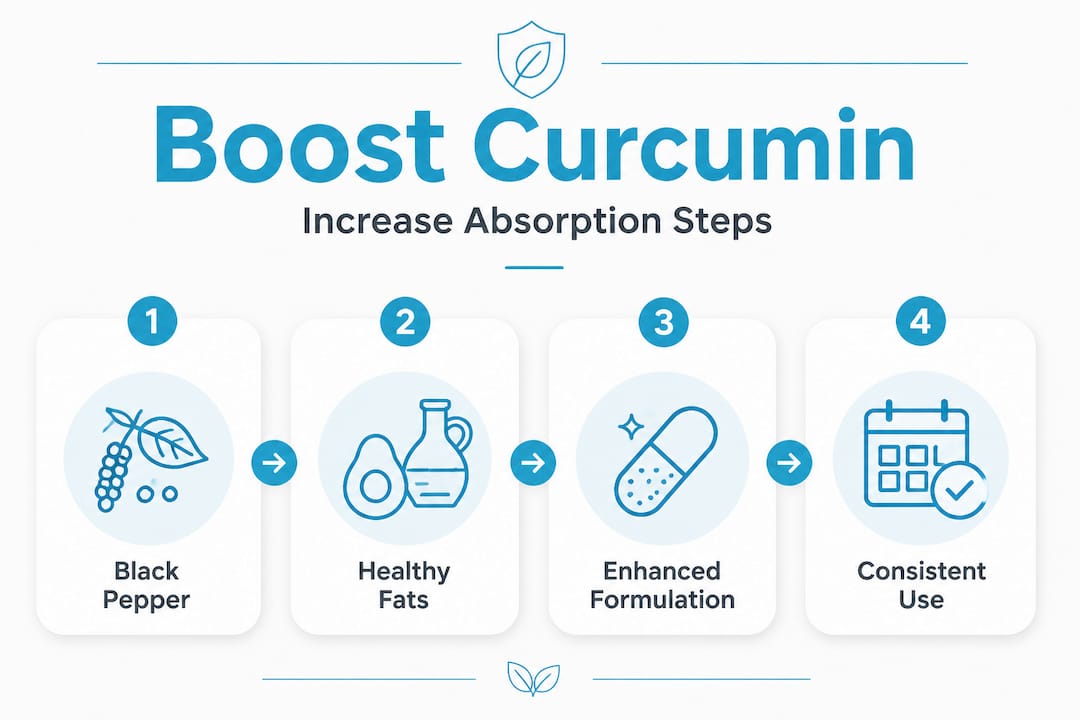
Understanding how to enhance absorption is what separates people who notice results from those who give up after a few weeks. Our BioSoluble® Curcumin™ technology was developed specifically to solve this absorption problem at the formulation level.
Once you understand bioavailability, it is time to consider safety and how to choose the right supplement for your goals.
Safety, dosing, and what to look for in a curcumin supplement
For most healthy adults, curcumin is well-tolerated at culinary and standard supplement doses. The safety profile is genuinely reassuring when you stay within recommended ranges. However, higher doses carry real risks that are worth knowing upfront.
Side effects at doses above 3000 mg can include nausea, diarrhea, headaches, and in rare cases, liver toxicity. Some cognitive trials have also reported higher rates of gastrointestinal discomfort at elevated doses. This does not mean curcumin is dangerous. It means that more is not always better, and that formulation quality matters as much as quantity.
Key safety considerations to keep in mind:
- Pregnancy and breastfeeding: High-dose curcumin supplements are not recommended. Culinary amounts are generally considered safe.
- Blood thinners: Curcumin may enhance the effects of anticoagulant medications. Check with a doctor if you take warfarin or similar drugs.
- Iron absorption: Very high doses may interfere with iron absorption over time, which is relevant for anyone managing iron levels.
- Gallbladder issues: Curcumin stimulates bile production, which can be problematic for people with gallstones or bile duct obstruction.
When choosing a supplement choice comparison that fits your needs, here is what to prioritize:
- Standardized curcuminoid content: Look for supplements standardized to at least 95% curcuminoids.
- Proven absorption technology: Piperine, phytosomes, liposomes, or patented systems like BioSoluble Curcumin.
- Transparent dosing: Avoid proprietary blends that hide individual ingredient amounts.
- RCT-backed formulations: The best products can point to randomized controlled trials supporting their specific form.
- Third-party verification: Independent testing confirms label accuracy and purity.
Pro Tip: A dose of 500 to 800 mg per day with a quality absorption enhancer is a practical starting point for most adults. This range sits comfortably within the safety window while still delivering meaningful support for inflammation and cognitive wellness.
Having explored practical details, let’s consider where curcumin actually stands, balancing hype with scientific realities.
What science really says: Sorting fact from hype
Curcumin is one of the most studied natural compounds in the world. That is both its strength and the source of a lot of confusion. The sheer volume of research creates space for both legitimate enthusiasm and misleading headlines.
“The gap between what curcumin does in a lab dish or animal model and what it reliably does in a human clinical trial is real, and it is primarily a bioavailability problem, not a potency problem.”
Human trials show inconsistent cognitive benefits, with some meta-analyses finding no global cognitive effect while others report domain-specific improvements, particularly in working memory. This inconsistency is largely explained by differences in formulation, dosing, study duration, and participant characteristics across trials.
What the evidence does support consistently:
- Inflammation markers: Regular curcumin use measurably reduces inflammatory biomarkers in blood.
- Joint symptoms: RA patients show meaningful symptom reduction with curcumin supplementation.
- Gut health: Clinical remission rates in UC show a relative risk of 2.45 compared to placebo, which is a clinically significant finding.
- Cognitive support over time: Benefits for memory and focus are real but require at least 24 weeks of consistent use to emerge.
- Preclinical robustness: Animal and cell-based studies consistently show strong effects, which gives researchers confidence that the potential is real even when human trials are mixed.
The honest takeaway is this: curcumin is not a miracle compound that will transform your health overnight. But for people who use bioavailable forms consistently and pair them with a healthy lifestyle, it is a genuinely useful tool. If advanced cognitive support is your goal, curcumin is a meaningful ingredient in that strategy, not a shortcut.
Why curcumin still matters: Our take on the science and healthy living
We have spent years reviewing the research on curcumin, and here is the perspective we keep coming back to: the biggest mistake people make with curcumin is treating it like a pharmaceutical drug. They expect a fast, dramatic result from a single ingredient, and when it does not arrive in two weeks, they conclude it does not work.
That is the wrong framework entirely. Curcumin is a long-term wellness ally. Its benefits are cumulative, systemic, and most powerful when they are layered on top of a diet rich in whole foods, consistent movement, and quality sleep. Taken in isolation, even the best curcumin supplement has limits. Taken as part of a thoughtful wellness routine, it can genuinely move the needle on inflammation, cognitive resilience, and overall vitality.
We also want to be direct about formulation. Not all curcumin supplements are created equal, and the difference between a generic turmeric capsule and a bioavailable curcumin formulation is not marginal. It is the difference between taking something and actually absorbing it. If you are going to invest in a curcumin supplement, invest in one where the delivery technology has been validated.
The science is not perfect. Human trials are messy, populations vary, and bioavailability remains a real challenge even with modern formulations. But the direction of the evidence is clear: curcumin, used correctly, supports a healthier inflammatory response and a sharper, more resilient mind over time. Learning how to maximize curcumin’s benefits through smart formulation choices and lifestyle pairing is where the real opportunity lies.
Boost your wellness with premium curcumin solutions
If this guide has clarified why curcumin quality and absorption technology matter so much, you are ready to take the next step with a supplement that actually delivers on the science.
At SuperNatural, we developed our patented BioSoluble® Curcumin™ process specifically to solve the bioavailability problem that limits most curcumin supplements on the market. Our BodyControl formula supports detoxification and a healthy inflammatory response, while our BrainBoost cognitive support formula is designed for those who want advanced mental performance, sharper focus, and long-term cognitive resilience. Both are built on the same foundation of superior absorption technology and transparent, evidence-backed formulation. Explore our range and find the right fit for your wellness goals.
Frequently asked questions
Is curcumin the same as turmeric?
No. Curcumin is the primary bioactive compound found inside turmeric, comprising just 2 to 9% of the spice by weight. Turmeric is the whole root; curcumin is its most potent active ingredient.
How much curcumin should you take daily?
Research points to an optimal dose of around 0.8 g per day for cognitive benefits, with therapeutic ranges of 500 to 800 mg being practical and well-tolerated for most adults using absorption-enhanced formulas.
Can you get enough curcumin from food?
Reaching therapeutic curcumin levels through diet alone is very difficult. Poor water solubility and rapid metabolism mean that even generous culinary use of turmeric delivers only a fraction of what a quality supplement provides.
Are there side effects from curcumin supplements?
Most people tolerate curcumin well at standard doses, but doses above 3000 mg can cause nausea, diarrhea, or headaches. Those on blood thinners or with gallbladder conditions should consult a doctor before supplementing.
Does curcumin really help with memory and focus?
Curcumin shows genuine promise for memory and focus, particularly in older adults, but human trials show inconsistent results across cognitive domains. Consistent use for at least 24 weeks with a bioavailable formulation gives you the best chance of meaningful benefit.
Recommended
- Curcumin absorption explained: maximize benefits for health – SuperNatural
- Natural supplements for brain health and inflammation – SuperNatural
- BioSoluble® Curcumin™ – SuperNatural
- How to support brain health: step-by-step habits that work – SuperNatural
- Dietary supplements explained: benefits, risks, and mushroom science – LongevityBotanicals