

Supplement synergy is defined as the strategic pairing of nutrients or compounds so they amplify each other’s absorption, function, or health impact beyond what either achieves alone. This principle, also called nutrient synergy in clinical nutrition, explains why Vitamin D3 paired with K2 outperforms either taken solo, and why Curcumin combined with Piperine delivers dramatically better bioavailability than Curcumin by itself. According to research from Supplements AI, effective pairings produce measurable physiological improvements within 2–8 weeks. Understanding what is supplement synergy gives you a real framework for getting more from your supplement routine, not just more products.
What is supplement synergy and how does it work?
Supplement synergy works through specific biochemical mechanisms that either increase absorption, activate co-factors, or support enzyme function. Think of it like wanting a strong cup of coffee instead of just sniffing the beans. The compound is there, but without the right delivery, your body never fully uses it.
The science breaks down into a few key mechanisms:
- Absorption enhancement: Piperine (from black pepper) increases Curcumin bioavailability by inhibiting metabolic enzymes that would otherwise break it down before it reaches the bloodstream.
- Co-factor activation: Magnesium acts as a co-factor for Vitamin D metabolism. Without adequate magnesium, your body cannot properly convert Vitamin D into its active hormonal form.
- Competitive absorption: Some nutrients share the same transport pathways. Iron and calcium, for example, compete for absorption in the gut, which is why timing matters as much as pairing.
- Pathway targeting: Targeted multi-pathway combinations like caffeine plus L-theanine produce balanced stimulation that neither compound achieves alone.
Whole foods naturally contain these synergistic groupings. Spinach delivers iron alongside Vitamin C, which enhances iron uptake. Isolated supplements lack that built-in balance, so intentional pairing replicates what nature already figured out. The challenge is knowing which pairings are supported by evidence and which are just marketing.
Synergy also has an opposite: antagonism. Calcium taken at the same time as iron actively blocks iron absorption. Zinc and copper compete for the same receptors. These are antagonistic interactions, and ignoring them can quietly undermine your entire supplement routine.

Pro Tip: Take fat-soluble vitamins (A, D, E, K) with a meal that contains healthy fat. Without dietary fat present, absorption drops significantly regardless of what else you pair them with.
What are the best supplement combinations for health?
The most effective supplement pairings are backed by clinical research, not just popular opinion. Here are the combinations with the strongest evidence base.
| Supplement Pair | Mechanism | Primary Benefit |
|---|---|---|
| Vitamin D3 + K2 | K2 directs calcium to bones, not arteries | Bone density and cardiovascular health |
| Curcumin + Piperine | Piperine blocks Curcumin breakdown | Anti-inflammatory support, joint health |
| Iron + Vitamin C | Vitamin C converts iron to absorbable form | Corrects iron deficiency more effectively |
| Magnesium + Vitamin D | Magnesium activates Vitamin D conversion | Immune function, mood, bone metabolism |
| Caffeine + L-Theanine | L-Theanine smooths caffeine’s stimulant edge | Focused energy without anxiety or crash |
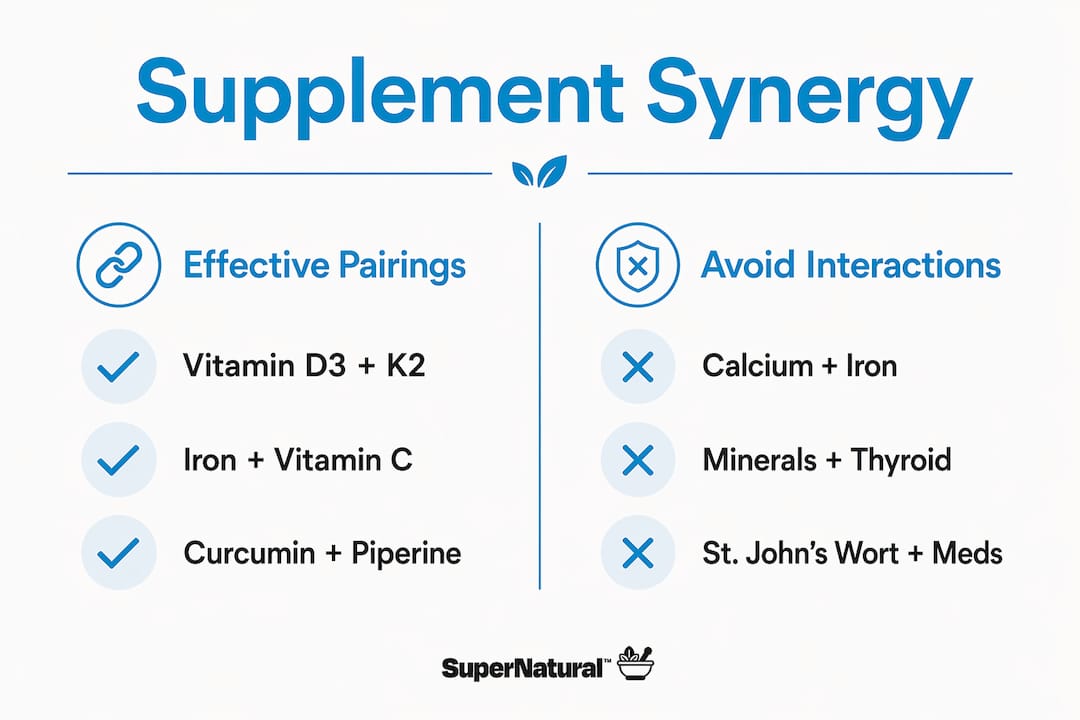
Vitamin C significantly increases iron absorption when taken together, making this one of the most clinically validated pairings in nutritional science. For anyone managing low iron levels, this combination is far more effective than iron supplementation alone.
The Vitamin D3 and K2 pairing deserves special attention. Vitamin D increases calcium absorption from food and supplements. K2 then activates proteins that direct that calcium into bones rather than soft tissue. Without K2, high-dose Vitamin D supplementation can theoretically contribute to arterial calcification over time. The two nutrients are genuinely interdependent.
A few other evidence-backed pairings worth noting:
- Omega-3 fatty acids + Vitamin E: Vitamin E protects omega-3s from oxidation, preserving their anti-inflammatory activity.
- Zinc + Vitamin A: Zinc is required for the liver to release stored Vitamin A into circulation.
- B vitamins (B6, B9, B12): These three work together in the methylation cycle, which affects mood, cardiovascular health, and DNA repair.
Pro Tip: When evaluating any supplement stack benefits, look for combinations that have been tested in randomized controlled trials, not just observational studies. The quality of evidence matters as much as the pairing itself.
Popular blends with high ingredient counts do not automatically deliver better results. The highest ingredient count does not equal best effect. A targeted two or three ingredient combination with solid clinical backing will outperform a 20-ingredient formula built on weak evidence every time.
What supplement interactions should you avoid?
Not all supplement combinations are beneficial. Some pairings reduce effectiveness, and others carry genuine health risks.
The most common problematic interactions include:
- Calcium and iron: High-dose calcium inhibits iron uptake when taken simultaneously. Space these at least 2 hours apart.
- St. John’s Wort and medications: This herbal supplement activates liver enzymes that accelerate the breakdown of antidepressants, birth control pills, and blood thinners, reducing their effectiveness significantly.
- Zinc and copper: Long-term high-dose zinc supplementation depletes copper, which can cause neurological symptoms over time.
- Vitamin E and blood thinners: High-dose Vitamin E has anticoagulant properties that can amplify the effect of medications like warfarin.
Minerals present a particularly subtle risk. Calcium, iron, and magnesium can interfere with the absorption of thyroid hormones and certain antibiotics when taken together. Spacing mineral supplements by 2–4 hours from medications is not optional. It is a clinical necessity.
The phrase “natural doesn’t mean safe” is not a cliché here. It is a documented reality. Herbal supplements are less regulated than prescription drugs, and their interactions with medications are frequently underreported. Always use a verified drug interaction checker, such as the one at Drugs.com, before adding any new supplement to a regimen that includes prescription medications.
Pro Tip: If you take thyroid medication, set a firm rule: no minerals, no calcium, no iron within 4 hours of your dose. This single habit protects the medication’s efficacy and prevents a common but invisible problem.
How to build a safe supplement synergy protocol
Building an effective supplement routine is not about adding more products. It is about building a defined protocol with clear goals, timing rules, and a feedback system.
A successful supplement stack is a structured protocol with timing, doses, explicit stop criteria, and a measurement plan. Here is how to build one that actually works:
- Define your goal first. Are you targeting inflammation, immune support, cognitive function, or bone health? Your goal determines your foundation nutrients. Without a goal, you are stacking by instinct, not by evidence.
- Start with foundational nutrients. Vitamin D3, magnesium, and omega-3s address widespread deficiencies and support multiple systems. Build your base before adding goal-specific modules.
- Add one supplement at a time. Adding one supplement at a time and logging outcomes is the only way to know what is actually working. Adding five supplements simultaneously makes it impossible to identify what helped or what caused a side effect.
- Set a reassessment window. Review your stack every 2–4 weeks. Check biomarkers where possible (blood tests for Vitamin D, iron, or inflammatory markers). Adjust doses or remove supplements that are not producing measurable results.
- Space competing minerals. Take calcium-based supplements and iron supplements at least 2 hours apart. Take minerals away from thyroid or antibiotic medications by at least 4 hours.
- Build in a washout period. Every 8–12 weeks, consider stopping non-essential supplements for 1–2 weeks. This helps you identify which supplements are genuinely contributing to how you feel.
- Consult a healthcare provider. Before adding herbal supplements or high-dose single nutrients, get a professional review. This is especially true if you take any prescription medications.
Stacks without evidence-based goals and measurement protocols often result in wasted money and no measurable benefit. The goal is not an impressive supplement shelf. The goal is a lean, targeted protocol that moves specific health markers in the right direction.
You can also explore a daily supplement plan built around these synergy principles to see how a structured approach comes together in practice.
Key takeaways
Supplement synergy produces the greatest benefit when specific, evidence-backed pairings are combined with clear goals, correct timing, and regular reassessment.
| Point | Details |
|---|---|
| Synergy requires intentional pairing | Combine nutrients that enhance each other’s absorption or function, not random combinations. |
| Timing prevents antagonism | Space competing minerals like calcium and iron by at least 2 hours to avoid blocking absorption. |
| Start with foundational nutrients | Build your base with Vitamin D3, magnesium, and omega-3s before adding goal-specific supplements. |
| Track and reassess every 2–4 weeks | Log effects and adjust your protocol based on measurable outcomes, not guesswork. |
| Medical review is non-negotiable | Herbal supplements and high-dose nutrients can interact with medications in serious ways. |
Our take on supplement synergy: what we’ve learned
We have spent years studying how nutrients interact, and the most common mistake we see is people treating their supplement routine like a grocery list. They add products based on what sounds good, not based on a defined goal or a feedback system. The result is expensive and ineffective.
The second most common mistake is assuming that more ingredients equal better results. The future of supplementation lies in multiplicative formulas that target multiple biological pathways with proven ingredient synergy. That is a fundamentally different philosophy from loading a capsule with 30 ingredients at trace doses.
What we have found actually works is a short, targeted stack built around one or two primary goals, with nutrients chosen for their documented interactions. The Curcumin and Piperine pairing is a perfect example. Curcumin alone has poor bioavailability. Add Piperine, and absorption increases dramatically. That is not marketing. That is biochemistry. We built our BioSoluble® Curcumin formulation around this exact principle because we wanted results you can feel, not just a label you can read.
The uncomfortable truth about supplement synergy is that it requires discipline. It requires you to track, reassess, and sometimes remove supplements that are not working. Most people skip that part. The ones who do not skip it are the ones who actually see results.
— SuperNatural
Discover SuperNatural supplements’ synergy-driven formulas
SuperNatural Supplements builds every product around the science of synergy, not ingredient volume. Our patented BioSoluble® Curcumin process delivers significantly enhanced bioavailability compared to standard curcumin, putting the Curcumin and Piperine synergy principle directly into practice. BodyControl supports detoxification and a healthy inflammatory response. BodyBoost is formulated for superior immune support. BrainBoost targets advanced cognitive function with synergistic ingredient combinations designed to support focus and mental clarity.
Every formula we create starts with a question: which combinations are actually supported by clinical evidence? If you are ready to move from a random supplement shelf to a targeted, synergy-based protocol, explore our full lineup at SuperNatural Supplements.
FAQ
What is supplement synergy in simple terms?
Supplement synergy is when two or more nutrients work together to produce a greater health benefit than either would alone. The Vitamin D3 and K2 pairing is one of the most well-known examples.
What are the most effective synergistic supplement pairs?
The strongest evidence supports Vitamin D3 plus K2 for bone health, Curcumin plus Piperine for inflammation, Iron plus Vitamin C for absorption, and Magnesium plus Vitamin D for immune and metabolic function.
Can supplement combinations be dangerous?
Yes. High-dose calcium inhibits iron absorption, St. John’s Wort interacts with multiple medications, and minerals can reduce the efficacy of thyroid hormones when taken together. Always consult a healthcare provider before combining supplements with prescription drugs.
How long does it take to see results from a supplement stack?
Measurable physiological improvements from synergistic supplement pairings typically appear within 2–8 weeks, depending on the nutrients involved and your baseline levels.
How do i know if my supplement stack is working?
Track specific biomarkers (such as Vitamin D blood levels or inflammatory markers) and log how you feel every 2–4 weeks. If no measurable change occurs after 8 weeks, reassess the protocol rather than simply adding more products.
This article is provided for educational and informational purposes only and does not constitute providing medical advice or professional services. Always consult with a qualified and licensed physician or other medical care provider. Statements have not been evaluated by the Food & Drug Administration. This product is not intended to diagnose, treat, cure, or prevent any disease.