

Not all supplements are created equal, and the difference between a basic multivitamin and a truly advanced formulation goes far beyond price. If you have ever taken a supplement faithfully for months without noticing any change, the problem likely was not your commitment. It was the formula. Understanding why choose advanced supplements comes down to one core issue: your body can only benefit from what it can actually absorb and use. This guide cuts through the marketing noise and gives you a clear, evidence-based picture of what separates advanced dietary supplements from the rest.
Table of Contents
- Key takeaways
- Why advanced supplements differ from basic ones
- The science of bioavailability and effective dosing
- When advanced supplements make the most sense
- How to evaluate and choose high-quality supplements
- My honest take on advanced supplements
- Discover formulations that actually deliver
- FAQ
Key takeaways
| Point | Details |
|---|---|
| Bioavailability drives results | The nutrient form determines how much your body actually absorbs, not just the dose listed on the label. |
| Cost per effective dose is what matters | A cheaper supplement with poor absorption often delivers less value than a pricier, well-formulated one. |
| Not all supplements are necessary | Advanced supplements work best when targeted to confirmed deficiencies or specific health goals, not used as broad insurance. |
| Third-party testing must be verifiable | Look for batch-specific Certificates of Analysis, not just logos on the bottle. |
| Label transparency signals quality | Exact ingredient doses and no proprietary blends are hallmarks of a trustworthy advanced formulation. |
Why advanced supplements differ from basic ones
Walk into any supplement aisle and you will see hundreds of products that look nearly identical. Same ingredient names, similar claims, similar prices. But the differences inside the capsule matter enormously.
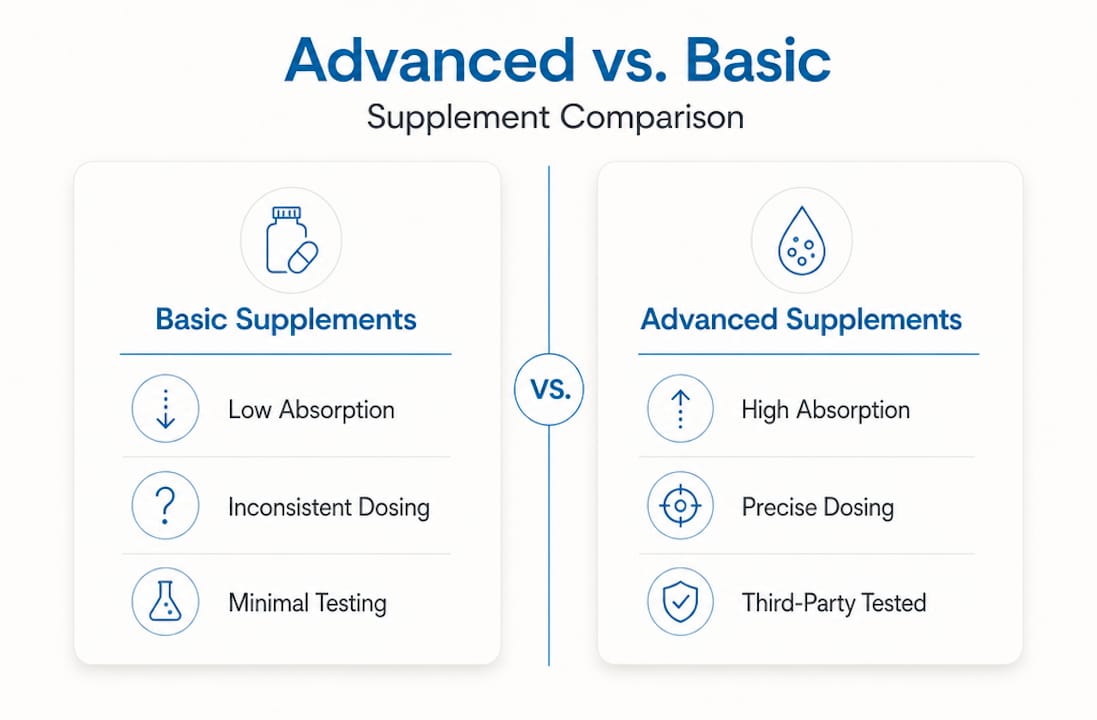
Advanced supplement formulas prioritize systems-based design, meaning they are built around how the body actually processes nutrients rather than simply throwing multiple ingredients together. A well-designed formula considers synergy between ingredients, physiological pathways, dosing precision, and the quality of each individual ingredient. This is the opposite of a “kitchen sink” blend that combines a dozen ingredients at doses too low to do anything meaningful.
Here is what actually separates advanced supplements from generic ones:
- Ingredient form: The specific chemical form of a nutrient determines how well it absorbs and whether it causes side effects. Methylcobalamin, for example, is the preferred B12 form over cyanocobalamin because the body uses it more directly.
- Delivery technology: Some nutrients are encapsulated in liposomes, phytosomes, or other delivery systems that protect them from degradation before absorption.
- Dosing accuracy: Advanced formulas disclose exact amounts of every ingredient. Generic formulas often hide amounts behind proprietary blends, which makes it impossible to know if a dose is therapeutic.
- Synergistic combinations: Certain nutrients enhance each other’s absorption or function. Vitamin D and K2 together, or curcumin paired with absorption-enhancing compounds, are examples of intentional, research-backed combinations.
- Quality control: Advanced manufacturers invest in third-party testing and batch-level documentation, not just internal quality checks.
The result is a supplement you can actually trust to do what the label says.
The science of bioavailability and effective dosing
Here is an analogy that puts it plainly: taking a poorly absorbed supplement is like wanting a strong cup of coffee but only sniffing the beans. The ingredient is present. Your body just cannot use it.
Bioavailability is the percentage of a nutrient that actually enters circulation and reaches the tissues where it is needed. This number varies dramatically depending on the ingredient form. Magnesium glycinate absorbs at 30 to 50%, while magnesium oxide absorbs at roughly 4%. That means 500mg of magnesium oxide delivers about 20mg of usable magnesium, while 200mg of magnesium glycinate delivers 80 to 100mg. The glycinate option gives you four to five times more actual magnesium per dose.

This is where the concept of cost per effective dose becomes critical for consumers. A bottle of magnesium oxide may cost less per capsule, but you get almost nothing for your money. The glycinate version costs more and delivers substantially more value per dollar. Choosing the cheapest option often means paying for something your body cannot use.
| Nutrient form | Bioavailability | Notes |
|---|---|---|
| Magnesium glycinate | 30 to 50% | Well tolerated, high absorption |
| Magnesium oxide | ~4% | Cheap, poor absorption, may cause GI distress |
| Methylcobalamin (B12) | High | Body-ready form, no conversion needed |
| Cyanocobalamin (B12) | Lower | Requires conversion; less effective for some people |
| Standard curcumin | ~1% | Extremely poor absorption without enhancement |
| BioSoluble® Curcumin™ | Significantly higher | Patented process for enhanced bioavailability |
Advanced supplements also account for tolerability. A formula that causes digestive upset or requires taking six capsules at once will not be used consistently, and consistency is what produces results. The best advanced formulas are refined with user tolerability in mind, not just theoretical efficacy in a lab.
Pro Tip: When evaluating a supplement’s third-party testing claims, do not just look for logos. Verify that batch-specific COAs are available, including the lab name, analytes tested, date, and lot number. A logo without documentation means very little.
When advanced supplements make the most sense
Supplements should complement a good diet, not substitute for one. Experts consistently recommend a food-first approach, using supplements to address confirmed deficiencies or targeted health goals rather than as general nutritional insurance. This is where advanced supplements genuinely shine. They are precise tools, not safety nets.
The people who benefit most from choosing advanced formulations include:
- Individuals with confirmed deficiencies such as low vitamin D, B12, magnesium, or iron, where the form of supplementation directly affects how quickly and fully levels are restored.
- Those with higher physiological demands such as athletes, people under chronic stress, older adults with reduced absorption capacity, or anyone recovering from illness.
- People managing specific health concerns such as inflammation, cognitive decline, or weakened immune function, where targeted formulations address those pathways directly.
- Anyone who has tried basic supplements without results, which often signals a bioavailability problem rather than a lack of need.
It is equally worth knowing what to skip. Detox supplements, fat burners, and certain performance boosters frequently lack credible clinical support. Advanced supplements are not synonymous with expensive or trendy. They are defined by evidence, precision, and transparency.
For targeted needs like brain health, Ordersupernatural’s BrainBoost cognitive support is designed with these exact principles. For immune function and inflammatory response, there are equally specific formulations built around bioavailable ingredients with documented mechanisms. The role of supplements in wellness is most powerful when the formula matches the need precisely.
How to evaluate and choose high-quality supplements
Knowing why advanced supplements matter is useful. Knowing how to identify them at the store or online is what protects your health and your wallet. Here is a practical process for choosing the best supplements.
-
Check the ingredient form, not just the ingredient name. “Magnesium” on a label tells you almost nothing. “Magnesium glycinate” or “magnesium malate” tells you the form, which determines absorption. Always look for the specific compound name.
-
Avoid proprietary blends. Labels with proprietary blends hide the exact amounts of each ingredient. This almost always means the formula is underdosed. A transparent label with exact milligrams per ingredient is the standard you should expect.
-
Look for third-party verification with documentation. Seals from organizations like NSF, USP, or Informed Sport are meaningful, but only if the company can provide actual batch-specific Certificates of Analysis. Ask for them. A trustworthy brand will have them ready.
-
Align the supplement with a confirmed need. Experts recommend starting with a targeted approach, measuring your baseline through bloodwork or symptom tracking, and then evaluating whether the supplement actually moves the needle. Random supplementation wastes money and can sometimes create imbalances.
-
Research the manufacturer’s quality standards. Who makes the supplement? Do they publish their manufacturing practices? Do they use Good Manufacturing Practices (GMP) certified facilities? A brand that is confident in its process will make this information easy to find.
Pro Tip: Before adding any new supplement to your routine, talk with your doctor or a registered dietitian. They can help you identify real deficiencies through testing, which makes your supplement choices far more precise and cost-effective.
The FDA does not approve supplements for efficacy before they reach the market. Manufacturers are responsible for product safety and accurate labeling. This makes independent evaluation skills non-negotiable for consumers. You are, in a meaningful sense, your own quality control department.
My honest take on advanced supplements
I have seen a lot of products come through the supplement world, and the label “advanced” gets attached to everything from legitimately engineered formulas to glorified multivitamins with an extra ingredient or two. Here is what I have learned: the word means something only when a brand can back it up with specifics.
What I look for first is transparency. Not natural versus synthetic (that distinction is often less meaningful than people think, since dose, form, purity, and context matter far more), but whether a company can tell me exactly what is in their product, at what dose, in what form, tested by whom, and in which batch. Most cannot. The ones that can have usually spent real resources on formulation.
The other thing I have learned is that advanced supplements work best as part of a broader strategy. They do not replace sleep, food quality, stress management, or exercise. What they do is fill specific gaps more effectively than generic options ever could. If you are taking a curcumin supplement but not getting any benefit, there is a very good chance your product has near-zero bioavailability. That is not a minor detail. That is the whole product.
My honest advice: be skeptical of anything that does not show you its work. And when you find a brand that does, that transparency itself is a meaningful signal.
— SuperNatural
Discover formulations that actually deliver
If you have read this far, you already understand that choosing advanced supplements is really about choosing formulations that have solved the bioavailability problem. That is exactly what we set out to do at Ordersupernatural.
Our patented BioSoluble® Curcumin™ process addresses one of the most documented failures in supplementation: standard curcumin absorbs at roughly 1%, making most curcumin products on the market nearly useless. Our formulation delivers significantly enhanced bioavailability through a groundbreaking patented process, so you get the real benefits of curcuminoids rather than expensive urine. Beyond curcumin, BodyControl supports detoxification and a healthy inflammatory response, BodyBoost is designed for superior immune support, and BrainBoost delivers advanced cognitive support with the same commitment to absorption and transparency. Every product we make is built on the principles this article lays out: verified forms, disclosed doses, and documented quality.
FAQ
What makes a supplement “advanced” vs. standard?
Advanced supplements use research-backed ingredient forms, precise therapeutic doses, and delivery systems that maximize absorption. They avoid proprietary blends and are backed by third-party testing with verifiable documentation.
Why does bioavailability matter so much?
Bioavailability determines how much of a nutrient your body actually absorbs and uses. A supplement with poor bioavailability, like magnesium oxide or standard curcumin, may deliver very little benefit even at high doses on the label.
Are expensive supplements always better?
Not automatically. Price alone is not a reliable quality signal. What matters is the ingredient form, dose transparency, and third-party verification. A well-formulated supplement at a moderate price often outperforms a flashy expensive one with a poorly absorbed ingredient form.
How do I know if a supplement is third-party tested?
Look beyond the logo. Request or locate batch-specific Certificates of Analysis that list the testing lab, the analytes checked, the date, and the lot number. Logos on the bottle without accessible documentation offer limited assurance.
Should I take advanced supplements without a doctor’s input?
It is best to check with a doctor or registered dietitian before starting any new supplement regimen. Bloodwork can confirm real deficiencies and help you choose targeted supplements that address confirmed needs rather than guessed ones.
This article is provided for educational and informational purposes only and does not constitute providing medical advice or professional services. Always consult with a qualified and licensed physician or other medical care provider. Statements have not been evaluated by the Food & Drug Administration. This product is not intended to diagnose, treat, cure, or prevent any disease.