

Picking a supplement off the shelf and assuming it works is a bit like smelling coffee beans and expecting a caffeine boost. The ingredient might be there, but without proper absorption, your body never actually gets the benefit. Bioavailability, which refers to how much of a nutrient your body can absorb and put to use, is the single most important quality factor most supplement shoppers never think about. This guide breaks down exactly why bioavailability matters, which ingredients stand out for focus and inflammation, and how to spot products that actually deliver measurable results rather than expensive promises.
Table of Contents
- What is bioavailability and why does it matter?
- How bioavailable supplements support focus and cognition
- Bioavailable ingredients versus standard supplements: What’s the difference?
- Bioavailability and inflammation: Evidence for real-world results
- How to choose the best bioavailable supplements
- The surprising truth: Why bioavailability beats marketing hype
- Next steps: Where to find science-backed bioavailable supplements
- Frequently asked questions
Key Takeaways
| Point | Details |
|---|---|
| Bioavailability unlocks results | Supplements only work when your body can absorb and use their nutrients efficiently. |
| Clinically proven forms matter | Choose supplements with ingredients shown to boost memory, focus, and reduce inflammation. |
| Quality over quantity | More milligrams are meaningless if absorption is poor—look for proven delivery systems instead. |
| Smart choices beat hype | Demand clinical evidence, branded ingredients, and avoid claims that ignore bioavailability. |
What is bioavailability and why does it matter?
Bioavailability is a term borrowed from pharmacology, and it simply answers one question: how much of what you swallow actually reaches your bloodstream and gets used by your body? A supplement could list 500mg of a beneficial compound on its label, yet if only 5% of that amount is absorbed, you are effectively getting 25mg of real benefit. That gap between label and reality is enormous, and it drives a significant portion of consumer disappointment with natural wellness products.
Understanding this concept is especially important if you are pursuing specific goals, whether that means sharper focus at work, a healthier inflammatory response, or stronger immune function. High bioavailability translates directly into greater real-world benefits. Low bioavailability means you might be spending money on supplements that are flushed out before they ever have a chance to work.
Here is a quick breakdown of what drives bioavailability:
- Molecular structure: Some nutrients are naturally water-soluble and absorb easily; others, like curcumin, are fat-soluble and notoriously difficult to absorb without help.
- Formulation technology: Patented carriers, phytosomes, liposomes, and co-factors like piperine can dramatically improve how much active compound reaches your cells.
- Digestive environment: Stomach acid, gut health, and the presence or absence of food all affect how well a nutrient is processed.
- Free vs. conjugated forms: Research shows that bioavailability claims often measure total conjugated forms rather than free, unconjugated active compounds, meaning plasma levels of the truly active ingredient can be far lower than marketing suggests.
This last point is critical. When a brand says their product is “10x more bioavailable,” you should ask: more bioavailable in what form? Free active compound, or total measured amount? The distinction matters enormously for your results.
Pro Tip: When reviewing any supplement’s bioavailability claims, look specifically for studies that measure free (unconjugated) active compound levels in plasma, not just total absorption. That is the number that reflects real biological activity.
To go deeper on the basics before we move forward, our guide on supplements explained offers a grounded starting point for understanding how natural compounds interact with your body.
How bioavailable supplements support focus and cognition
Now that you know bioavailability is the real driver of effective supplementation, let’s look at how it applies directly to brain health and cognitive performance.
Two ingredients stand out when it comes to clinically supported, bioavailable options for mental sharpness: Magnesium L-threonate and Alpha-GPC.

Magnesium L-threonate (often sold under the brand name Magtein) is a form of magnesium specifically designed to cross the blood-brain barrier, something standard magnesium oxide or citrate cannot do effectively. In a randomized controlled trial, Magnesium L-threonate improved cognition, including working memory, episodic memory, and reaction time, with participants showing the cognitive profile of someone roughly 7.5 years younger (p=0.043). That is not a subtle difference. That is the kind of measurable shift you can actually feel.
Alpha-GPC is a choline compound that the body converts into acetylcholine, the neurotransmitter most closely tied to memory formation and focused attention. Because Alpha-GPC is highly bioavailable, it crosses into brain tissue efficiently and raises acetylcholine levels in ways that standard lecithin or choline bitartrate supplements simply cannot match.
Here is a side-by-side comparison of common cognitive supplements in their standard versus bioavailable forms:
| Ingredient | Standard form | Bioavailable form | Key benefit |
|---|---|---|---|
| Magnesium | Magnesium oxide | Magnesium L-threonate | Crosses blood-brain barrier |
| Choline | Choline bitartrate | Alpha-GPC | Raises brain acetylcholine levels |
| Curcumin | Plain curcumin powder | BioSoluble or piperine-enhanced | Dramatically improved plasma levels |
| B12 | Cyanocobalamin | Methylcobalamin | Better cellular uptake and activity |
The pattern is clear. Each bioavailable form targets a specific absorption challenge that limits the standard version. These are not marketing upgrades. They reflect real differences in how your body processes these compounds.
Key reasons to prioritize bioavailable cognitive ingredients:
- Standard magnesium rarely crosses the blood-brain barrier in meaningful amounts.
- Alpha-GPC outperforms generic choline for memory and attention in clinical studies.
- Bioavailable forms produce changes in measurable brain markers, not just theoretical benefits.
- Lower doses of bioavailable compounds often achieve the same or better results than higher doses of standard forms.
Pro Tip: If you take magnesium for sleep or relaxation and have never noticed a cognitive benefit, you may be using a form that never reaches your brain. Switching to Magnesium L-threonate could make a noticeable difference within a few weeks.
For a broader look at how specific ingredients support mental clarity and reduce neuroinflammation, check out our coverage on supplements for brain health, or explore brain health habits for the lifestyle side of the equation.
Bioavailable ingredients versus standard supplements: What’s the difference?
Seeing the differences side by side reveals why bioavailable forms consistently outperform ordinary supplements, especially when the goal is reducing inflammation or supporting immunity over the long term.
The core distinction comes down to how the ingredient is prepared and delivered. Bioavailable supplements use specific delivery mechanisms to overcome the body’s natural absorption barriers. Standard supplements often skip this step entirely because it is cheaper and simpler to just pack more milligrams into a capsule.
Here is a practical comparison:
| Factor | Standard supplement | Bioavailable supplement |
|---|---|---|
| Absorption rate | Often under 10% | Can reach 20-40% or higher |
| Plasma levels | Low, inconsistent | Higher, more predictable |
| Required dose | High to compensate | Often lower, more efficient |
| Evidence base | Frequently limited | Typically more robust clinical data |
| Cost | Lower per bottle | Higher per bottle, but better value |
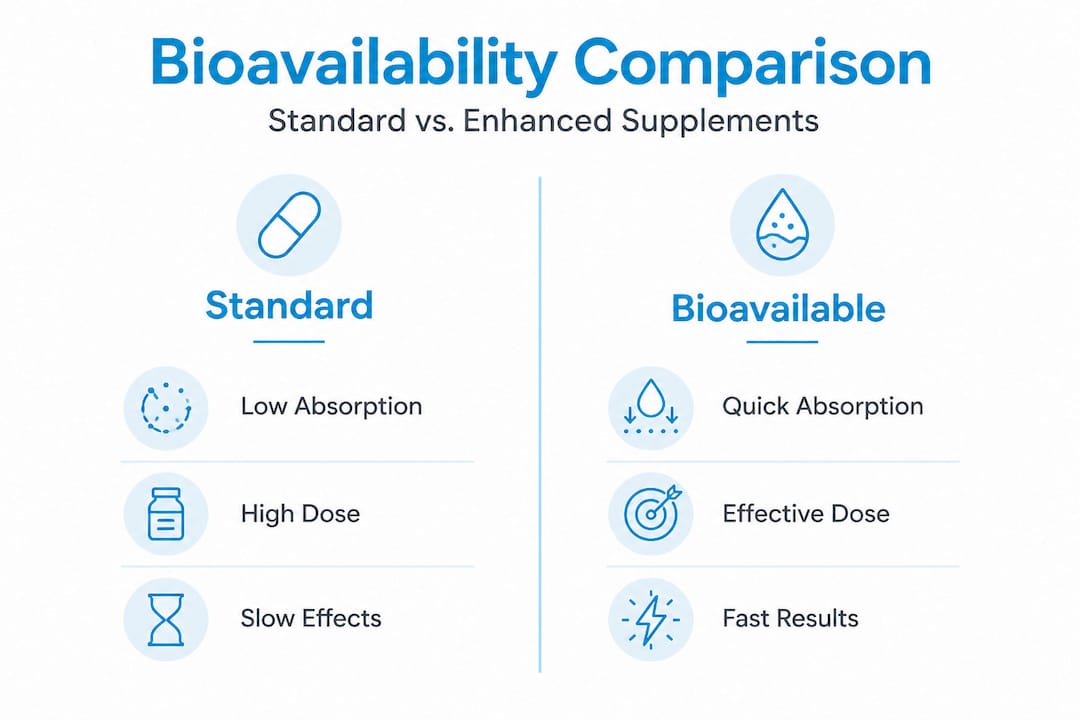
It is also worth noting that not all enhancements are equal, and the key is to verify free active compound levels rather than total absorption data. A supplement that increases total curcumin in your blood by 20x but only marginally increases the free, active curcumin form may not deliver the results you expect.
Here is a numbered list of factors that separate genuinely bioavailable products from the rest:
- Patented delivery systems: Look for phytosomes, liposomes, nanoemulsions, or named technologies like BioSoluble or Magtein.
- Co-factor inclusion: Piperine (black pepper extract) enhances curcumin absorption by up to 2,000% in some studies, and legitimate products include this or an equivalent.
- Standardized extracts: A supplement standardized to 95% curcuminoids is more reliable than a generic “turmeric powder” without specification.
- Third-party verified data: Legitimate companies cite published studies showing measurable outcomes, not just absorption curves.
- Transparent labeling: Bioavailable forms are typically named specifically (e.g., Magnesium L-threonate, not simply “magnesium”).
For a detailed look at why curcumin absorption is such a critical topic, our article on curcumin absorption explained is a useful next step. You can also explore the ingredients for cognition that combine anti-inflammatory and brain-supporting properties in one approach.
Bioavailability and inflammation: Evidence for real-world results
Armed with an understanding of what bioavailability means in practice, let’s look at the actual evidence for anti-inflammatory compounds and what the research says about real-world outcomes.
Three ingredients consistently show up at the top of evidence-based inflammation research: curcumin, omega-3 fatty acids, and magnesium glycinate.
Curcumin is the active compound in turmeric, and in its enhanced forms, it reduces CRP and IL-6 at levels comparable to common NSAIDs (non-steroidal anti-inflammatory drugs), without the gastrointestinal side effects. CRP (C-reactive protein) and IL-6 (interleukin-6) are two of the most widely measured markers of systemic inflammation, so this is clinically meaningful data, not theoretical.
Omega-3 fatty acids at doses of 2 to 3 grams of EPA plus DHA per day are proven to lower TNF-alpha and IL-6, two key inflammatory signaling molecules. The VITAL trial, a large randomized study, found a 40% reduction in heart attack risk among low fish consumers taking omega-3 supplements. That is the kind of outcome data that moves beyond laboratory markers into actual disease risk reduction.
Magnesium glycinate stands apart from cheaper magnesium forms because glycine, the amino acid it is bound to, actively supports calm and cellular repair. It is more absorbable than magnesium oxide (which is primarily used as a laxative) and better tolerated than magnesium citrate for most people.
“The supplements with the strongest anti-inflammatory evidence are not exotic or expensive. They are well-researched compounds used in forms your body can actually absorb and deploy.”
Key takeaways from the inflammation evidence:
- Enhanced curcumin (with piperine or equivalent technology) shows clinical inflammation-reducing effects in multiple trials.
- Omega-3s at therapeutic doses (2-3g EPA+DHA) demonstrate measurable reductions in cardiovascular risk and inflammatory markers.
- Magnesium glycinate supports the inflammatory response without the digestive discomfort of lower-grade magnesium salts.
- Results depend on bioavailable forms; the same ingredient in a poorly absorbed version may show no benefit at all.
Pro Tip: When reading supplement research, look for studies that measure outcomes like reduced CRP or fewer pain events, not just changes in plasma levels. Plasma levels tell you what’s circulating; outcomes tell you what’s working.
You can explore the full range of evidence-backed approaches in our detailed article on supplements for inflammation, or learn more about curcumin benefits and how they translate into daily wellness.
How to choose the best bioavailable supplements
Once you know what separates genuine quality from marketing noise, choosing the right supplement becomes far more straightforward. Here is a practical, step-by-step framework for evaluating any bioavailable supplement before you buy.
-
Look for clinical evidence of absorption or effect. Does the product page or label cite specific studies? Are those studies published in peer-reviewed journals? General health claims backed by nothing specific are a red flag.
-
Check for standardized or patented ingredient forms. Names like Magtein, BioSoluble, Bioperine, or FloraGLO signal that the manufacturer has invested in proven delivery technology rather than generic raw materials.
-
Prefer companies that disclose absorption studies. Reputable brands reference bioavailability data and distinguish between total and free active compound levels. As research confirms, verifying free active compound levels rather than just total dose data is the right standard.
-
Watch for dose-only marketing. A label that leads with “1,000mg!” without specifying the form or absorption data is prioritizing the appearance of value over actual efficacy.
-
Prioritize both safety and third-party testing. Bioavailable does not automatically mean safe in all doses. Look for NSF, USP, or Informed Sport certification where available, and always check with a doctor if you take medications.
-
Balance cost with evidence. Bioavailable forms cost more because they require real research and advanced manufacturing. But the math often works in your favor: a 250mg dose of a well-absorbed compound can outperform a 1,000mg dose of a poorly absorbed one.
Our detailed guide on how to maximize curcumin absorption offers a practical example of these principles in action with one of the most studied natural anti-inflammatory compounds.
Pro Tip: Bioavailable supplements may carry a higher price tag, but consider the cost-per-effective-dose rather than cost-per-milligram. Paying more for something your body actually uses is almost always a better investment than paying less for something your body discards.
The surprising truth: Why bioavailability beats marketing hype
Here is something the supplement industry rarely admits openly: the milligram arms race, where brands compete by stuffing more and more of an ingredient into each capsule, is largely irrelevant if the ingredient cannot be absorbed in the first place. We have seen this pattern repeat across dozens of popular supplements, and it benefits manufacturers far more than it benefits you.
The uncomfortable reality is that some of the most heavily marketed “enhanced bioavailability” products still fall short when measured against a critical standard: free, unconjugated active compound levels in plasma. Research confirms that curcumin plasma levels can remain below 2nM even in enhanced formulations, depending on the technology used. That is a striking reminder that not all enhancement claims are created equal.
What this means practically is that you need to ask harder questions. Demand published clinical data, not just company-funded testimonials. Look for outcome-based evidence showing actual health improvements, not just favorable lab values. And remember that the best supplement is not the one with the most aggressive marketing or the biggest milligram count. It is the one that works in your body, at a dose your physiology can actually absorb and use.
We built our formulations around this standard because we believe you deserve products grounded in real science. Explore bioavailability myths to see how common misconceptions can cost you both money and health progress.
Next steps: Where to find science-backed bioavailable supplements
You now have a clear, evidence-based framework for evaluating and choosing supplements that actually work. Putting that knowledge into action is the natural next step.
At SuperNatural Supplements, we put years of research into every formulation, starting with our patented BioSoluble® Curcumin™, which is engineered for superior absorption compared to standard curcumin products. Our BodyControl formula supports healthy detoxification and a balanced inflammatory response, while our BrainBoost supplement is formulated for advanced cognitive support using highly bioavailable ingredients clinically linked to sharper focus and better memory. Every product we offer is built around the principle that absorption drives results, not milligram counts or eye-catching labels. If you are ready to invest in supplements that work with your body’s biology, we are here to help you take that step with confidence.
Frequently asked questions
What does ‘bioavailable’ mean on a supplement label?
Bioavailable means the nutrient is in a form your body can absorb and actually use, not simply present in a high dose. A bioavailable nutrient reaches your bloodstream and tissues in an active, functional form.
Are bioavailable supplements worth the higher price?
Yes, because your body absorbs them more efficiently, meaning you get more real benefit per dose. Research confirms that high bioavailability translates into greater impact on focus, inflammation, and overall health compared to standard bulk supplements.
Which ingredients should I look for to support focus?
Magnesium L-threonate and Alpha-GPC are two clinically supported, highly bioavailable options for cognitive performance. Studies show Magnesium L-threonate reduced cognitive age by 7.5 years in a randomized trial, while Alpha-GPC raises acetylcholine levels to support memory and attention.
How can I verify a supplement’s bioavailability?
Check for clinical studies cited by the manufacturer, and specifically look for standardized or patented ingredient forms with published absorption data. Independent research confirms that verifying free active compound levels, not just total absorption figures, is the most reliable way to evaluate a product’s true efficacy.