

Detox supplements line every health store shelf, and most of them make bold promises that science simply doesn’t back up. Curcumin is different, but not for the reasons most marketing claims suggest. The real story involves specific biological pathways, liver enzyme activity, and a significant absorption challenge that most generic turmeric products completely ignore. If you’ve ever wondered whether curcumin actually does anything useful for detoxification, or if it’s just another overhyped ingredient, this guide separates the facts from the noise and gives you a clear, evidence-grounded picture.
Table of Contents
- What does detox really mean for your body?
- Curcumin’s true role in detoxification and liver support
- Why bioavailability matters: Getting results from curcumin
- How to use curcumin for safe and effective detox support
- The real story: Detox, curcumin, and what most people miss
- Unlock better detox support with advanced curcumin solutions
- Frequently asked questions
Key Takeaways
| Point | Details |
|---|---|
| Redefine detox | Detox is about supporting your body’s natural elimination processes, especially in the liver. |
| Curcumin boosts liver health | Evidence shows curcumin enhances liver enzyme activity and protects against toxins via antioxidant effects. |
| Absorption is key | Choosing a bioavailable curcumin supplement maximizes health benefits and real detox support. |
| Safety matters | Stick to recommended doses and be mindful with high-absorption forms to minimize rare risks. |
| Evidence beats hype | Science supports curcumin as a liver-supportive tool, not a miracle toxin eraser—choose wisely and read labels. |
What does detox really mean for your body?
The word “detox” gets used so loosely that it has nearly lost meaning. Walk into any supplement store and you’ll find products promising to “flush toxins,” “purify your blood,” or “reset your system” in 10 days. These claims feel intuitive, but they don’t reflect how the body actually works.
True detoxification is something your body does on its own, primarily through the liver. Your liver processes everything you eat, breathe, and absorb, converting harmful substances into water-soluble compounds that can be excreted through urine or bile. No supplement removes toxins by itself. What certain nutrients can do is support the biological systems your liver already relies on.
The mechanisms that actually matter include:
- Glutathione production: Glutathione is your body’s master antioxidant. It binds to reactive molecules and neutralizes them before they damage cells.
- Nrf2 pathway activation: Nrf2 (nuclear factor erythroid 2-related factor 2) is a protein that signals your cells to produce protective enzymes. Think of it as your body’s internal hazard response system.
- Reduction of oxidative stress: Free radicals and reactive oxygen species (ROS) build up during normal metabolism. Antioxidant systems keep them in check.
- NF-kB inhibition: This pathway, when overactivated, drives chronic inflammation that impairs liver function over time.
Understanding natural supplements explained as tools that support these pathways, rather than replace them, is the key mental shift. No supplement cleanses your liver for you. The goal is giving your liver’s existing machinery better fuel.
“Curcumin supports liver health and detoxification processes primarily through antioxidant and anti-inflammatory mechanisms, including activation of the Nrf2 pathway, enhancement of glutathione levels, and inhibition of NF-κB and JAK/STAT pathways.”
Focusing on these evidence-based mechanisms means you spend your money and attention on what genuinely helps, not on marketing language dressed up as science.
Curcumin’s true role in detoxification and liver support
With a clear picture of what detox actually involves, curcumin’s role becomes much more interesting, and much more credible.

Curcumin is the primary active curcuminoid (bioactive compound) in turmeric root. Research has identified several ways it directly supports liver health and the body’s detoxification systems. One of curcumin’s most important contributions involves the liver’s phase II detoxification enzymes, particularly glutathione S-transferase (GST). These enzymes attach glutathione to harmful molecules, making them easier to excrete. Curcumin measurably raises both GST activity and free glutathione levels in the liver.
Here’s a stepwise view of how curcumin impacts the liver:
- Ingestion and initial absorption: Curcumin enters the digestive tract, where absorption begins (more on this challenge shortly).
- Nrf2 activation: Curcumin triggers the Nrf2 pathway in liver cells, signaling upregulation of antioxidant and detox enzymes.
- Glutathione enhancement: Elevated Nrf2 activity increases glutathione synthesis, improving the liver’s capacity to neutralize harmful compounds.
- ROS scavenging: Curcumin directly neutralizes reactive oxygen species, reducing oxidative stress markers like malondialdehyde (MDA).
- Inflammation reduction: By inhibiting NF-κB, curcumin lowers inflammatory signaling, reducing liver cell damage from chronic inflammatory cycles.
- Measurable clinical outcomes: In clinical trials, these mechanisms translate to improved liver enzyme levels (ALT and AST) and better lipid profiles.
Research confirms that curcumin enhances GST and protects against toxin-induced liver damage from substances like aflatoxin, acetaminophen, and isoniazid by scavenging ROS, reducing MDA, and restoring glutathione.
| Mechanism | What it does | Clinical outcome |
|---|---|---|
| Nrf2 pathway activation | Upregulates antioxidant and detox enzymes | Higher glutathione and GST activity |
| ROS scavenging | Neutralizes free radicals directly | Lower MDA, reduced oxidative stress |
| NF-κB inhibition | Reduces inflammatory signaling | Lower inflammatory markers |
| ALT/AST improvement | Reflects reduced liver cell stress | Better liver function markers |
| Lipid profile effects | Reduces hepatic fat accumulation | Improved triglycerides and cholesterol |
In patients with non-alcoholic fatty liver disease (NAFLD) and other chronic liver conditions, curcumin reduces hepatic fat, inflammation, and oxidative stress, with measurable improvements in ALT/AST levels and lipid profiles in clinical trials. That’s not a vague “cleansing effect.” That’s documented, repeatable biological activity with real markers you can measure.
Learning more about curcumin’s health benefits gives you a broader view of how these same mechanisms extend beyond liver support into areas like joint comfort and cognitive health.
Why bioavailability matters: Getting results from curcumin
Understanding what curcumin does is vital, but how well your body absorbs it can make all the difference.
Here’s the frustrating reality: standard curcumin has notoriously poor bioavailability. It’s poorly absorbed in the gut, rapidly metabolized, and quickly eliminated. Taking a generic turmeric capsule is a bit like wanting a strong cup of coffee but only sniffing the bag. The active compound is present, but almost none of it actually reaches your bloodstream in meaningful concentrations.
This is why formulation matters so much. Several enhanced delivery methods have been developed to overcome this limitation:
- Phytosomes: Curcumin bound to phospholipids (fat molecules found in cell membranes), which significantly improves uptake through the gut wall.
- Liposomal curcumin: Encapsulated in lipid spheres (liposomes) that protect the compound through digestion and enhance absorption.
- Nanoparticle formulations: Curcumin reduced to nano-scale particles for greater surface area and faster absorption.
- Piperine (black pepper extract): A common additive that inhibits curcumin’s metabolism, increasing blood levels by up to 2,000% in some studies. However, piperine also interferes with drug metabolism and may not be appropriate for everyone.
Research shows that enhanced curcumin formulations like NovaSOL achieve significantly higher area under the curve (AUC, a measure of total absorption), though unconjugated curcumin levels remain relatively low even with these methods. The science of curcumin absorption explained is nuanced, and choosing the right form truly changes your outcome.
| Form | Relative bioavailability | Key benefit | Considerations |
|---|---|---|---|
| Standard turmeric powder | Baseline (very low) | Affordable, widely available | Minimal systemic absorption |
| Piperine-enhanced curcumin | Up to 20x higher | Cost-effective improvement | May interact with medications |
| Phytosome (e.g., Meriva) | 29x higher | Well-researched, reliable | Slightly higher cost |
| Liposomal curcumin | 10-20x higher | Gentle on digestion | Variable quality on market |
| Nanoparticle/BioSoluble forms | Significantly enhanced | High bioavailability, consistent | Best for therapeutic use |
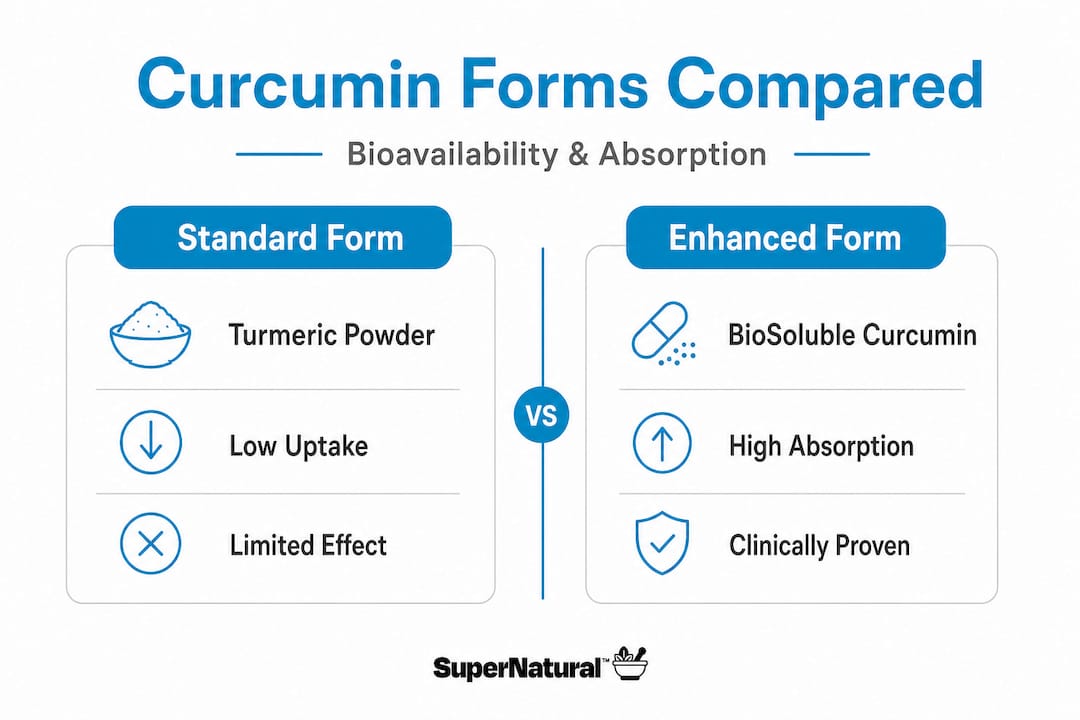
SuperNatural’s patented BioSoluble Curcumin process is specifically designed to address this absorption barrier, delivering curcumin in a form your body can actually use at meaningful levels. If you’re serious about using curcumin for detox support, reading the bioavailable supplements guide will help you understand exactly what to look for.
Pro Tip: When choosing a curcumin supplement, always look for a named, clinically studied delivery form on the label. Terms like “turmeric extract” with no further specification almost always indicate a poorly absorbed product. A named technology means a company has invested in research, not just marketing.
How to use curcumin for safe and effective detox support
Once you understand absorption, it’s important to safely translate this knowledge into action.
Even the best curcumin supplement needs to be used thoughtfully. Here’s a practical, step-by-step approach to using curcumin safely for detox and liver support:
- Choose an enhanced form: As covered above, standard turmeric supplements won’t deliver therapeutic concentrations. Prioritize phytosome, liposomal, nanoparticle, or BioSoluble formulations.
- Start with lower doses: Especially when using a high-bioavailability form, begin conservatively. Enhanced formulations deliver more active curcumin per dose, so lower amounts may be sufficient initially.
- Take with a meal containing healthy fat: Even enhanced forms benefit from fat-soluble support. Curcumin is a fat-soluble compound, so pairing it with avocado, olive oil, or a small portion of fatty fish improves uptake further.
- Be aware of drug interactions: Curcumin, particularly piperine-containing products, can interact with blood thinners, diabetes medications, and drugs metabolized by the liver’s cytochrome P450 enzymes. Always consult your physician before stacking curcumin with prescription medications.
- Track your markers: If you’re using curcumin for liver support, ask your doctor for periodic ALT and AST tests. These liver enzymes give you objective data on whether your liver health is improving over time.
- Combine with lifestyle support: Curcumin works best as part of a broader approach. Adequate hydration, reduced alcohol intake, fiber-rich nutrition, and regular physical activity amplify its effects significantly.
Regarding safety, curcumin is generally considered safe up to 8g/day, but high-absorption formulations, particularly those containing piperine, have been linked to rare cases of liver injury, possibly connected to genetic susceptibility. These cases are uncommon, but they underscore why you should start cautiously, avoid rechallenge if you experience any adverse reaction, and consult a physician if you have existing liver conditions.
To learn more about curcumin’s best uses beyond liver support, including joint health and cognitive function, there’s a wealth of evidence worth reviewing.
If you’ve had liver issues in the past, or if you take any prescription medications regularly, check with a doctor before starting any high-bioavailability curcumin product. Safety and efficacy go hand in hand.
Pro Tip: Don’t chase the highest dose. With enhanced curcumin formulations, a moderate, consistent dose taken daily over several weeks will outperform an irregular high dose. Steady bioavailability beats short bursts.
The real story: Detox, curcumin, and what most people miss
Step back for a moment from the individual mechanisms, the absorption tables, and the clinical data. There’s a bigger picture here that we think most supplement articles never quite say directly.
The detox supplement market is, frankly, built on a significant amount of confusion. Products are marketed with language that implies they do something the human body cannot do on its own. “Cleanses,” “flushes,” and “resets” sound dramatic and appealing. But your liver, kidneys, and lymphatic system are already doing exactly this work every single moment. The real question is never “can this product remove toxins?” The real question is “can this product help my own systems work better?”
That reframing changes everything about how you evaluate supplements. Detox claims are broadly overstated; curcumin doesn’t cleanse toxins directly, but supports liver function through Nrf2 and glutathione upregulation and genuine hepatoprotection. That’s actually impressive, but it requires honest framing to appreciate.
We also want to be direct about bioavailability: more is not automatically better. Some consumers assume that if 95% curcuminoid extract is good, taking more of it is better. With enhanced delivery systems, that logic breaks down quickly. The goal is optimal therapeutic levels, not maximum quantity. Higher-bioavailability products increase the risk of side effects at doses that would have been harmless in a low-absorption form. Precision matters more than potency.
The healthiest and most rational approach combines three things: reasonable skepticism toward marketing claims, a solid understanding of the mechanisms that matter (Nrf2, glutathione, inflammation reduction), and a lifestyle that gives those mechanisms room to work. Supplements like bioavailable curcumin are genuinely useful tools when chosen correctly. They are not magic. But used thoughtfully, they can meaningfully support the systems your body already depends on.
Unlock better detox support with advanced curcumin solutions
If this article has made one thing clear, it’s that the curcumin you choose matters as much as the decision to take it. Generic turmeric won’t move the needle on your liver health. But a clinically supported, high-bioavailability formulation can genuinely support the Nrf2 and glutathione pathways your body depends on for real detoxification.
At SuperNatural, we built our BioSoluble Curcumin supplement around exactly this science. Our patented BioSoluble process delivers curcumin at significantly enhanced bioavailability, meaning your body actually gets the active compound where it needs to go. For targeted detox and inflammation support, BodyBoost brings this same advanced formulation to your daily routine. When you’re ready to move beyond generic supplements and invest in something evidence-based, explore SuperNatural supplements and find the right fit for your health goals.
Frequently asked questions
Is curcumin the same as turmeric?
Curcumin is a specific compound found within turmeric root, and it’s responsible for most of turmeric’s proven health effects, including antioxidant and anti-inflammatory activity. Turmeric contains only about 3-5% curcumin by weight, which is why concentrated extracts are used in research and clinical applications.
What’s the safest way to take curcumin for detox?
Choose a clinically researched enhanced form and start with conservative doses, since high-absorption formulations deliver more active curcumin and can rarely cause side effects at doses that would be harmless in standard forms. Always consult your physician if you take prescription medications.
Does curcumin really remove toxins from the body?
Curcumin does not directly remove toxins. Instead, it strengthens your liver’s own detoxification pathways, particularly by upregulating Nrf2 and glutathione, so your body’s natural systems can function more effectively.
Can I take curcumin with other supplements or medications?
Curcumin, especially piperine-containing products, may interact with blood thinners, certain diabetes medications, and drugs processed by liver enzymes. Always consult your physician before combining curcumin supplements with any prescription medication or existing supplement regimen.
What’s the best curcumin supplement for absorption?
Innovative delivery forms such as phytosome, liposomal, or nanoparticle curcumin consistently outperform standard turmeric extract for systemic absorption. Look for a named, clinically studied technology on the label to confirm you’re getting a well-researched formulation.