

Supplements are everywhere. More than half of American adults take at least one daily, yet most people can’t clearly explain why dietary supplements matter beyond a vague sense that they’re “being healthy.” That gap between habit and understanding is exactly where problems start. The truth is that supplements are neither miracle workers nor useless pills. They are targeted tools, and like any tool, their value depends entirely on whether you’re using the right one, at the right time, for the right reason. This article cuts through the noise to help you understand when and why supplements genuinely earn their place in a health routine.
Table of Contents
- Key takeaways
- What dietary supplements actually are
- Who actually benefits from supplementation
- Supplements for cognitive health and inflammation
- How to choose and use supplements wisely
- My honest take on supplements
- Supplements designed around the science
- FAQ
Key takeaways
| Point | Details |
|---|---|
| Supplements aren’t universal | Routine multivitamins show no mortality benefit for healthy adults with varied diets. |
| Targeted use works | Specific populations, such as older adults and pregnant women, see real, documented benefits from supplementation. |
| Quality varies widely | Supplements are regulated as foods, not drugs, so third-party verification matters more than label claims. |
| Cognition has evidence | Adults over 50 show measurable cognitive gains from daily multivitamin use in clinical trial settings. |
| Food comes first | Supplements fill gaps; they do not replace the foundational pillars of diet, sleep, and exercise. |
What dietary supplements actually are
Most people picture a multivitamin when they hear the word “supplement,” but the category is far broader. Dietary supplements include vitamins, minerals, botanicals, amino acids, enzymes, probiotics, and herbal extracts. They come as capsules, powders, gummies, liquids, and bars. The defining characteristic is this: they are intended to add to your diet, not replace food.
Here is where it gets important. The FDA regulates dietary supplements as a category of food, not as pharmaceutical drugs. That distinction has real consequences. Supplement manufacturers are not required to conduct the kind of pre-market clinical trials that pharmaceutical companies must complete before a drug reaches shelves. In practice, this means a supplement can be sold with health-supportive language before anyone has independently verified that it works or that the label accurately reflects the contents.
This is not a reason to abandon supplements. It is a reason to be selective. The safest approach involves looking for products that carry third-party certifications from organizations like NSF International or USP. These certifications confirm that what is on the label is actually in the bottle, at the stated dose, with no harmful contaminants.
- What third-party certifications check for: accurate ingredient quantities, absence of harmful contaminants, good manufacturing practices, and label truthfulness
- What they do not verify: whether the supplement produces the clinical outcomes you are hoping for
- High-risk categories to approach cautiously: weight loss products, sexual enhancement supplements, and pre-workout formulas, which are frequently adulterated with undisclosed pharmaceutical ingredients
Pro Tip: Search the FDA’s Dietary Supplement Ingredient Advisory List before purchasing any supplement in a high-risk category. It takes two minutes and can prevent a serious health incident.
Who actually benefits from supplementation
Here is the honest answer that most supplement marketing skips: most adults who eat a reasonably varied diet get the micronutrients they need from food. A 2024 analysis of nearly 400,000 adults found no mortality benefit from routine daily multivitamin use. The USPSTF currently finds insufficient evidence to recommend multivitamins for general disease prevention. That does not mean supplements are useless. It means they work best when matched to a real, identified need.
The populations with the clearest evidence-based cases for supplementation include:
- Older adults needing vitamin B12. Absorption of B12 from food depends on a stomach compound called intrinsic factor, which declines with age. People taking metformin for diabetes or proton pump inhibitors for acid reflux face additional risk. B12 deficiency in these groups can cause anemia and neurological damage, both of which are preventable with high-dose oral supplementation.
- Pregnant women needing folic acid. The evidence here is among the strongest in nutrition science. Adequate folate in early pregnancy significantly reduces the risk of neural tube defects in the developing fetus. This is a case where food sources alone often fall short of the recommended 400 to 800 micrograms daily.
- People with limited sun exposure needing vitamin D. Those who live in northern climates, work indoors, or have darker skin pigmentation produce less vitamin D from sunlight. Deficiency is linked to reduced bone density and immune function. Supplementation in confirmed deficient individuals is well-supported.
- Individuals with confirmed deficiencies from blood testing. Iron deficiency anemia, for example, requires supplemental iron. But taking iron supplements without confirming a deficiency can cause its own problems, including gastrointestinal distress and interference with other minerals.
The pattern here matters. In each case, the benefit of supplementation comes from addressing a specific, measurable gap, not from a generalized hope that more nutrients equal better health.
Pro Tip: Ask your doctor for a basic micronutrient panel before starting any new supplement. Knowing your actual levels removes the guesswork and protects you from taking something unnecessary or at the wrong dose.

Supplements for cognitive health and inflammation
This is the area that draws the most interest and, frankly, the most confusion. The science is genuinely promising in some areas and genuinely incomplete in others. Understanding both sides helps you make smarter choices.
What the evidence supports
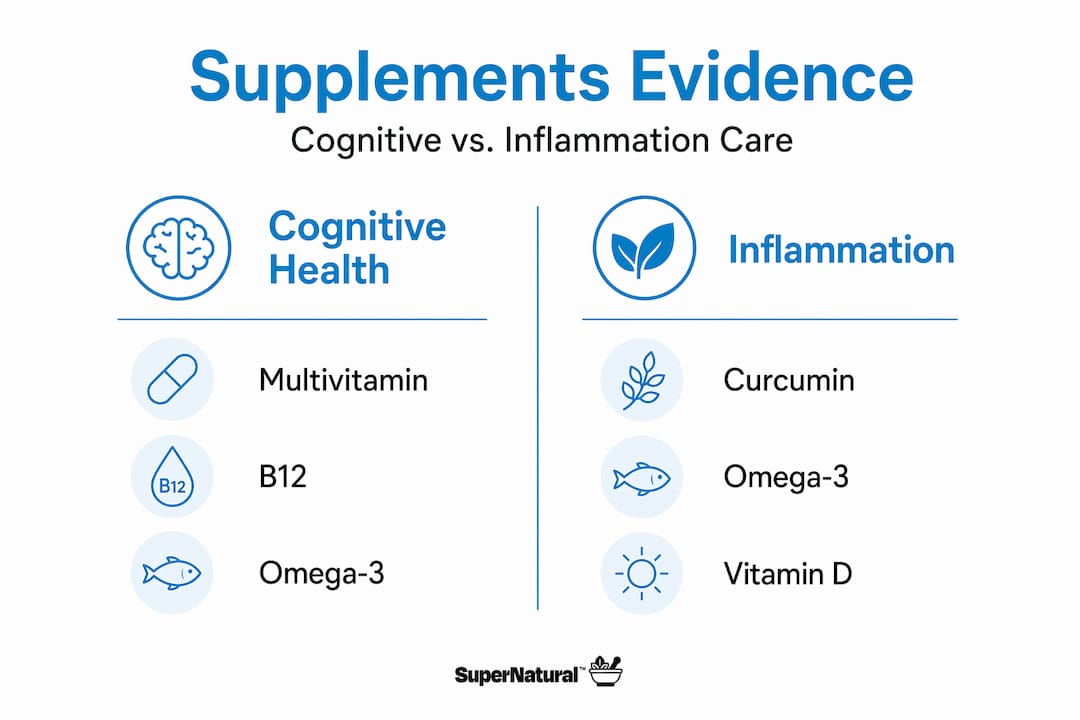
The COSMOS-Mind trial, a rigorous clinical study, found that adults over 50 who took a daily multivitamin showed cognitive improvements equivalent to approximately three years of reduced cognitive aging compared to placebo. That is a meaningful finding, particularly because the benefit appeared most pronounced in people with a history of cardiovascular disease. It does not mean multivitamins prevent Alzheimer’s, but it does suggest that for older adults, the advantages of dietary nutrients extend into brain health.
For inflammation management, curcumin (the active compound in turmeric) and omega-3 fatty acids have accumulated substantial research attention. Omega-3s and vitamin E combinations show some promise in reducing inflammation markers and improving certain neurological scores, though results across trials remain inconsistent. Think of it like this: the science is pointing in an encouraging direction, but it hasn’t arrived at a definitive destination yet.
What to keep in perspective
| Supplement | Potential benefit | Current evidence level | Important caveat |
|---|---|---|---|
| Multivitamin | Cognitive support in adults 50+ | Strong (COSMOS-Mind RCT) | Benefit clearest in those with CVD history |
| Omega-3 fatty acids | Reduced inflammation markers | Moderate, mixed across trials | No proven disease progression prevention |
| Curcumin (bioavailable forms) | Anti-inflammatory response | Promising, ongoing research | Standard curcumin has poor absorption |
| Vitamin B complex | Neurological function support | Strong for deficient individuals | Limited benefit without confirmed deficiency |
The critical point here, and one we want to be straightforward about, is that supplements for cognitive and neurological conditions should never replace standard treatments. They are complementary. If you or someone you care for is managing a neurodegenerative condition, a supplement may support the overall strategy, but it should be one component among several, not the whole plan. Exploring natural supplements for brain health can help you understand the current research landscape before making decisions.
How to choose and use supplements wisely
Knowing why dietary supplements matter is only half the equation. Knowing how to use them well is where the real advantage lies. These principles apply whether you are just starting or refining an existing routine.
- Test before you supplement. Blood testing before starting supplementation helps you confirm a real deficiency and avoid masking an underlying condition that needs medical attention.
- Mind your mineral timing. Calcium and iron compete for absorption when taken together. Splitting these doses throughout the day, or choosing a mineral-free multivitamin to pair with individual minerals, improves how much your body actually uses.
- Check for medication interactions. Vitamin K can reduce the effectiveness of blood thinners like warfarin. St. John’s Wort interacts dangerously with several antidepressants. If you take any prescription medication, reviewing your supplement list with a pharmacist or physician is not optional. It is necessary.
- Prioritize food first, always. Supplements fill gaps in an otherwise solid diet. They do not compensate for poor eating patterns, inadequate sleep, or a sedentary lifestyle. Think of them as finishing details on a well-built structure, not the foundation itself.
- Read the label critically. Look for products that list specific forms of nutrients (for example, methylcobalamin for B12 rather than cyanocobalamin), disclose all inactive ingredients, and carry recognized third-party certification marks.
Pro Tip: If you find the label confusing or can’t identify the certifying body, that’s a signal to keep looking. Reputable manufacturers make this information easy to find because transparency is part of what you’re paying for.
For a structured approach to supplement use, a daily supplement plan built around your specific health goals and test results will serve you far better than grabbing the best-seller off the shelf.
My honest take on supplements
I’ve seen both ends of the spectrum: people who dismiss supplements entirely as expensive placebos, and people who take seventeen capsules a day hoping to outsmart aging. Neither approach gets it right.
What I’ve learned, after years of research and working closely with formulations that prioritize bioavailability above all else, is that the single biggest reason supplements fail people is not the ingredients. It’s the mismatch between what the person needs and what they’re actually taking. Someone popping a generic turmeric capsule while eating well and sleeping eight hours probably won’t notice much. But someone with a confirmed B12 deficiency or chronic low-grade inflammation who finds the right, well-absorbed formulation? The difference is real and measurable.
The uncomfortable truth I’ve come to accept is that most supplement marketing sells hope, not science. The companies doing the work differently are the ones investing in absorption technology, third-party verification, and honest communication about what the evidence does and doesn’t say. That’s the standard I hold us to at SuperNatural Supplements, and it’s the standard I’d encourage you to demand from any brand you trust with your health.
Supplements work best as one well-chosen layer in a health strategy that already includes real food, adequate sleep, movement, and regular checkups. They are not a shortcut. They are a precision tool. Used precisely, they matter a great deal.
— SuperNatural
Supplements designed around the science
At SuperNatural Supplements, we put years of research into solving one of the most persistent problems in the supplement industry: most ingredients never reach the cells that need them. Our patented BioSoluble Curcumin process delivers significantly enhanced bioavailability compared to standard curcumin, which is the difference between sniffing a strong cup of coffee and actually drinking it.
Our formulations target the areas where the evidence is strongest. BrainBoost is built for advanced cognitive support, BodyBoost for superior immune function, and BodyControl for detoxification and a healthy inflammatory response. Every product is made with transparent ingredients and designed to complement an informed, personalized health routine. If you are ready to move from guessing to knowing, SuperNatural Supplements is where that starts.
FAQ
Do dietary supplements really help?
Supplements help when they address a confirmed, specific need. Evidence is strong for targeted use (such as B12 in older adults or folic acid in pregnancy), but limited for routine multivitamin use in healthy adults with varied diets.
Should I take supplements without a doctor’s recommendation?
Consulting a healthcare provider and confirming deficiencies through blood testing before starting supplementation is always the safer approach, since some supplements can mask underlying conditions or interact with medications.
What supplements support cognitive function?
Daily multivitamins have shown meaningful cognitive benefits in adults over 50 in the COSMOS-Mind clinical trial, while omega-3 fatty acids and B vitamins show supporting evidence for neurological health in specific populations.
Why does bioavailability matter in supplements?
A supplement is only as effective as what your body actually absorbs. Standard curcumin, for example, has notoriously poor absorption. Enhanced bioavailability formulations are engineered to improve how much of the active compound reaches your bloodstream and target tissues.
Are natural supplements safe to take with medications?
Not always. Vitamin K reduces the effectiveness of blood thinners, and St. John’s Wort has documented dangerous interactions with antidepressants. Always review your supplement list with a qualified healthcare provider if you take any prescription drugs.
This article is provided for educational and informational purposes only and does not constitute providing medical advice or professional services. Always consult with a qualified and licensed physician or other medical care provider. Statements have not been evaluated by the Food & Drug Administration. This product is not intended to diagnose, treat, cure, or prevent any disease.